All species › Passerines › Mockingbirds and thrashers › Curve-billed Thrasher
Position in the tree Birds Aves › Birds with a flexible palate Neognathae › All other modern birds Neoaves › Landbirds Telluraves › Falcons, parrots and passerines Australaves › Falcons and passerines Eufalconimorphae › Parrots and passerines Psittacopasserae
Curve-billed Thrasher | Toxostoma curvirostre
Krombekspotlijster | Cuitlacoche pico curvo
The Curve-billed Thrasher is the commonest thrasher of the deserts and dry scrub of Mexico. It is grey-brown, with a long, curved black bill and an orange eye, and draws attention mainly by its loud, two-syllabled call. In the guide area it lives from the northern border of Mexico to Oaxaca.

Voice
The call is a loud, sharp whit-wheet or whit-wheet-wheet, heard all year. The song is a long, fast, varied series of rich and hoarse phrases with little repetition.
Recording: Scott Crabtree — CC BY-NC-SA 4.0 · shortened to the first 60 s, mono · xeno-canto
Identification
25–28 cm. Upperparts plain grey-brown. Underparts paler greyish buff with blurry, round grey spots on the breast. Eye orange to orange-yellow. Bill long, black and clearly decurved. Wings with narrow, pale wing bars, clearest in eastern birds. Tail long, with pale tips to the outer feathers. The sexes are alike; juveniles have a shorter bill and a yellowish eye.
Confusion species
Bendire's Thrasher Toxostoma bendirei is smaller, with a shorter, straighter bill with a pale base to the lower mandible, a yellow eye and fine, arrowhead-shaped streaks on the breast. Crissal Thrasher Toxostoma crissale lacks breast spots, has a dark malar stripe and a rufous undertail. LeConte's Thrasher Toxostoma lecontei is much paler and sandier with a dark eye. Long-billed Thrasher Toxostoma longirostre is rufous-brown with black streaks on white.
Habitat
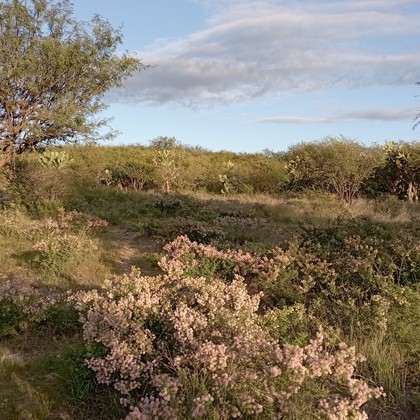
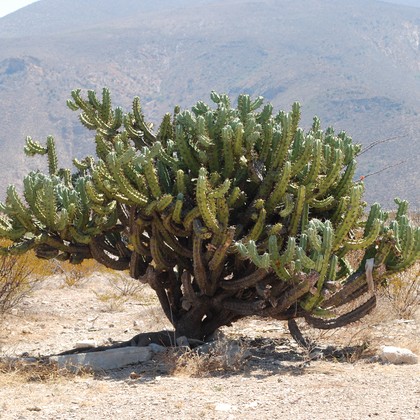
Desert and semi-desert with cacti, especially cholla and prickly pear, mesquite and thorn scrub, dry grassland with shrubs, also villages, farmyards and gardens; from the lowlands to about 2500 m. It forages on the ground for insects by digging in the soil with its bill and also eats cactus fruit. The nest is often placed in a cholla.
Where the bird is most at home, classified by the vegetation units of Mexico and Central America.



Range and movements
South-western United States (Arizona, New Mexico and western Texas). In the guide area from Sonora and Chihuahua across the Mexican Plateau and the lowlands of Sonora and Sinaloa south to Puebla and Oaxaca, and in the north-east to Nuevo León and Tamaulipas.
- Resident
- dark = core range, pale = thinly spread
How and when to look
It often perches on top of a cactus or shrub and calls loudly; best heard early in the morning. In villages in dry regions it is regularly found in gardens.
Conservation status
Not threatened (LC). Common, but locally declining through conversion of desert scrub to farmland and built-up areas.
Scientific name
Toxostoma curvirostre | (Swainson, 1827)
Swainson described the species in 1827 as Orpheus curvirostris; because it was later moved to another genus, the author and year stand in brackets. The genus Toxostoma was introduced in 1831 by Wagler. Toxostoma is Greek, from toxon 'bow' and stoma 'mouth', after the long, curved bill. curvirostre is Latin, from curvus 'curved' and rostrum 'bill', after the strongly decurved bill. The specimen the first description was based on came from Mexican Plateau (not specified further).