All species › Passerines › Antthrushes › Black-headed Antthrush
Position in the tree Birds Aves › Birds with a flexible palate Neognathae › All other modern birds Neoaves › Landbirds Telluraves › Falcons, parrots and passerines Australaves › Falcons and passerines Eufalconimorphae › Parrots and passerines Psittacopasserae
Black-headed Antthrush | Formicarius nigricapillus
Zwartkopmierlijster | Formicario cabecinegro
The Black-headed Antthrush is a dark ground bird of humid foothill forest in Costa Rica and Panama. Like other antthrushes it walks over the forest floor with its tail cocked and is detected mainly by its song. It is shyer and harder to see than Black-faced Antthrush.

Voice
The song is a series of about ten to twenty short, hollow whistles that grow louder and rise slightly, then stop abruptly.
Recording: Niels Krabbe — CC BY-NC-SA 4.0 · shortened to the first 60 s, mono · xeno-canto
Identification
18 cm, with a compact, rounded build, fairly long legs and a short tail that is often held up. Head, neck and breast black; a narrow bare bluish ring of skin around the eye. Back, wings and tail dark olive-brown to rufous-brown. Belly dark olive-grey, undertail coverts rufous-brown. Bill black. Male and female are alike.
Confusion species
Black-faced Antthrush Formicarius analis has only the throat and cheek black, a brown crown, rufous neck sides and a grey belly, and lives mainly lower down. Rufous-breasted Antthrush Formicarius rufipectus has a rufous breast and crown and lives on average higher in the mountains.
Habitat
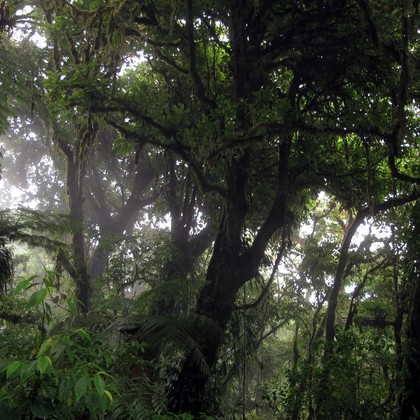
Floor and undergrowth of humid evergreen foothill forest and lower montane forest, especially on steep slopes and in ravines; roughly between 300 and 1200 m, locally lower or higher. It forages on foot in the leaf litter for insects and other invertebrates.
Where the bird is most at home, classified by the vegetation units of Mexico and Central America.


Range and movements
Caribbean slope of Costa Rica and western Panama; elsewhere locally in Panama, including the east (Darién). Outside the guide area in western Colombia and Ecuador.
- Resident
- dark = core range, pale = thinly spread
How and when to look
Best tracked down by its song in foothill forest on the Caribbean slope of Costa Rica. It usually stays well hidden in dense undergrowth; patience near a singing bird is needed.
Conservation status
Not threatened. Locally fairly common, but confined to a narrow elevational band and therefore sensitive to deforestation of the foothills.
Scientific name
Formicarius nigricapillus | Ridgway, 1893
Ridgway described the species in 1893 and placed it straight away in the genus where it still stands. The genus Formicarius was introduced in 1783 by Boddaert. Formicarius is Latin, from formica 'ant' with the suffix -arius: 'ant-bird'. nigricapillus is Latin, from niger 'black' and capillus 'hair of the head', after the black head. The specimen the first description was based on came from Buena Vista, Costa Rica.