All species › Passerines › Antthrushes › Rufous-breasted Antthrush
Position in the tree Birds Aves › Birds with a flexible palate Neognathae › All other modern birds Neoaves › Landbirds Telluraves › Falcons, parrots and passerines Australaves › Falcons and passerines Eufalconimorphae › Parrots and passerines Psittacopasserae
Rufous-breasted Antthrush | Formicarius rufipectus
Roodborstmierlijster | Formicario pechirrufo
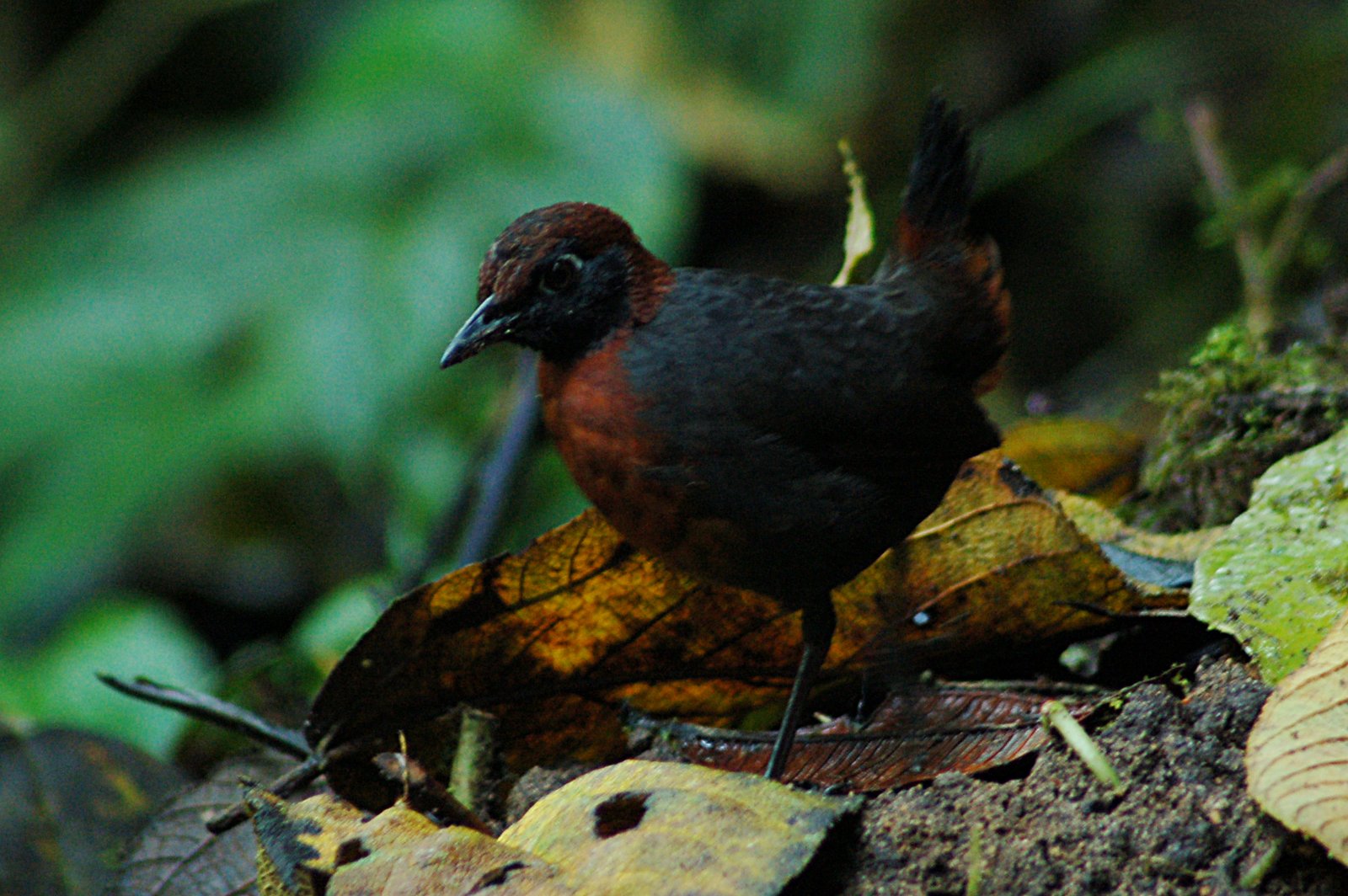
The Rufous-breasted Antthrush is the antthrush of the montane forests of Costa Rica and Panama. It lives hidden on the floor of dense, humid forest and is nearly always first identified by its simple, whistled song.
Voice
The song consists of two short, clear whistles in quick succession, the second often slightly higher, repeated at intervals.
Recording: José María Loaiza B. — CC BY-NC-SA 4.0 · shortened to the first 60 s, mono · xeno-canto
Identification
19 cm, with a compact, rounded build, fairly long legs and a short tail that is often held up. Crown and nape chestnut, face and throat blackish. Back, wings and tail dark brown. Breast bright rufous, belly darker olive-brown, undertail coverts rufous. Bill black. Male and female are alike.
Confusion species
Black-headed Antthrush Formicarius nigricapillus has an all-black head and breast and lives on average lower down. Black-faced Antthrush Formicarius analis has a grey breast and belly and lives mainly in the lowlands.
Habitat
Floor and undergrowth of humid, dense montane forest, especially on steep slopes and in ravines; roughly between 900 and 2000 m, locally lower. It forages on foot in the leaf litter for insects and other invertebrates.
Where the bird is most at home, classified by the vegetation units of Mexico and Central America.


Range and movements
Mountains of Costa Rica and Panama, mainly on the Caribbean slope, and in eastern Panama (Darién). Outside the guide area in the Andes of Colombia and Ecuador to Peru.
- Resident
- dark = core range, pale = thinly spread
How and when to look
Best found by listening for the two-noted song in humid montane forest. Rarely seen well; it sometimes steps briefly onto a quiet forest trail.
Conservation status
Not threatened. Poorly known and local and scarce in the guide area, but its mountain habitat is still largely forested.
Scientific name
Formicarius rufipectus | Salvin, 1866
Salvin described the species in 1866 and placed it straight away in the genus where it still stands. The genus Formicarius was introduced in 1783 by Boddaert. Formicarius is Latin, from formica 'ant' with the suffix -arius: 'ant-bird'. rufipectus is Latin, from rufus 'red' and pectus 'breast', after the rufous breast. The specimen the first description was based on came from Santiago de Veraguas, Panama.