All species › Passerines › Tanagers and allies › Black-headed Saltator
Position in the tree Birds Aves › Birds with a flexible palate Neognathae › All other modern birds Neoaves › Landbirds Telluraves › Falcons, parrots and passerines Australaves › Falcons and passerines Eufalconimorphae › Parrots and passerines Psittacopasserae
Black-headed Saltator | Saltator atriceps
Zwartkopsaltator | Picurero cabeza negra
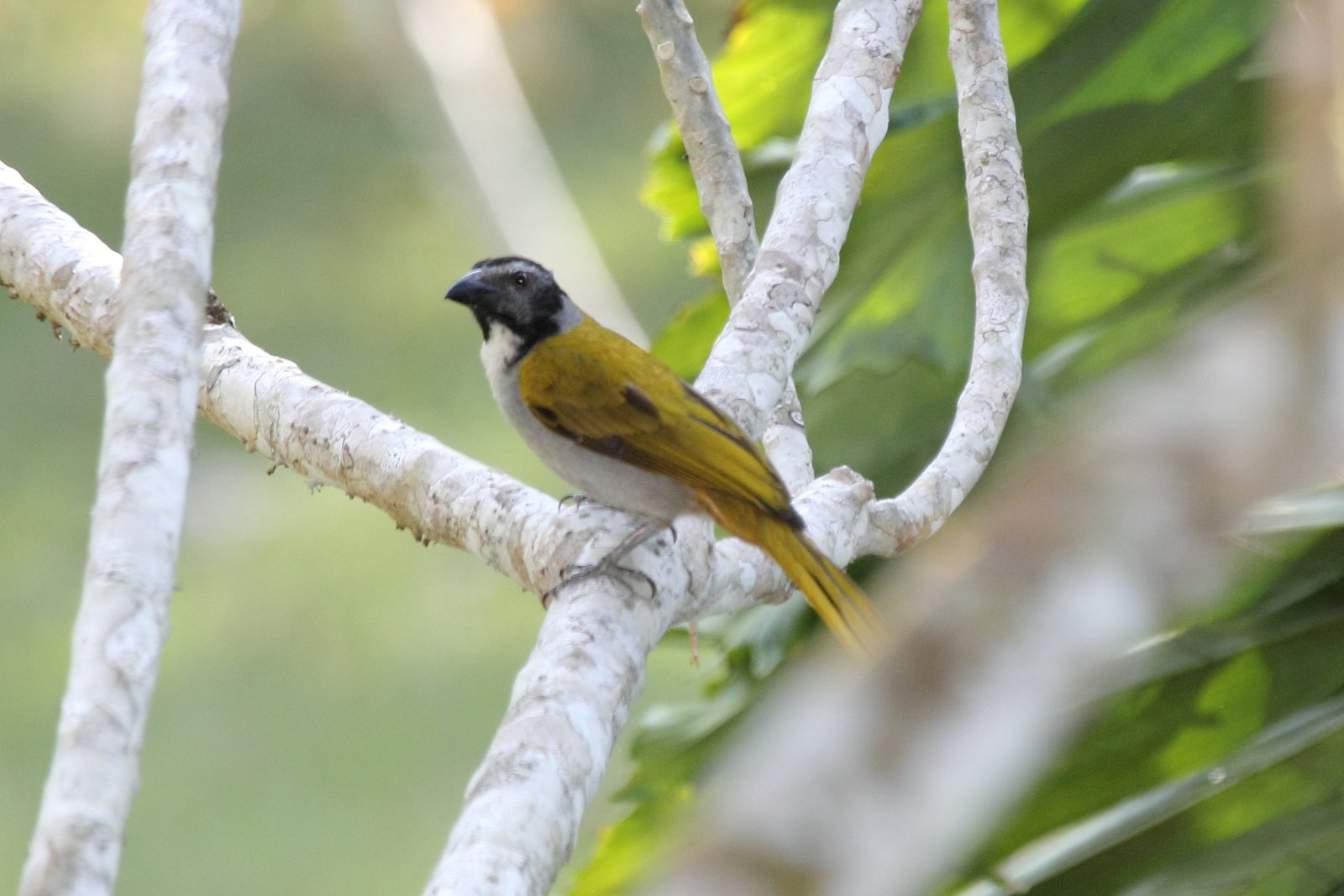
The Black-headed Saltator is the largest saltator in the guide area: a big, olive-green tanager with a black head, a white throat and a heavy black bill. Pairs and small groups give loud, harsh, cackling calls from dense forest edges. It occurs from eastern and southern Mexico to eastern Panama.
Voice
Loud, harsh and explosive: raucous cackling, squawking and chattering, often as a duet or a chorus from a small group. Also a series of hoarse, whistled notes. Call a hard, metallic chak.
Recording: Bill Pyle — CC BY-NC-SA 4.0 · converted to mono · xeno-canto
Identification
24–26 cm. Crown and side of the head black to blackish-grey (greyer on the crown in some regions), with a short white supercilium. Throat white, bordered by black that forms a narrow band below the throat. Upperparts olive-green, breast and belly grey, undertail coverts cinnamon to buff. Bill heavy and black. Male and female alike; young birds are duller, with a yellower throat and less black on the head.
Confusion species
Buff-throated Saltator Saltator maximus is smaller, has a grey head, a throat with a buff lower part and a melodious song. Cinnamon-bellied Saltator Saltator grandis is smaller and has grey upperparts. Streaked Saltator Saltator striatipectus has a streaked breast.
Habitat
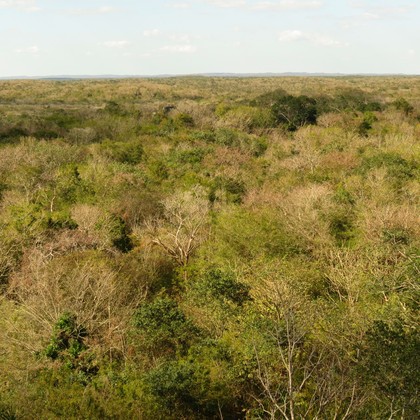
Dense forest edges, secondary forest, scrub, gallery forest, marsh edges, plantations and hedgerows in humid and semi-humid lowlands, locally to about 1500 m. It eats fruit, flowers, buds and insects. It lives in pairs or noisy small groups, usually well hidden in dense foliage.
Where the bird is most at home, classified by the vegetation units of Mexico and Central America.





Range and movements
Eastern and southern Mexico, on the Gulf slope from Tamaulipas and San Luis Potosí southwards, throughout the Yucatán Peninsula and on the Pacific slope from Guerrero and Oaxaca to Chiapas, further through Belize, Guatemala, El Salvador, Honduras, Nicaragua and Costa Rica to eastern Panama.
- Resident
- dark = core range, pale = thinly spread
How and when to look
Often heard before it is seen: the loud cackling of a group gives away its position. Regularly seen at forest edges and at fruit feeders in the lowlands of Yucatán, Belize and Costa Rica.
Conservation status
Not threatened (LC). Common and widespread; it benefits from forest edges and secondary growth.
Scientific name
Saltator atriceps | (Lesson, 1832)
Lesson described the species in 1832 as Tanagra (Saltator) atriceps; because it was later moved to another genus, the author and year stand in brackets. The genus Saltator was introduced in 1816 by Vieillot. Saltator is Latin for 'dancer, leaper', after the birds' hopping movements. atriceps is Latin, from ater 'black' and -ceps '-headed', after the black head. The specimen the first description was based on came from Veracruz, Mexico.