All species › Passerines › Tyrant flycatchers and allies › Black-headed Tody-Flycatcher
Position in the tree Birds Aves › Birds with a flexible palate Neognathae › All other modern birds Neoaves › Landbirds Telluraves › Falcons, parrots and passerines Australaves › Falcons and passerines Eufalconimorphae › Parrots and passerines Psittacopasserae
Black-headed Tody-Flycatcher | Todirostrum nigriceps
Zwartkopschoffelsnavel | Espatulilla cabecinegra
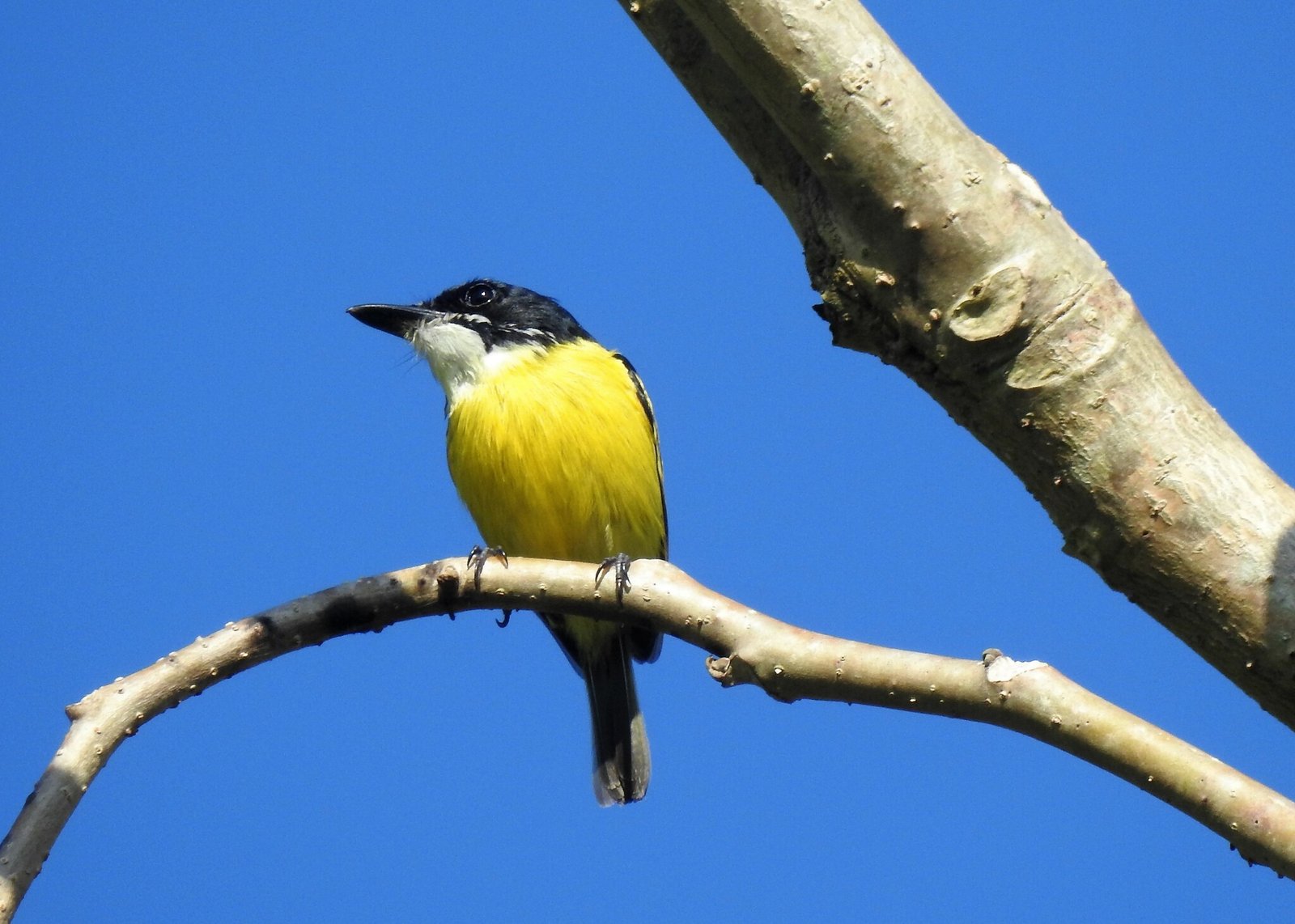
The Black-headed Tody-Flycatcher is a very small tyrant flycatcher of the canopy of humid lowland forest, with a glossy black head, a white throat and yellow underparts. Living high in the trees, it is noticed mainly by its call. In the guide area it lives in Costa Rica and Panama.
Voice
A series of a few high, sharp chip notes, repeated from the treetops.
Recording: GABRIEL LEITE — CC BY-NC-SA 4.0 · converted to mono · xeno-canto
Identification
9 cm. Head glossy black, sharply set off from the bright olive-green back. Wings black with yellow edges to the coverts and tertials. Tail short and black. Throat white, rest of the underparts bright yellow. Iris dark. Bill long and flat, black. Sexes alike.
Confusion species
Common Tody-Flycatcher Todirostrum cinereum has entirely yellow underparts without a white throat, a pale iris, a longer white-tipped tail and a greyer crown; it lives mainly in gardens and semi-open country. Black-capped Pygmy Tyrant Myiornis atricapillus is even smaller, with a short, narrow bill, white lores and eye-ring and a white breast.
Habitat
Canopy and edges of humid lowland and foothill forest, mature secondary forest and tall trees in clearings and in plantations at the forest edge; mainly in the lowlands, locally in the foothills. It searches for insects among the foliage high in the trees.
Where the bird is most at home, classified by the vegetation units of Mexico and Central America.




Range and movements
Caribbean slope of Costa Rica and Panama; in Panama also in the east on the Pacific side. Outside the guide area in northern and western Colombia, north-western Venezuela and western Ecuador.
- Resident
- dark = core range, pale = thinly spread
How and when to look
Most easily found by its call. Tall trees at forest edges and clearings in the Caribbean lowlands of Costa Rica and along Pipeline Road (Camino del Oleoducto) in Panama give the best chance of seeing it.
Conservation status
Not threatened. Fairly common in suitable forest, but easily overlooked because it lives high in the trees.
Scientific name
Todirostrum nigriceps | Sclater, 1855
Sclater described the species in 1855 and placed it straight away in the genus where it still stands. The genus Todirostrum was introduced in 1831 by Lesson. Todirostrum combines the genus Todus (tody) with Latin rostrum 'bill', after the long, flat, tody-like bill. nigriceps is Latin, from niger 'black' and -ceps '-headed', after the glossy black head. The specimen the first description was based on came from Santa Marta, Colombia.