All species › Passerines › Tyrant flycatchers and allies › Slaty-headed Tody-Flycatcher
Position in the tree Birds Aves › Birds with a flexible palate Neognathae › All other modern birds Neoaves › Landbirds Telluraves › Falcons, parrots and passerines Australaves › Falcons and passerines Eufalconimorphae › Parrots and passerines Psittacopasserae
Slaty-headed Tody-Flycatcher | Poecilotriccus sylvia
Grijskeelschoffelsnavel | Espatulilla gris
The Slaty-headed Tody-Flycatcher is a small, skulking tyrant flycatcher of dense shrubbery and overgrown second growth, with a slate-grey head, white spectacles and distinct yellow wing-bars. It usually stays low in thickets and is noticed mainly by its dry call. In the guide area it lives from south-eastern Mexico to Panama.

Voice
A short, dry, somewhat frog-like trill, and single dry tuk notes.
Recording: JAYRSON ARAUJO DE OLIVEIRA — CC BY-NC-SA 4.0 · converted to mono · xeno-canto
Identification
9–10 cm. Crown and sides of head slate-grey, with white lores and a narrow white eye-ring. Back olive-green. Wings blackish with two distinct yellow wing-bars and yellow edges to the tertials. Tail fairly short. Throat and breast greyish-white, belly whitish with a yellowish wash on the flanks and undertail. Bill long, flat and dark. Sexes alike.
Confusion species
Common Tody-Flycatcher Todirostrum cinereum has bright yellow underparts, a black forehead without white lores and a pale iris, and lives in more open places. Black-capped Pygmy Tyrant Myiornis atricapillus is smaller, with a black cap, a short bill and a yellow belly, and lives higher in the forest. Northern Bentbill Oncostoma cinereigulare has a thick, bent bill and a yellow belly.
Habitat
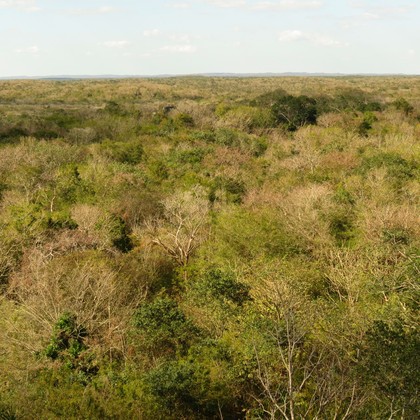
Dense shrubbery, overgrown and young second growth, forest edges, overgrown plantations and dense riverside thickets, in both humid and seasonally dry areas; from the lowlands to about 1000 m. It gleans insects from the undersides of leaves, usually low and in pairs.
Where the bird is most at home, classified by the vegetation units of Mexico and Central America.




Range and movements
From south-eastern Mexico (including southern Veracruz, Tabasco, Chiapas and the Yucatán Peninsula) through Belize, Guatemala, Honduras, Nicaragua and Costa Rica to Panama; in the north of the guide area mainly on the Caribbean slope. Outside the guide area in northern South America, from Colombia and Venezuela to the Guianas and north-eastern Brazil.
- Resident
- dark = core range, pale = thinly spread
How and when to look
Listen in overgrown thickets and forest edges for the dry trill and wait for the bird to show itself in a gap; with patience it can often be seen at close range.
Conservation status
Not threatened. Widespread and locally fairly common; benefits from young second growth.
Scientific name
Poecilotriccus sylvia | (Desmarest, A-G, 1806)
Desmarest, A-G described the species in 1806 as Todus sylvia; because it was later moved to another genus, the author and year stand in brackets. The genus Poecilotriccus was introduced in 1884 by Berlepsch. Poecilotriccus is Greek, from poikilos 'variegated' and trikkos, an unidentified small bird; in ornithology triccus denotes a tyrant flycatcher. sylvia is Modern Latin for 'woodland sprite, little bird, warbler', from Latin silva 'woodland'. The specimen the first description was based on came from unknown; probably Cayenne, French Guiana.