All species › Tubenoses › Petrels, shearwaters and diving petrels › Black Petrel
Position in the tree Birds Aves › Birds with a flexible palate Neognathae › All other modern birds Neoaves › Birds of the elements Elementaves › Tropicbirds and waterbirds Phaethoquornithes › Core waterbirds Aequornithes
Black Petrel | Procellaria parkinsoni
Zwarte stormvogel | Petrel de Parkinson
The Black Petrel breeds only on two islands off the North Island of New Zealand, but spends the non-breeding months in the eastern tropical Pacific. In this way the species reaches the waters far off the Pacific coast of the guide area, on the other side of the ocean. It is hardly ever seen from land.
Voice
Usually silent at sea. In the colonies clattering and moaning calls at night.
Recording: Dan Lane — CC BY-NC-SA 4.0 · converted to mono · xeno-canto
Identification
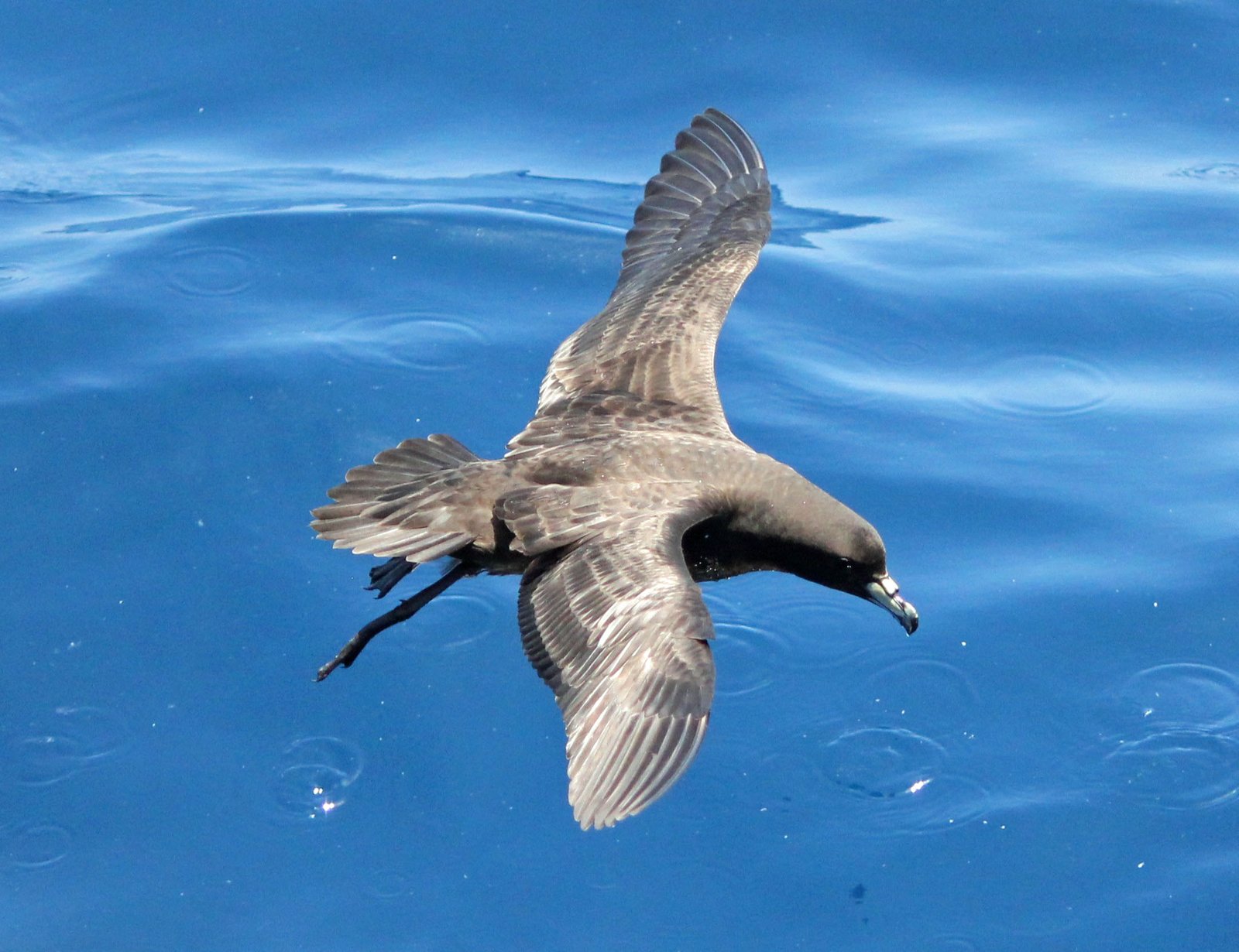
46 cm, a fairly large, entirely blackish-brown petrel with a short, rounded body, long wings and a short, wedge-shaped tail. The bill is stout and pale horn to ivory, with a dark tip, and stands out well against the dark plumage. Legs and feet black. In good light the bases of the primaries shine silvery on the underside. Flies calmly and rather heavily, with series of slow beats and glides, and often follows fishing boats and groups of dolphins.
Confusion species
Sooty Shearwater Ardenna grisea has a long, thin, dark bill, an obvious silvery-white band along the middle of the underwing and a faster, stiffer wingbeat. Dark morph Wedge-tailed Shearwater Ardenna pacifica has a thin, dark grey bill, a long, pointed tail and flesh-coloured legs. Christmas Shearwater Puffinus nativitatis is clearly smaller, with a thin, dark bill.
Habitat
Open, deep ocean far offshore. Feeds mainly on squid, but also on fish and crustaceans, taken at the surface or caught in short dives; often feeds with groups of dolphins and schools of tuna. Breeds in burrows in forest on the ridges of the breeding islands.
Where the bird is most at home, classified by the vegetation units of Mexico and Central America.

Range and movements
Far out at sea off the Pacific coast of the guide area, mainly from the waters off Oaxaca and Chiapas to off Costa Rica and Panama; rare further north. Records come almost exclusively from ships, so its distribution at sea is incompletely known. Outside the guide area the species breeds only on Great Barrier Island and Little Barrier Island in northern New Zealand, and winters in the eastern tropical Pacific, south to Ecuador and Peru.
- Summer visitor (c. Apr–Sep)
- dark = core range, pale = thinly spread
How and when to look
Pelagic trips to deep water off Costa Rica, Panama or southern Mexico in the northern summer offer the best chance, especially with groups of dolphins and tuna. An entirely dark, stocky petrel with a pale, dark-tipped bill is the best feature.
Conservation status
Vulnerable. The world population is small and breeds on only two islands. In the past introduced cats and rats hit the colonies hard; the main threat now is bycatch in longline and trawl fisheries around New Zealand and in the waters where the birds winter.
Scientific name
Procellaria parkinsoni | Gray, 1862
Gray described the species in 1862 and placed it straight away in the genus where it still stands. The genus Procellaria was introduced in 1758 by Linnaeus. Procellaria comes from the Latin procella, 'storm' — sailors associated petrels with stormy weather at sea. parkinsoni honours the Scottish natural-history artist Sydney Parkinson (c. 1745–1771), who sailed on James Cook's first voyage. The specimen the first description was based on came from New Zealand.