All species › Passerines › Crows, jays and magpies › Black-throated Magpie-Jay
Position in the tree Birds Aves › Birds with a flexible palate Neognathae › All other modern birds Neoaves › Landbirds Telluraves › Falcons, parrots and passerines Australaves › Falcons and passerines Eufalconimorphae › Parrots and passerines Psittacopasserae
Black-throated Magpie-Jay | Cyanocorax colliei
Collies ekstergaai | Urraca hermosa cara negra
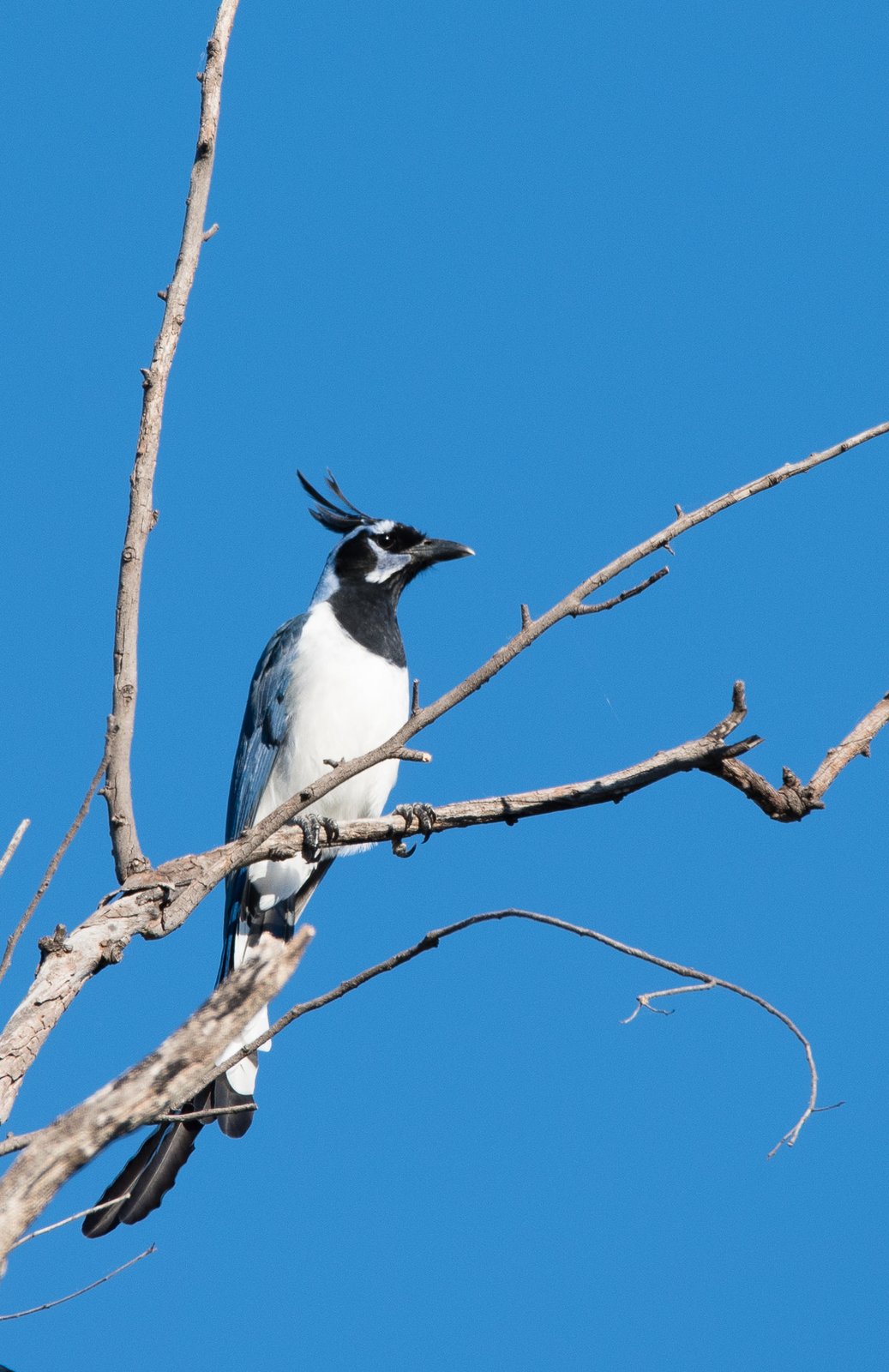
The Black-throated Magpie-Jay is a large jay with a very long, graduated tail, a tall crest of forward-curled feathers and a black throat and breast. It moves through dry forest and forest edges in noisy groups. It occurs only in north-western and western Mexico.
Voice
Highly varied: loud, shrill and rasping calls, parrot-like screeches, clicking notes and whistles. Groups are noisy and react strongly to disturbance.
Recording: Paul Marvin — CC BY-NC-SA 4.0 · converted to mono · xeno-canto
Identification
58–77 cm, more than half of which is tail. Crest tall, black and curled forward. Face, throat and breast largely black, with a blue patch below the eye. Upperparts bright blue, belly white. Tail very long and graduated, blue with white tips to the outer feathers. Bill and legs black.
Confusion species
White-throated Magpie-Jay Cyanocorax formosus, further south along the Pacific slope, has a white throat and breast with a narrow black band and a shorter tail. Where the two ranges meet, in western Mexico, hybrids with intermediate patterns occur. Brown Jay Cyanocorax morio is brown and has no crest.
Habitat
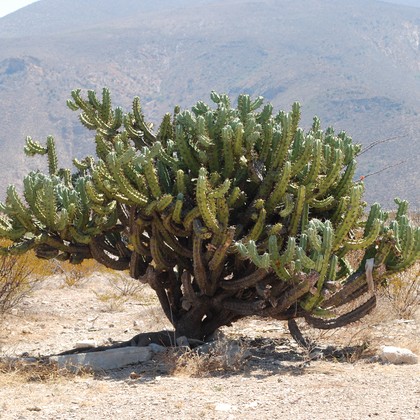
Tropical dry forest, thorn forest, gallery forest along rivers, forest edges and semi-open country with trees, also plantations and orchards. Groups forage in trees and on the ground for insects, small vertebrates, eggs, fruit and nectar.
Where the bird is most at home, classified by the vegetation units of Mexico and Central America.



Range and movements
Endemic to Mexico: Pacific lowlands and lower slopes from southern Sonora and western Chihuahua and Durango through Sinaloa and Nayarit to Jalisco. The entire range lies within the guide area.
- Resident
- dark = core range, pale = thinly spread
How and when to look
Fairly common around San Blas in Nayarit and along the Pacific coast of Sinaloa and Nayarit, where groups often noisily frequent forest edges and plantations.
Conservation status
Not threatened. Locally common in dry forest and semi-open country.
Scientific name
Cyanocorax colliei | (Vigors, 1829) (GBIF: Calocitta colliei)
Vigors described the species in 1829 as Pica colliei; because it was later moved to another genus, the author and year stand in brackets. The genus Cyanocorax was introduced in 1826 by Boie. Cyanocorax is Greek, from kuanos 'dark blue' and korax 'raven': a 'blue raven', after the blue colours of many species. colliei honours the Scottish naval surgeon and naturalist Alexander Collie (1793–1835), who collected on Beechey's Blossom expedition. The specimen the first description was based on came from San Blas (Nayarit) and Mazatlán (Sinaloa), Mexico.