All species › Passerines › Crows, jays and magpies › Unicolored Jay
Position in the tree Birds Aves › Birds with a flexible palate Neognathae › All other modern birds Neoaves › Landbirds Telluraves › Falcons, parrots and passerines Australaves › Falcons and passerines Eufalconimorphae › Parrots and passerines Psittacopasserae
Unicolored Jay | Aphelocoma unicolor
Leiblauwe gaai | Chara unicolor
The Unicolored Jay is a fairly large, entirely dark violet-blue jay without a crest, found in cloud forest and humid pine-oak forest in the mountains of southern Mexico and northern Central America. It lives in groups, which are often heard before they are seen. Its range is highly fragmented.

Voice
Harsh, rasping and rattling calls, often given by several birds of a group at once. Also softer, varied notes.
Recording: GABRIEL LEITE — CC BY-NC-SA 4.0 · shortened to the first 60 s, mono · xeno-canto
Identification
30–34 cm, of which much is tail. Entirely dark violet-blue, underparts included; wings and tail slightly brighter blue. Lores and area around the eye blackish. Bill and legs black. Juveniles are duller and may have a pale bill.
Confusion species
Steller's Jay Cyanocitta stelleri has a long crest and a dark head and breast contrasting with the blue body. Bushy-crested Jay Cyanocorax melanocyaneus (Guatemala to Nicaragua) has a black head and breast, a yellow eye and a short crest. The jays of the genus Cyanolyca are smaller and have a patterned head or throat. Transvolcanic Jay Aphelocoma ultramarina and Mexican Jay Aphelocoma wollweberi are pale grey below.
Habitat
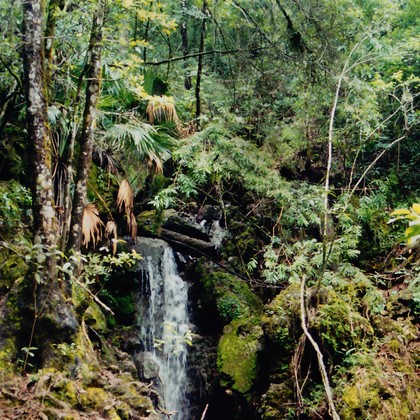
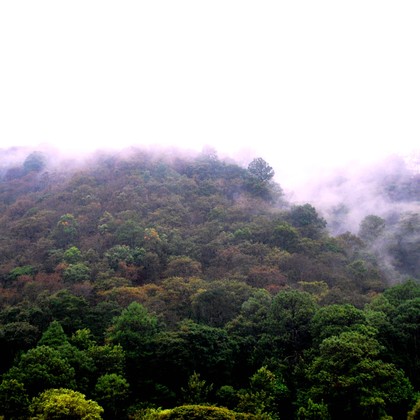
Humid montane forest, especially cloud forest and humid pine-oak forest rich in epiphytes, also forest edges. Groups forage in the middle and upper levels of the forest for insects, small animals, seeds and fruit.
Where the bird is most at home, classified by the vegetation units of Mexico and Central America.

Range and movements
Mountains of southern Mexico, including Guerrero, Oaxaca, Veracruz and Chiapas, and on through Guatemala to El Salvador and Honduras. The entire range lies within the guide area.
- Resident
- dark = core range, pale = thinly spread
How and when to look
Groups are best found by listening for their loud calls in cloud forest; they often move quickly through the canopy and rarely stay long in one place.
Conservation status
Not threatened. Locally fairly common, but dependent on montane forest that is becoming fragmented in many places.
Scientific name
Aphelocoma unicolor | (Du Bus de Gisignies, B-AL, 1847)
Du Bus de Gisignies, B-AL described the species in 1847 as Cyanocorax unicolor; because it was later moved to another genus, the author and year stand in brackets. The genus Aphelocoma was introduced in 1851 by Cabanis. Aphelocoma is Greek, from aphelēs 'simple, smooth' and komē 'hair of the head', after the uncrested head. unicolor is Latin for 'one-coloured', after the uniformly dark blue plumage. The specimen the first description was based on came from San Cristóbal de las Casas, Chiapas, Mexico.