All species › Swifts › Hummingbirds › Black-throated Mango
Position in the tree Birds Aves › Birds with a flexible palate Neognathae › All other modern birds Neoaves › Birds of the elements Elementaves › Nightjars and swifts Strisores
Black-throated Mango | Anthracothorax nigricollis
Zwartkeelmango | Mango gorjinegro
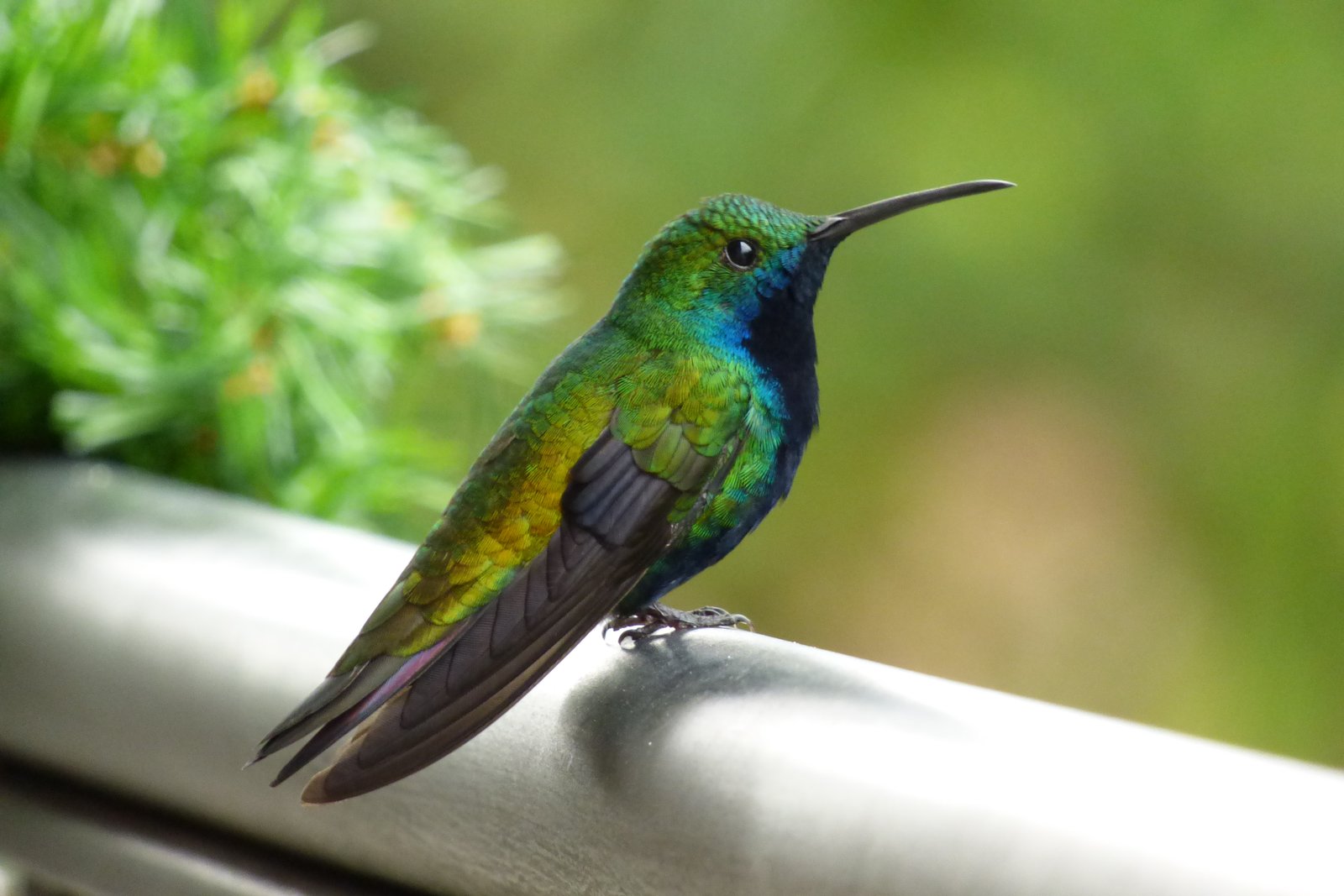
The Black-throated Mango is a large hummingbird of semi-open lowlands that occurs in the guide area only in Panama, mainly in the central and eastern part. It is one of the most numerous mangos in South America. Mangos are bulky hummingbirds with a decurved bill and a wine-red tail that often feed high in flowering trees and fiercely chase off other hummingbirds there.
Voice
High, sharp tsik calls and in chases a dry, rapid chirping. The song is a series of thin, buzzy and squeaky notes from a high perch.
Recording: Jonas Nilsson — CC BY-NC-SA 4.0 · converted to mono · xeno-canto
Identification
10–12 cm, with a fairly long, slightly decurved black bill. The male is bronze-green above; a velvety black stripe runs from the chin over throat and breast onto the belly and is bordered on each side by a glittering blue-green edge; the flanks are green. The tail is purple-red to wine-red with dark edges; the central feathers are dark bronze-green. The female is white below with a black central stripe from throat to belly and green flanks; the outer tail feathers are wine-red with a dark band and a white tip. Young birds have a rufous border along the central stripe.
Confusion species
Veraguan Mango Anthracothorax veraguensis is very similar; in the field the two often cannot be separated with certainty. Where they meet, in central Panama, range is the main clue: Veraguan Mango is the mango of the Pacific lowlands of western Panama. Green-breasted Mango Anthracothorax prevostii occurs in Panama only in Bocas del Toro. Female Ruby-topaz Hummingbird Chrysolampis mosquitus is smaller, with a short bill and a chestnut tail.
Habitat
Semi-open country in the lowlands and lower hills up to about 1000 m: forest edges, riverbanks, pastures with scattered trees, plantations, gardens and parks. It often feeds high in flowering trees and defends a flower-rich spot there; it also catches many small insects in the air.
Where the bird is most at home, classified by the vegetation units of Mexico and Central America.





Range and movements
In the guide area only in Panama, on both the Pacific and Caribbean slopes, mainly from the Panama Canal area east to Darién; scarcer further west, to Coclé and locally Bocas del Toro. Outside the guide area across much of South America east of the Andes, from Colombia and Venezuela to Bolivia, Paraguay and northern Argentina, and on Trinidad and Tobago.
- Resident
- dark = core range, pale = thinly spread
How and when to look
Around the Panama Canal, for example in gardens and parks in Panama City and along forest edges near Gamboa, and in Darién, males often sit high on a bare branch above a flowering tree. Against the light the black central stripe shows first.
Conservation status
Not threatened. The world population is large. The species benefits from open country with trees and is common in farmland and gardens.
Scientific name
Anthracothorax nigricollis | (Vieillot, 1817)
Vieillot described the species in 1817 as Trochilus nigricollis; because it was later moved to another genus, the author and year stand in brackets. The genus Anthracothorax was introduced in 1831 by Boie. Anthracothorax is Greek, from anthrax 'coal' (i.e. 'black') and thōrax 'chest', after the black central stripe on breast and belly. nigricollis is Latin, from niger 'black' and collum 'neck', after the black throat and breast stripe. The specimen the first description was based on came from Brazil.