All species › Passerines › Tanagers and allies › Blue-and-gold Tanager
Position in the tree Birds Aves › Birds with a flexible palate Neognathae › All other modern birds Neoaves › Landbirds Telluraves › Falcons, parrots and passerines Australaves › Falcons and passerines Eufalconimorphae › Parrots and passerines Psittacopasserae
Blue-and-gold Tanager | Bangsia arcaei
Blauw-gouden tangare | Tangara de Arcé
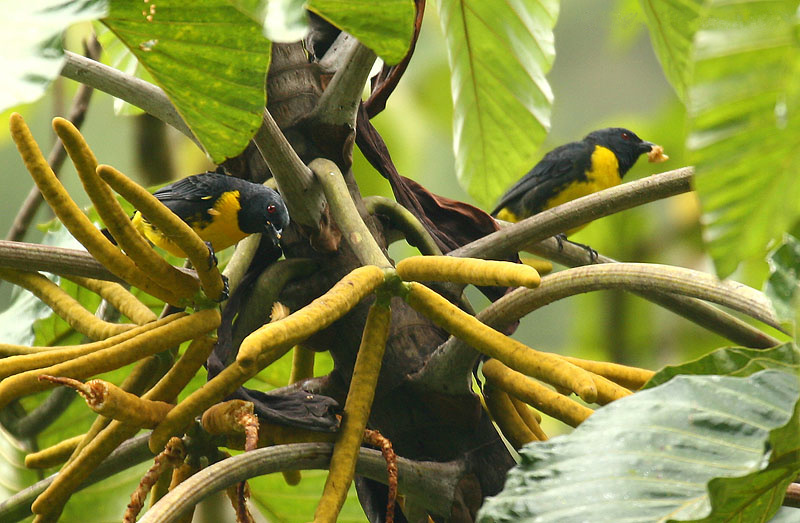
The Blue-and-gold Tanager is a stocky tanager with dark blue upperparts and bright yellow underparts, found only in the wet foothills of the Caribbean slope of Costa Rica and Panama. It lives in mossy, dripping forest and often sits still for long periods in the middle storey. The species does not occur outside the guide area.
Voice
The call is a high, thin and sharp tseet. The song is a short series of high, thin and somewhat sibilant notes, often given early in the morning.
No recording with a suitable Creative Commons licence is available for this species yet.
Identification
15–16 cm. A fairly large, compact tanager with a short, thick black bill. Crown, back, wings and tail deep dark blue; face around the eye and throat even darker, almost blackish blue. Breast and belly bright yellow, flanks washed olive-green. Iris red. Male and female are alike; young birds are duller and have a dark iris.
Confusion species
The male Yellow-throated Euphonia Euphonia hirundinacea and other euphonias with blue-black upperparts and yellow underparts are much smaller, have a yellow forehead patch and lack the red iris. Black-and-yellow Tanager Chrysothlypis chrysomelas is smaller and has black rather than blue upperparts. No other tanager within its range shows this combination of dark blue and yellow.
Habitat
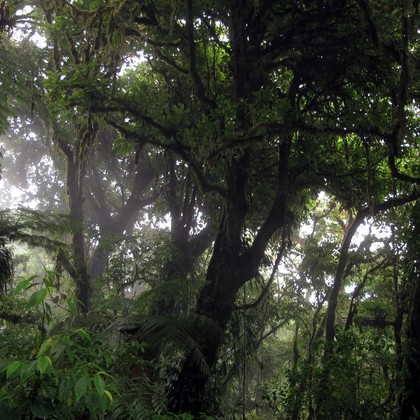
Middle and upper storeys and edges of very wet, mossy foothill forest on the Caribbean slope, roughly between 400 and 1500 m, mainly between 700 and 1200 m. It forages alone, in pairs or with mixed flocks. It eats mainly fruit and berries, as well as insects.
Where the bird is most at home, classified by the vegetation units of Mexico and Central America.


Range and movements
Endemic to the guide area: Caribbean slope of the mountains of Costa Rica, from the Cordillera de Guanacaste and Tilarán south-eastwards, and from western Panama to the centre of the country, where in Veraguas and Coclé it also crosses the continental divide.
- Resident
- dark = core range, pale = thinly spread
How and when to look
Regularly seen in the Quebrada González sector of Braulio Carrillo and at Rara Avis in Costa Rica, and at El Copé (Omar Torrijos National Park) in Panama. It often sits still on a branch in the middle storey for long periods and is easily overlooked.
Conservation status
Near Threatened (NT). Small range in a narrow elevation band; declining through clearance of foothill forest, but still fairly regular in several protected areas.
Scientific name
Bangsia arcaei | (Sclater & Salvin, 1869)
Sclater & Salvin described the species in 1869 as Buthraupis arcaei; because it was later moved to another genus, the author and year stand in brackets. The genus Bangsia was introduced in 1919 by Penard. Bangsia honours the American zoologist and collector Outram Bangs (1863–1932). arcaei honours Enrique Arcé (active around 1870), a Guatemalan collector who worked in Guatemala, Costa Rica and Panama. The specimen the first description was based on came from Cordillera del Chucú, Veraguas, Panama.