All species › Passerines › Tanagers and allies › Cocos Finch
Position in the tree Birds Aves › Birds with a flexible palate Neognathae › All other modern birds Neoaves › Landbirds Telluraves › Falcons, parrots and passerines Australaves › Falcons and passerines Eufalconimorphae › Parrots and passerines Psittacopasserae
Cocos Finch | Pinaroloxias inornata
Cocosvink | Pinzón de la isla del Coco
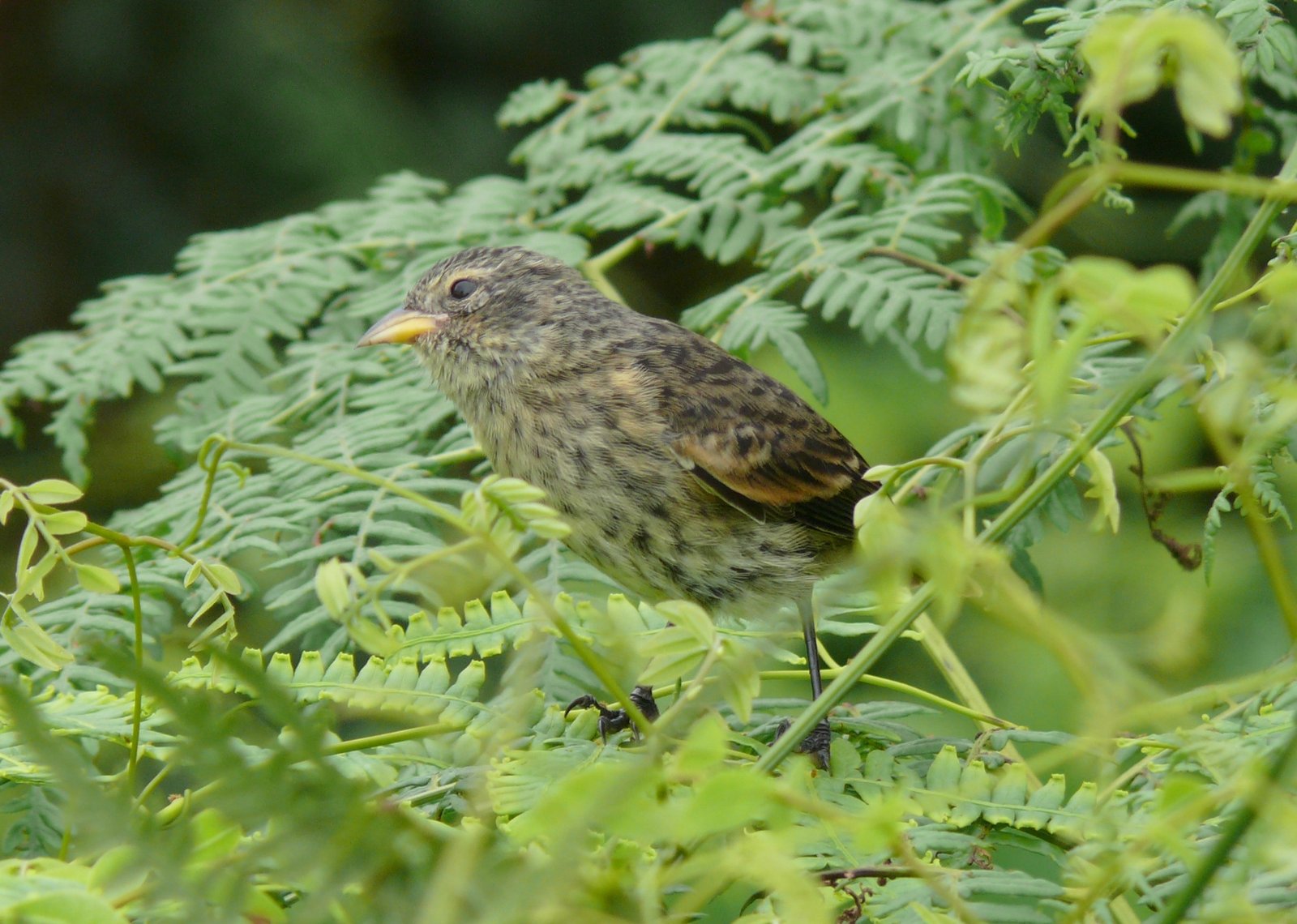
The Cocos Finch occurs only on Isla del Coco, a remote Costa Rican island in the Pacific Ocean. It is related to Darwin's finches of the Galápagos Islands and is the only species of that group outside those islands. The male is all black, the female streaked brown. On the island the species is common and shows little fear.
Voice
The song is a fast, high and thin series of whistles and trills, with regional differences on the island. The call is a short, sharp tseep.
No recording with a suitable Creative Commons licence is available for this species yet.
Identification
11–12 cm. Pointed, slightly curved bill, longer and thinner than in most seed-eaters; black in the male, paler and yellowish at the base in the female. The adult male is uniform dull black. The female and young birds are brown above with dark streaks and pale brown to buff below with dark streaks on the breast and flanks. Young males acquire the black plumage gradually and are mottled for a time.
Confusion species
No other seed-eaters occur regularly on the island. Cocos Tyrannulet Nesotriccus ridgwayi is olive grey with wing bars and a flat bill and catches insects in flight. Cocos Cuckoo Coccyzus ferrugineus is much larger, with a long tail. Vagrants from the mainland, such as Indigo Bunting Passerina cyanea, have a shorter, conical bill.
Habitat
All vegetation on the island, from beach and coastal forest to the humid forest and cloud forest on the highest parts, also around the ranger station buildings. Feeds in a wide variety of ways: insects, spiders, nectar, seeds and fruit, on the ground, in trees and in flowers.
Where the bird is most at home, classified by the vegetation units of Mexico and Central America.
Range and movements
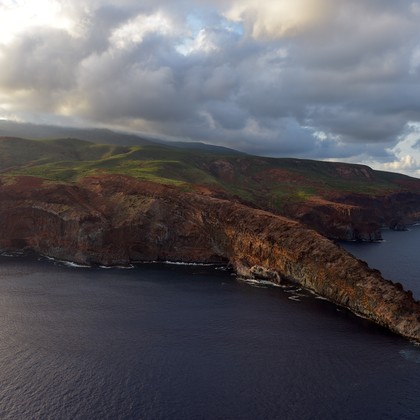
Endemic to Isla del Coco, about 500 km southwest of the Costa Rican mainland. The island is a national park and can only be reached by boat.
- Resident
- dark = core range, pale = thinly spread
How and when to look
The Cocos Finch can be seen from the landing sites and the trails near the bays, where the birds often come close to people. A visit requires a boat trip of several days and permission from the park service.
Conservation status
Vulnerable (VU). The entire range covers one small island. Numbers appear stable, but introduced animals such as rats, cats, pigs and deer pose a risk through predation and damage to the vegetation.
Scientific name
Pinaroloxias inornata | (Gould, 1843)
Gould described the species in 1843 as Cactornis inornatus; because it was later moved to another genus, the author and year stand in brackets. The genus Pinaroloxias was introduced in 1885 by Sharpe. Pinaroloxias is Greek, from pinaros 'dirty, shabby' and Loxia (crossbills): a 'shabby crossbill', after the plain, dark plumage. inornata is Latin for 'unadorned, plain', after the plain dark or brown plumage. The specimen the first description was based on came from Cocos Island, Costa Rica.