All species › Passerines › Finches, euphonias and allies › Blue-crowned Chlorophonia
Position in the tree Birds Aves › Birds with a flexible palate Neognathae › All other modern birds Neoaves › Landbirds Telluraves › Falcons, parrots and passerines Australaves › Falcons and passerines Eufalconimorphae › Parrots and passerines Psittacopasserae
Blue-crowned Chlorophonia | Chlorophonia occipitalis
Blauwkruinorganist | Clorofonia corona azul
The Blue-crowned Chlorophonia is a stocky, bright green chlorophonia of cloud forest and humid montane forest, with a blue crown and a yellow belly. Despite its green plumage it is inconspicuous in the canopy and is often first noticed by its plaintive whistle. In the guide area it lives from southern Mexico to Nicaragua.

Voice
A soft, plaintive whistle, pyuu or teeuw, slightly falling and often repeated at regular intervals; also soft, nasal calls. The song is a short series of soft, varied notes.
Recording: Isaí López — CC BY-NC-SA 4.0 · converted to mono · xeno-canto
Identification
12–13 cm. The male is bright grass-green on the head, back, throat and breast, with a sky-blue crown and nape and a narrow blue eye-ring. The belly is yellow and is separated from the green breast by a narrow brown line. The female is duller green, with less blue on the crown and nape, a greenish-yellow belly and no brown line. Bill short, thick and dark.
Confusion species
The female Elegant Euphonia Chlorophonia elegantissima also has a blue cap, but is more olive and has a rufous forehead and a tawny throat. Golden-browed Chlorophonia Chlorophonia callophrys has a yellow supercilium and lives further south, in Costa Rica and western Panama, without overlap. Other green birds of the cloud forest, such as small tanagers, are slimmer and lack the combination of blue crown and yellow belly.
Habitat
Cloud forest and humid evergreen montane forest, also forest edges and tall trees in shade coffee; mostly between about 900 and 2500 m. Outside the breeding season partly lower, in foothill forest. It eats mainly mistletoe berries, figs and other small fruits, usually in pairs or small groups high in the trees.
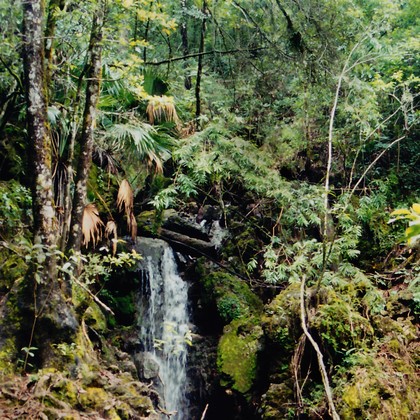
Where the bird is most at home, classified by the vegetation units of Mexico and Central America.



Range and movements
From central Veracruz and northern Oaxaca through Chiapas to Guatemala, El Salvador and Honduras to northern and central Nicaragua. Does not occur outside the guide area.
- Resident
- dark = core range, pale = thinly spread
How and when to look
In cloud forest best found by listening for the soft, plaintive whistle and then scanning fruiting trees or mistletoe in the canopy; the birds often sit still for long periods.
Conservation status
Not threatened (LC). Locally fairly common; dependent on montane forest and therefore sensitive to deforestation.
Scientific name
Chlorophonia occipitalis | (Du Bus de Gisignies, B-AL, 1847)
Du Bus de Gisignies, B-AL described the species in 1847 as Euphonia occipitalis; because it was later moved to another genus, the author and year stand in brackets. The genus Chlorophonia was introduced in 1851 by Bonaparte. Chlorophonia combines Greek khlōros 'green' with the genus name Euphonia, after the green plumage. occipitalis is Latin, from occiput 'back of the head', after the blue crown and nape. The specimen the first description was based on came from Mexico.