All species › Passerines › Finches, euphonias and allies › Yellow-collared Chlorophonia
Position in the tree Birds Aves › Birds with a flexible palate Neognathae › All other modern birds Neoaves › Landbirds Telluraves › Falcons, parrots and passerines Australaves › Falcons and passerines Eufalconimorphae › Parrots and passerines Psittacopasserae
Yellow-collared Chlorophonia | Chlorophonia flavirostris
Geelkraagorganist | Clorofonia acollarada
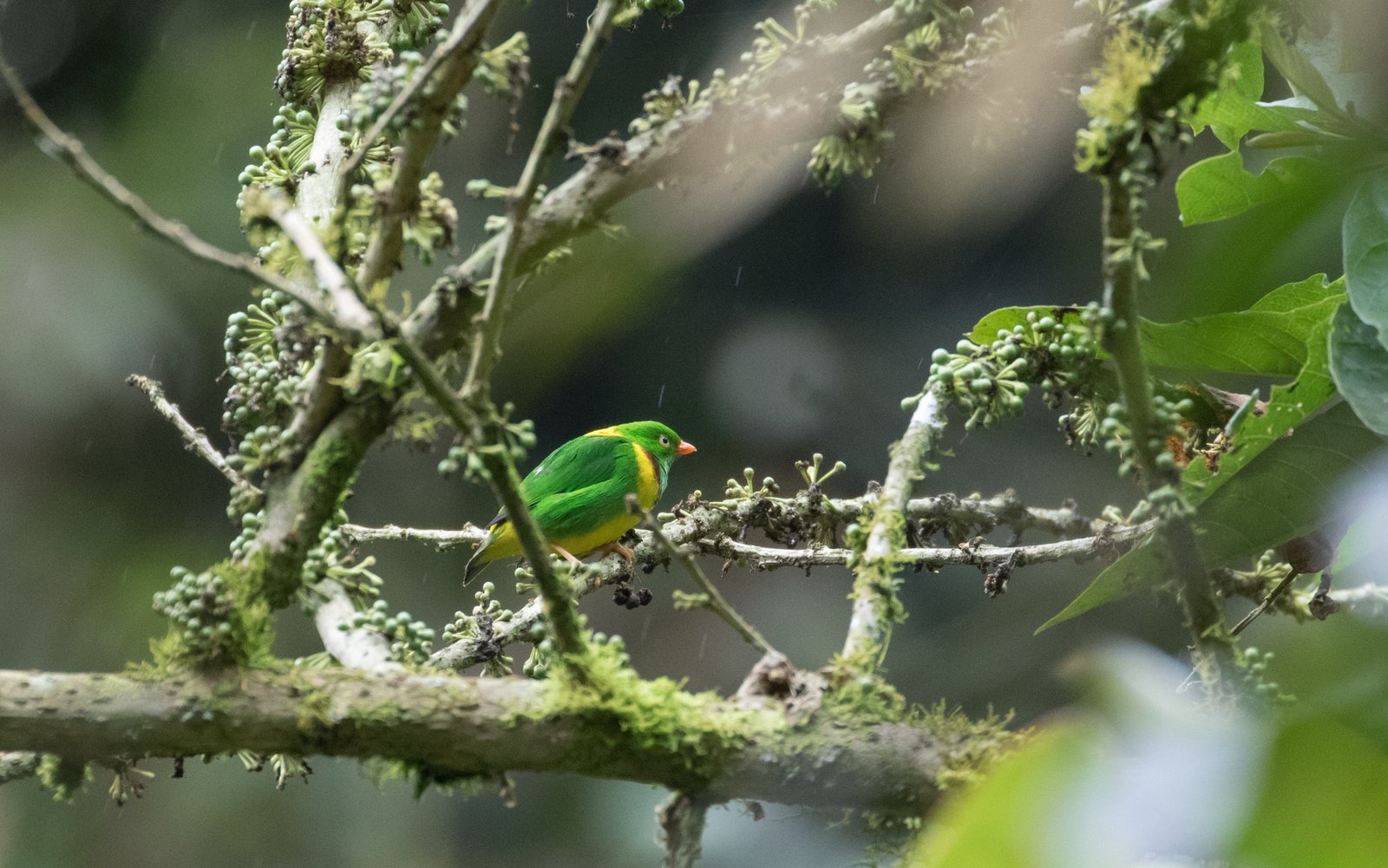
The Yellow-collared Chlorophonia is a small, bright green chlorophonia of wet montane forest in the Chocó region. In the guide area it is known only from the higher mountains of eastern Panama, where it is rare. The yellow hindneck collar and the orange bill and legs are characteristic.
Voice
Soft, high and somewhat plaintive whistles, often repeated singly. The voice is poorly documented.
Recording: rudy gelis — CC BY-NC-SA 4.0 · shortened to the first 60 s, mono · xeno-canto
Identification
10 cm. The male is mostly bright grass-green, with a yellow band across the hindneck and a yellow belly that contrasts sharply with the green breast. A white ring around the eye. Bill and legs orange to orange-yellow. The female is green with a yellowish-green belly and no yellow collar, but has the same orange bill, orange legs and white eye-ring.
Confusion species
Golden-browed Chlorophonia Chlorophonia callophrys (Costa Rica and western Panama) is larger, has a blue crown and nape, a yellow supercilium and a dark bill; their ranges do not overlap. Females of Euphonia species are more olive and lack the orange bill and legs.
Habitat
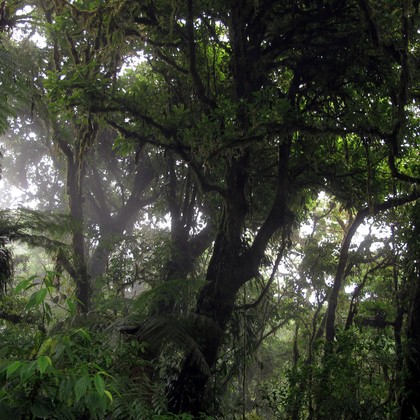
Wet montane forest and cloud forest rich in mosses and epiphytes, also forest edges; in eastern Panama above about 1000 m. It forages in pairs or small groups in the canopy for mistletoe berries and other small fruits.
Where the bird is most at home, classified by the vegetation units of Mexico and Central America.

Range and movements
In the guide area only in eastern Panama, in the mountains of Darién (including Cerro Pirre and Cerro Tacarcuna). Outside the guide area in the Western Andes and on the Pacific slope of Colombia to north-western Ecuador.
- Resident
- dark = core range, pale = thinly spread
How and when to look
In Panama only to be expected in the remote montane forests of Darién. Groups are easiest to find at fruiting trees and mistletoe in the canopy.
Conservation status
Not threatened (LC). Rare and local in the guide area; fairly common locally outside it. May decline through the loss of montane forest.
Scientific name
Chlorophonia flavirostris | Sclater, 1861
Sclater described the species in 1861 and placed it straight away in the genus where it still stands. The genus Chlorophonia was introduced in 1851 by Bonaparte. Chlorophonia combines Greek khlōros 'green' with the genus name Euphonia, after the green plumage. flavirostris is Latin, from flavus 'yellow' and -rostris '-billed', after the yellow bill. The specimen the first description was based on came from Ecuador.