All species › Passerines › Gnatwrens and gnatcatchers › Blue-grey Gnatcatcher
Position in the tree Birds Aves › Birds with a flexible palate Neognathae › All other modern birds Neoaves › Landbirds Telluraves › Falcons, parrots and passerines Australaves › Falcons and passerines Eufalconimorphae › Parrots and passerines Psittacopasserae
Blue-grey Gnatcatcher | Polioptila caerulea
Blauwgrijze muggenvanger | Perlita azulgris
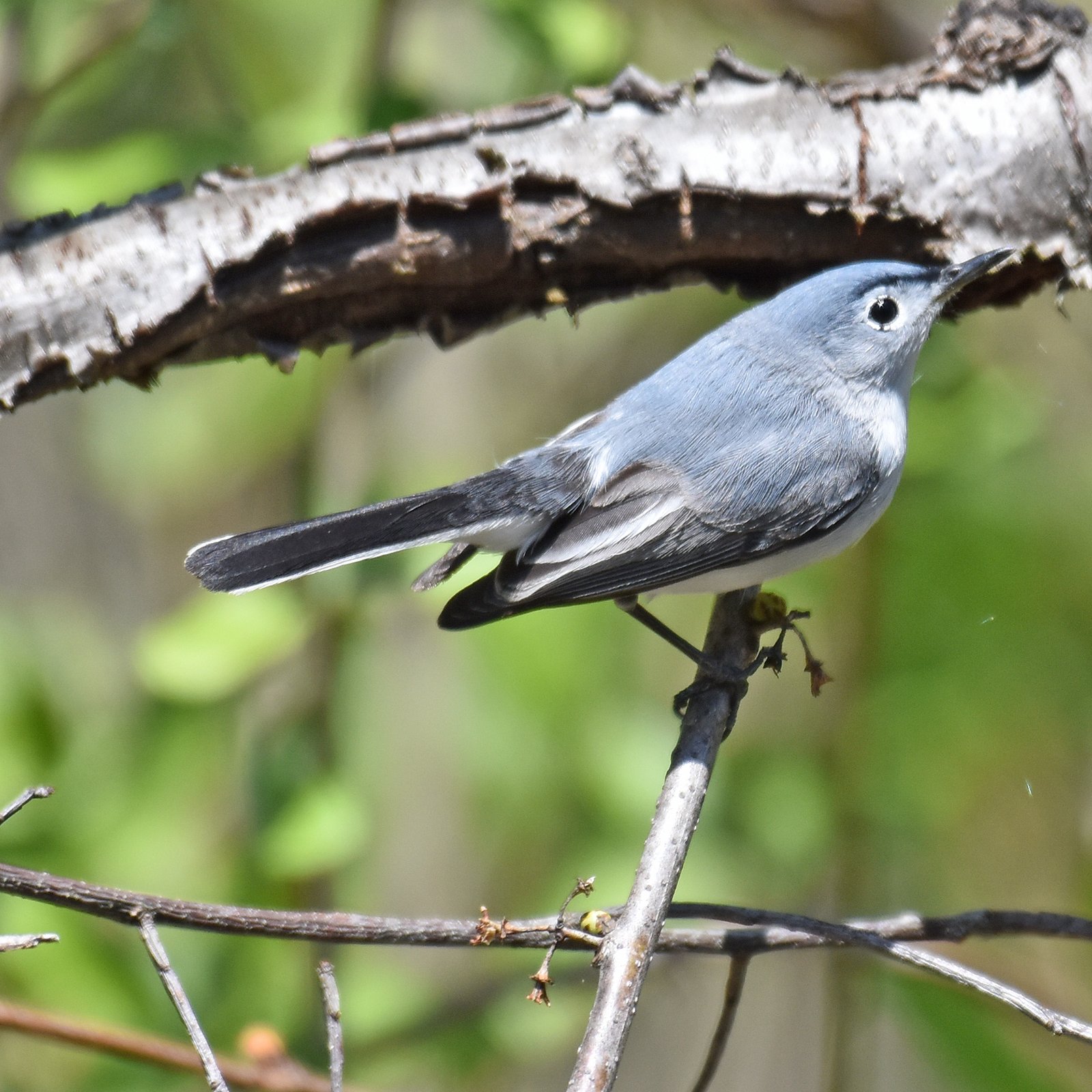
The Blue-grey Gnatcatcher is a small, slim songbird with a long black-and-white tail that it constantly cocks and flicks from side to side. It is the most widespread gnatcatcher in North America. In the guide area it breeds in much of Mexico and is common in winter as far as northern Central America.
Voice
The call is a thin, nasal, plaintive spee or zee, often repeated. The song is a soft, chattering series of squeaky and nasal notes, sometimes including imitations of other birds.
Recording: Manuel Grosselet — CC BY-NC-SA 4.0 · converted to mono · xeno-canto
Identification
10–12 cm, with a long tail. Upperparts blue-grey, greyer in the female; underparts white. Distinct white eye-ring. In the breeding season the male has a narrow black line across the forehead that continues above the eye; outside the breeding season this is absent. Tail black with white outer feathers; seen from below almost entirely white. Wings grey with pale edges to the secondaries. Bill short and thin.
Confusion species
Black-tailed Gnatcatcher Polioptila melanura and California Gnatcatcher Polioptila californica have a largely black underside to the tail. Breeding males of Black-capped Gnatcatcher Polioptila nigriceps and White-lored Gnatcatcher Polioptila albiloris have a full black cap. White-browed Gnatcatcher Polioptila bilineata and Yucatan Gnatcatcher Polioptila albiventris have, in the male, a black crown bordered below by a white supercilium.
Habitat
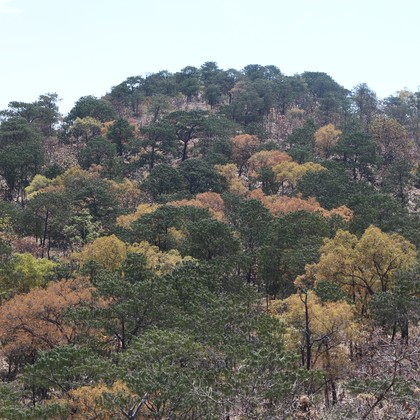
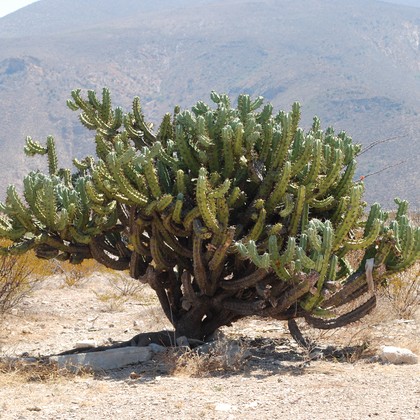
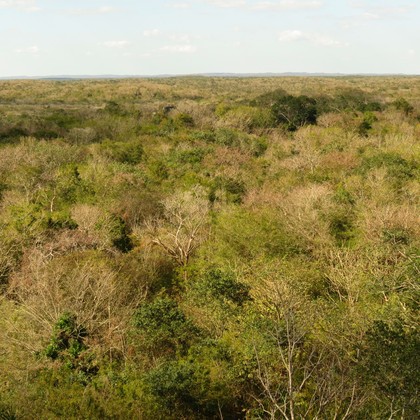
Open woodland and forest edges, especially oak and pine-oak woodland, dry deciduous forest, thorn scrub and riparian woodland; in winter in almost any wooded habitat, including the lowlands, parks and gardens. It gleans small insects and spiders from foliage and in winter often joins mixed flocks.
Where the bird is most at home, classified by the vegetation units of Mexico and Central America.




Range and movements
Breeds in northern Mexico and in the highlands south to southern Mexico; resident birds also live in eastern Mexico, on the Yucatán Peninsula and in Belize. In winter spread over almost all of Mexico and south to Guatemala, El Salvador and Honduras; rare further south. Outside the guide area it breeds over much of the United States and in extreme southern Canada, and also winters in Cuba and the Bahamas.
- Resident
- Summer visitor (c. Apr–Sep)
- Winter visitor (c. Oct–Mar)
- Passage (Mar–Apr, Oct–Nov)
- dark = core range, pale = thinly spread
How and when to look
In winter often in mixed songbird flocks at forest edges and in parks; the thin, nasal call and the flicking tail with much white give it away.
Conservation status
Not threatened. Common and widespread; its North American breeding range has expanded northwards in recent decades.
Scientific name
Polioptila caerulea | (Linnaeus, 1766)
Linnaeus described the species in 1766 as Motacilla caerulea; because it was later moved to another genus, the author and year stand in brackets. The genus Polioptila was introduced in 1855 by Sclater. Polioptila is Greek, from polios 'grey' and ptilon 'feather': 'grey-feathered'. caerulea is Latin for 'sky-blue', after the blue-grey upperparts. The specimen the first description was based on came from Philadelphia, Pennsylvania, USA.