All species › Passerines › Cardinals and allies › Blue Grosbeak
Position in the tree Birds Aves › Birds with a flexible palate Neognathae › All other modern birds Neoaves › Landbirds Telluraves › Falcons, parrots and passerines Australaves › Falcons and passerines Eufalconimorphae › Parrots and passerines Psittacopasserae
Blue Grosbeak | Passerina caerulea
Blauwe bisschop | Picogordo azul
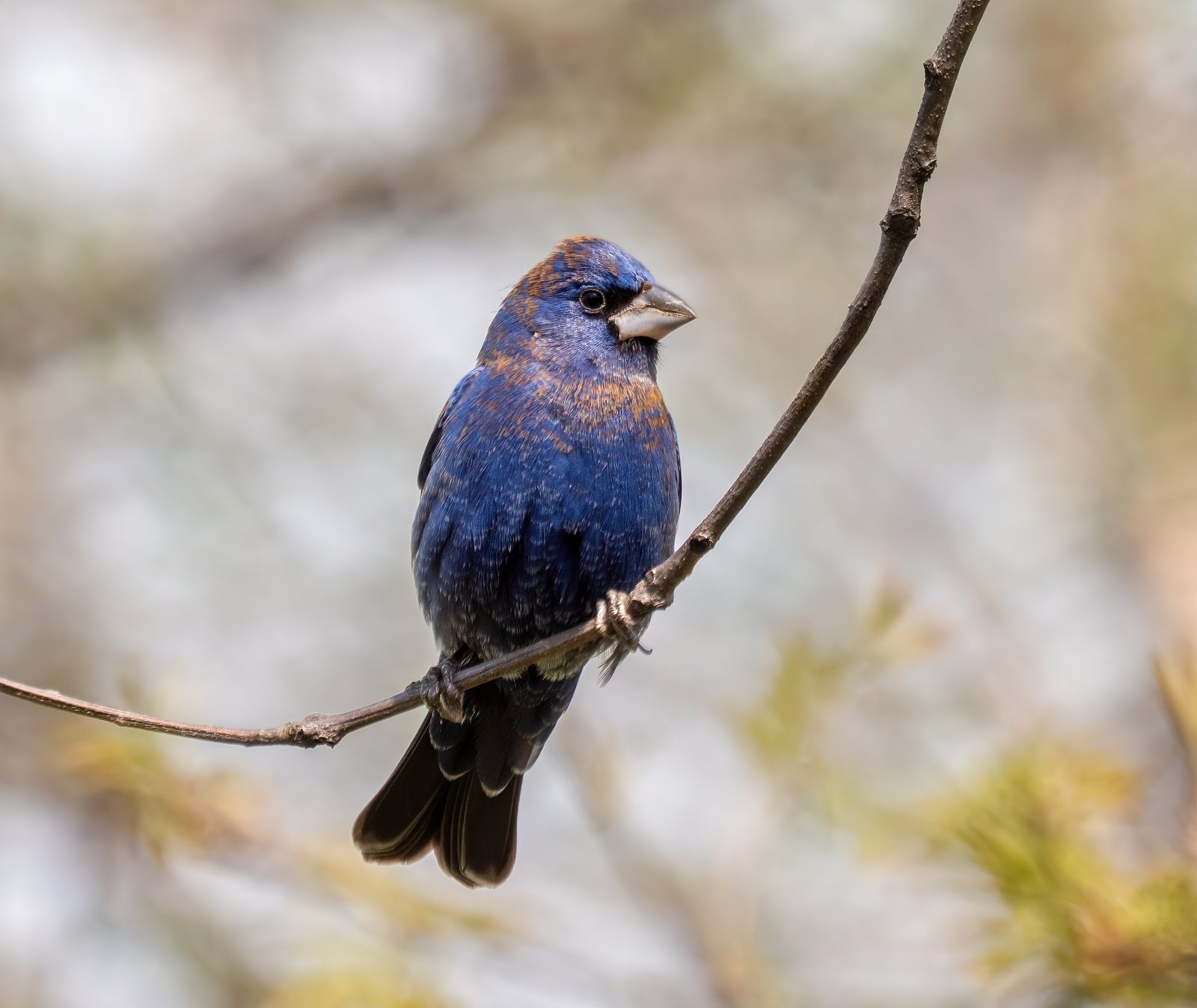
The Blue Grosbeak is a large, blue seed-eater with a heavy bill and rufous wing bars. It lives in semi-open country with shrubs and hedges. In the guide area it is widespread: a resident in much of Mexico and Central America, a summer visitor in the north, and in winter it is joined by birds from North America.
Voice
The song is a long, rich and somewhat rambling series of warbled notes that rises and falls. The call is a loud, metallic chink.
Recording: Manuel Grosselet — CC BY-NC-SA 4.0 · shortened to the first 60 s, mono · xeno-canto
Identification
15–17 cm. Heavy, conical bill, silvery grey with a darker upper mandible. The male is deep blue with black around the base of the bill, blackish wings and tail and two broad rufous wing bars. The female is warm brown, paler below, with two buffy to rufous wing bars and often a blue tinge on the shoulder and rump. Young males are mottled brown and blue. It often flicks its tail from side to side.
Confusion species
Indigo Bunting Passerina cyanea is smaller, with a much smaller bill and no rufous wing bars. Blue-black Grosbeak Cyanoloxia cyanoides is darker blue-black, without wing bars, and lives in humid forest. Blue Bunting Cyanocompsa parellina is smaller, without wing bars, and lives in dense undergrowth. The female Brown-headed Cowbird Molothrus ater has a more pointed bill and no rufous wing bars.
Habitat
Semi-open country with shrubs: overgrown pastures, hedges, field edges, thorn scrub, riparian thickets and forest edges; from sea level to about 2500 m. Often sings from a wire or an exposed branch.
Where the bird is most at home, classified by the vegetation units of Mexico and Central America.




Range and movements
Breeds from the central and southern United States through Mexico and Central America to Costa Rica. Birds from the United States and northern Mexico winter in Mexico and Central America to Panama; in Panama mainly a scarce winter visitor. Absent or scarce in the most humid forest regions.
- Resident
- Summer visitor (c. Apr–Sep)
- Winter visitor (c. Oct–Mar)
- Passage (Mar–Apr, Oct–Nov)
- dark = core range, pale = thinly spread
How and when to look
Often seen on fences, wires and bushes along roads through semi-open farmland; the rufous wing bars are the best feature even in brown birds.
Conservation status
Not threatened (LC). Common and widespread; benefits from semi-open farmland and has increased in North America.
Scientific name
Passerina caerulea | (Linnaeus, 1758)
Linnaeus described the species in 1758 as Loxia caerulea; because it was later moved to another genus, the author and year stand in brackets. The genus Passerina was introduced in 1816 by Vieillot. Passerina comes from the Latin passerinus 'sparrow-like', from passer 'sparrow'. caerulea is Latin for 'blue', after the male's blue plumage. The specimen the first description was based on came from South Carolina.