All species › Passerines › Cardinals and allies › Lazuli Bunting
Position in the tree Birds Aves › Birds with a flexible palate Neognathae › All other modern birds Neoaves › Landbirds Telluraves › Falcons, parrots and passerines Australaves › Falcons and passerines Eufalconimorphae › Parrots and passerines Psittacopasserae
Lazuli Bunting | Passerina amoena
Lazuligors | Colorín lázuli
The Lazuli Bunting is a small bunting from western North America. The male has a turquoise-blue head and back, an orange-brown breast and white wing bars. In the guide area it breeds only in northern Baja California; in winter it is fairly common in dry scrub and weedy fields in western Mexico.

Voice
The song is a fast, somewhat scratchy series of varied notes, partly in pairs, sometimes ending in a buzzy note. The call is a sharp spik, the flight call a buzzy zzeet.
Recording: Ed Pandolfino — CC BY-NC-SA 4.0 · converted to mono · xeno-canto
Identification
13–14 cm. Short, conical grey bill. The breeding male has a turquoise-blue head, throat, back and rump, a cinnamon-orange breast band, white flanks and belly, and a broad white upper wing bar with a narrower second one below it. In winter plumage the blue is partly hidden by brown feather edges. The female is grey-brown above with a blue-grey tinge to the rump and tail, an unstreaked buffy breast, a whitish belly and two pale wing bars.
Confusion species
The female Indigo Bunting Passerina cyanea is warmer brown with faint streaks on the breast and less distinct wing bars; the two species sometimes hybridise where their breeding ranges meet. Western Bluebird Sialia mexicana and Eastern Bluebird Sialia sialis are larger, with a thin bill and an upright posture. The female Varied Bunting Passerina versicolor is plain grey-brown without distinct wing bars.
Habitat
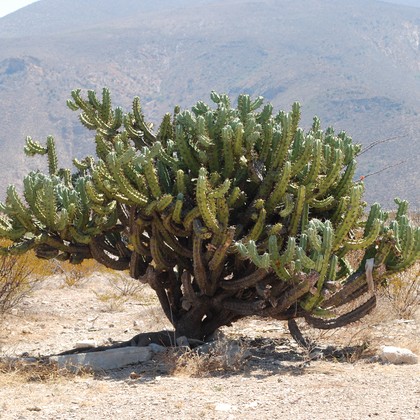
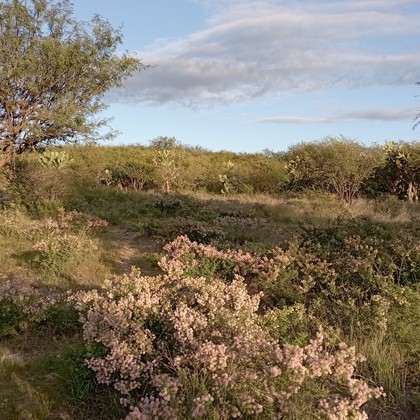
In winter dry and semi-dry scrub, thorn scrub, semi-desert grassland, weedy fields, hedges and field edges, often in small flocks with other seed-eaters; from sea level to about 2000 m. Breeds on brushy slopes, in chaparral and in thickets along streams.
Where the bird is most at home, classified by the vegetation units of Mexico and Central America.



Range and movements
Breeds in western North America, from southern Canada to northern Baja California. After breeding many birds first move to the south-western United States and north-western Mexico to moult there. Winters in western Mexico, from Sonora and southern Baja California to Guerrero and Oaxaca, inland to the central plateau. On migration widespread in north-western Mexico.
- Winter visitor (c. Oct–Mar)
- dark = core range, pale = thinly spread
How and when to look
In winter often in small flocks with other buntings and sparrows in weedy fields and along farmland on the Pacific slope of Mexico; in brown birds the white wing bars and the buffy breast are the best features.
Conservation status
Not threatened (LC). Common and widespread; the population appears stable.
Scientific name
Passerina amoena | (Say, 1822)
Say described the species in 1822 as Emberiza amoena; because it was later moved to another genus, the author and year stand in brackets. The genus Passerina was introduced in 1816 by Vieillot. Passerina comes from the Latin passerinus 'sparrow-like', from passer 'sparrow'. amoena is Latin for 'lovely, charming', after the handsome blue, orange and white male. The specimen the first description was based on came from near Cañon City, Colorado (USA).