All species › Waterfowl › Ducks, swans and geese › Brant
Position in the tree Birds Aves › Birds with a flexible palate Neognathae › Fowl Galloanserae
Brant | Branta bernicla
Rotgans | Barnacla carinegra
The Brant is a small, dark sea goose of the Arctic tundra that in the guide area winters almost only in the coastal lagoons of north-western Mexico. These are Black Brant Branta bernicla nigricans, a large part of whose Pacific population spends the winter in the lagoons of Baja California. The species is closely tied to eelgrass.

Voice
A low, rolling, guttural rronk or krrr-onk; flocks keep up a continuous murmur, both on the water and in flight.
Recording: Sjouke Scholten — CC BY-NC-SA 4.0 · converted to mono · xeno-canto
Identification
55–66 cm, no bigger than a large duck and with a short neck. Head, neck and breast are black, with a white necklace that is closed at the front in Black Brant. Back and belly are dark blackish-brown, the flanks have broad white bars and the undertail and the sides of the rump are white. Bill and legs are black. In their first autumn juveniles largely lack the necklace and have pale fringes to the wing coverts. It flies fast, low over the water, in long, undulating lines.
Confusion species
Canada Goose Branta canadensis and Cackling Goose Branta hutchinsii have a white cheek patch instead of a necklace and a light brown body. Surf Scoter Melanitta perspicillata and White-winged Scoter Melanitta deglandi also look dark at a distance, but have a heavy, patterned or bulbous bill and dive for food.
Habitat
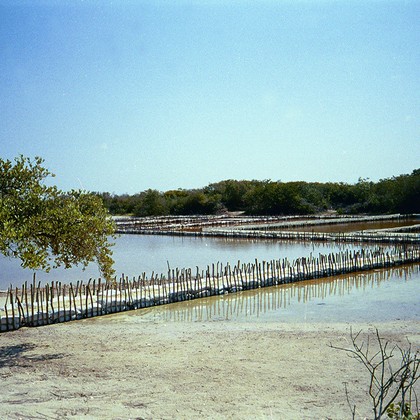
Shallow coastal lagoons and bays with eelgrass beds of Zostera marina, where the birds graze at low tide; also mudflats, salt marsh and sheltered coastal waters. In the guide area it rarely comes inland.
Where the bird is most at home, classified by the vegetation units of Mexico and Central America.


Range and movements
Winters along the Pacific coast of Baja California and Baja California Sur, mainly in Bahía San Quintín, Laguna Ojo de Liebre, Laguna San Ignacio and Bahía Magdalena, and in smaller numbers in the Gulf of California along the coasts of Sonora and Sinaloa. Very rare further south. Breeds on the tundra of Alaska, northern Canada and north-eastern Siberia; other subspecies also breed in Greenland and northern Eurasia.
- Winter visitor (c. Oct–Mar)
- dark = core range, pale = thinly spread
How and when to look
In winter in flocks on the water of the large lagoons on the Pacific side of Baja California, such as Ojo de Liebre near Guerrero Negro and Bahía San Quintín; at low tide they graze on the exposed eelgrass beds.
Conservation status
Not threatened globally. In the guide area a numerous winter visitor in a small number of lagoons, which makes the population vulnerable to disturbance and to the decline of eelgrass.
Scientific name
Branta bernicla | (Linnaeus, 1758)
Linnaeus described the species in 1758 as Anas Bernicla; because it was later moved to another genus, the author and year stand in brackets. The genus Branta was introduced in 1769 by Scopoli. Branta is a Latinised form of Old Norse brandgás, 'burnt goose', that is, black goose. bernicla is Medieval Latin for 'barnacle', from the old belief that these geese grew from barnacles. The specimen the first description was based on came from Sweden.