All species › Passerines › New World sparrows › Brewer's Sparrow
Position in the tree Birds Aves › Birds with a flexible palate Neognathae › All other modern birds Neoaves › Landbirds Telluraves › Falcons, parrots and passerines Australaves › Falcons and passerines Eufalconimorphae › Parrots and passerines Psittacopasserae
Brewer's Sparrow | Spizella breweri
Brewers gors | Gorrión de Brewer
Brewer's Sparrow is a small, slim and plainly marked sparrow of dry shrublands. It breeds in western North America and winters in flocks in the deserts and semi-deserts of northern Mexico. Outside the breeding season it often associates with other small sparrows.

Voice
The song is long and varied: series of buzzy trills and rapid, canary-like notes following each other at different pitches. In winter mainly the call, a thin, high tsip; towards the end of winter flocks sometimes sing before departure.
Recording: Don Profota — CC BY-NC-SA 4.0 · converted to mono · xeno-canto
Identification
13–14 cm. Small and slim, with a fairly long, notched tail and a small, pinkish-brown bill. Crown grey-brown with fine dark streaks and no central stripe. Head greyish brown with a narrow white eye-ring and a brown ear patch with a fine dark border. Back sandy brown with dark streaks; two narrow pale wing bars. Underparts plain pale grey to greyish buff, without streaks. The sexes are alike.
Confusion species
Chipping Sparrow Spizella passerina in winter plumage has a dark loral and eye stripe, a grey rump and often a faint pale central crown stripe. Clay-colored Sparrow Spizella pallida has a stronger head pattern, with a pale central crown stripe, a sharply outlined ear patch and a grey nape that contrasts with the brown back. Worthen's Sparrow Spizella wortheni has a rufous crown, a plain grey head and a bright pink bill.
Habitat
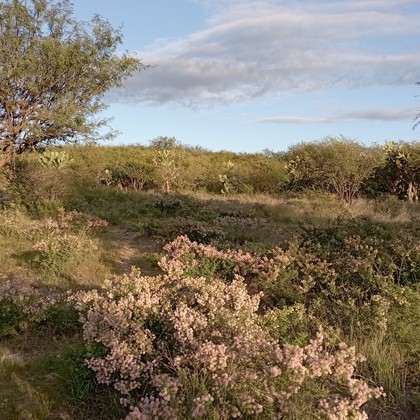
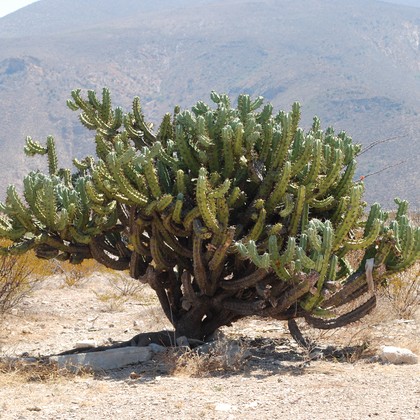
Breeds in sagebrush steppe and other low, dry scrub. In winter in desert and semi-desert scrub, dry grassland with scattered shrubs, thorn scrub and fallow fields. It forages in small groups for seeds and small insects on the ground and in low shrubs.
Where the bird is most at home, classified by the vegetation units of Mexico and Central America.


Range and movements
Breeds in western Canada and the western United States, especially in the Great Basin. Winters in the south-western United States and northern Mexico, with Baja California, Sonora, Chihuahua, Coahuila and Durango as the core area and south to about Jalisco, Guanajuato and San Luis Potosí. In the guide area only in winter and on migration.
- Winter visitor (c. Oct–Mar)
- dark = core range, pale = thinly spread
How and when to look
In winter often in flocks of dozens of birds in low desert scrub, sometimes together with Chipping and Clay-colored Sparrows; flushed flocks fly up and drop back into the bushes a short distance away.
Conservation status
Not threatened (LC). Common and widespread, but declining through the loss and fragmentation of sagebrush steppe in the breeding range; in the guide area a numerous winter visitor.
Scientific name
Spizella breweri | Cassin, 1856
Cassin described the species in 1856 and placed it straight away in the genus where it still stands. The genus Spizella was introduced in 1831 by Bonaparte. Spizella is a diminutive of the Greek spiza 'finch': 'little finch'. breweri honours the American ornithologist and oologist Thomas Mayo Brewer (1814–1880). The specimen the first description was based on came from Black Hills, Dakota (USA).