All species › Passerines › New World sparrows › Worthen's Sparrow
Position in the tree Birds Aves › Birds with a flexible palate Neognathae › All other modern birds Neoaves › Landbirds Telluraves › Falcons, parrots and passerines Australaves › Falcons and passerines Eufalconimorphae › Parrots and passerines Psittacopasserae
Worthen's Sparrow | Spizella wortheni
Mexicaanse veldgors | Gorrión de Worthen
Worthen's Sparrow is a small sparrow with a rufous crown and a bright pink bill. It occurs only in the plateau grasslands of north-eastern Mexico and is one of the rarest sparrows in the guide area. The world population numbers at most a few hundred birds.

Voice
The song is a dry, flat trill or rapid series of chip notes, sometimes slightly accelerating. The call is a thin, high tsip.
Recording: Richard E. Webster — CC BY-NC-SA 4.0 · shortened to the first 60 s, mono · xeno-canto
Identification
13–14 cm. Small, with a long tail and a small, bright pink bill. Crown plain rufous; rest of the head and nape plain grey, without eye stripe or facial markings, with a narrow white eye-ring. Back brown with dark streaks; two pale wing bars and rufous edges to the wing feathers. Underparts plain pale grey, whiter towards the belly. Legs pink. The sexes are alike; juveniles are finely streaked on breast and crown.
Confusion species
Field Sparrow Spizella pusilla, which winters in north-eastern Mexico, closely resembles Worthen's Sparrow but has a rufous stripe behind the eye, a browner cheek and more brown on the flanks. Chipping Sparrow Spizella passerina has a white supercilium, a dark eye stripe and a black bill in breeding plumage. Brewer's Sparrow Spizella breweri has a streaked grey-brown crown and a pale brownish bill.
Habitat
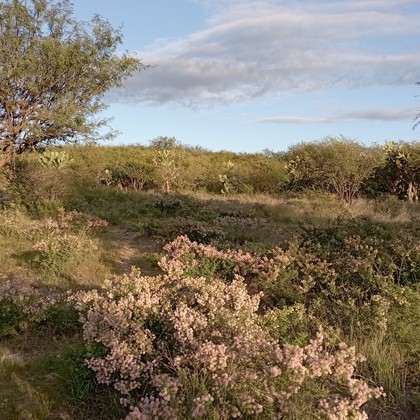
Open, semi-arid grassland with scattered low shrubs, often with juniper, yucca or mesquite, on plateaus between about 1,200 and 2,400 metres. It nests in low shrubs; outside the breeding season in small groups, sometimes with other sparrows. It searches for seeds and insects on the ground.
Where the bird is most at home, classified by the vegetation units of Mexico and Central America.

Range and movements
Endemic to north-eastern Mexico. Today known mainly from a small number of sites in south-eastern Coahuila and adjacent western Nuevo León, with scattered records in Zacatecas and San Luis Potosí. Formerly also known from Chihuahua, Puebla and Veracruz, and once collected in New Mexico.
- Resident
- dark = core range, pale = thinly spread
How and when to look
Most likely in spring and early summer, when singing males can be heard from low shrubs in the grassland on the plateaus south of Saltillo.
Conservation status
Endangered (EN). Very small and fragmented population. The grassland it inhabits is disappearing through conversion to farmland, overgrazing and shrub encroachment; the decline of prairie dog colonies, which keep the grassland open, also plays a part.
Scientific name
Spizella wortheni | Ridgway, 1884
Ridgway described the species in 1884 and placed it straight away in the genus where it still stands. The genus Spizella was introduced in 1831 by Bonaparte. Spizella is a diminutive of the Greek spiza 'finch': 'little finch'. wortheni honours the American draughtsman and naturalist Charles Kimball Worthen (1850–1909). The specimen the first description was based on came from Silver City, New Mexico (USA).