All species › Passerines › New World sparrows › Yellow-throated Chlorospingus
Position in the tree Birds Aves › Birds with a flexible palate Neognathae › All other modern birds Neoaves › Landbirds Telluraves › Falcons, parrots and passerines Australaves › Falcons and passerines Eufalconimorphae › Parrots and passerines Psittacopasserae
Yellow-throated Chlorospingus | Chlorospingus flavigularis
Geelkeeltangare | Clorospingo gorjiamarillo
The Yellow-throated Chlorospingus is a fairly large Chlorospingus with a yellow throat and otherwise grey underparts. In the guide area it lives only in the foothills of western Panama; the rest of its range lies in the Andes. It moves in small groups through humid forest, often together with other species.

Voice
The call is a sharp, high tsip or chit, often repeated within groups. The song is a rapid series of high, dry notes.
Recording: rudy gelis — CC BY-NC-SA 4.0 · converted to mono · xeno-canto
Identification
14–15 cm. Head and upperparts olive green to greyish olive, without a white spot or stripe near the eye. Throat yellow, brightest at the sides; breast and belly grey to olive-grey, without a yellow breast band. Bill dark and fairly stout. The sexes are alike.
Confusion species
Common Chlorospingus Chlorospingus flavopectus has a dull white, speckled throat, a yellow breast band and a white spot behind the eye. Ashy-throated Chlorospingus Chlorospingus canigularis has a grey throat and a yellow-olive breast band; in both species the yellow is therefore on the breast and not on the throat.
Habitat
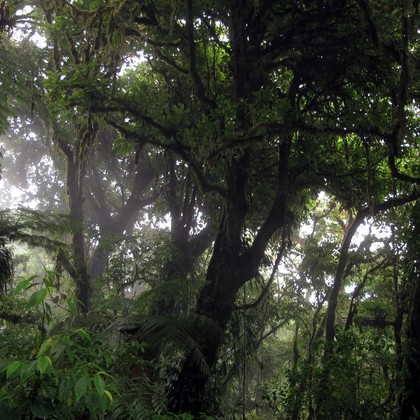
Humid foothill and lower montane forest, mainly between about 500 and 1,500 metres, and its edges. It lives in small groups in the middle levels and lower canopy and often joins mixed foraging flocks. It eats insects and small fruits.
Where the bird is most at home, classified by the vegetation units of Mexico and Central America.


Range and movements
In the guide area in western Panama, mainly on the Caribbean slope from Bocas del Toro to Veraguas and Coclé. Beyond that in the Andes of Colombia and Ecuador to Peru and Bolivia.
- Resident
- dark = core range, pale = thinly spread
How and when to look
In the foothills of western Panama mainly found in mixed foraging flocks along forest edges and roads; the yellow throat shows best when a bird is seen from the front.
Conservation status
Not threatened (LC). Widespread in the Andes; in the guide area confined to a small area of western Panama, where deforestation of the foothills is the main threat.
Scientific name
Chlorospingus flavigularis | (Sclater, 1852)
Sclater described the species in 1852 as Pipilopsis flavigularis; because it was later moved to another genus, the author and year stand in brackets. The genus Chlorospingus was introduced in 1851 by Cabanis. Chlorospingus is Greek, from khlōros 'green' and spingos 'finch', after the olive-green upperparts. flavigularis is Latin, from flavus 'yellow' and gula 'throat', after the yellow throat. The specimen the first description was based on came from Bogotá, Colombia.