All species › Swifts › Hummingbirds › Bronze-tailed Plumeleteer
Position in the tree Birds Aves › Birds with a flexible palate Neognathae › All other modern birds Neoaves › Birds of the elements Elementaves › Nightjars and swifts Strisores
Bronze-tailed Plumeleteer | Chalybura urochrysia
Bronsstaartpluimkolibrie | Colibrí patirrojo
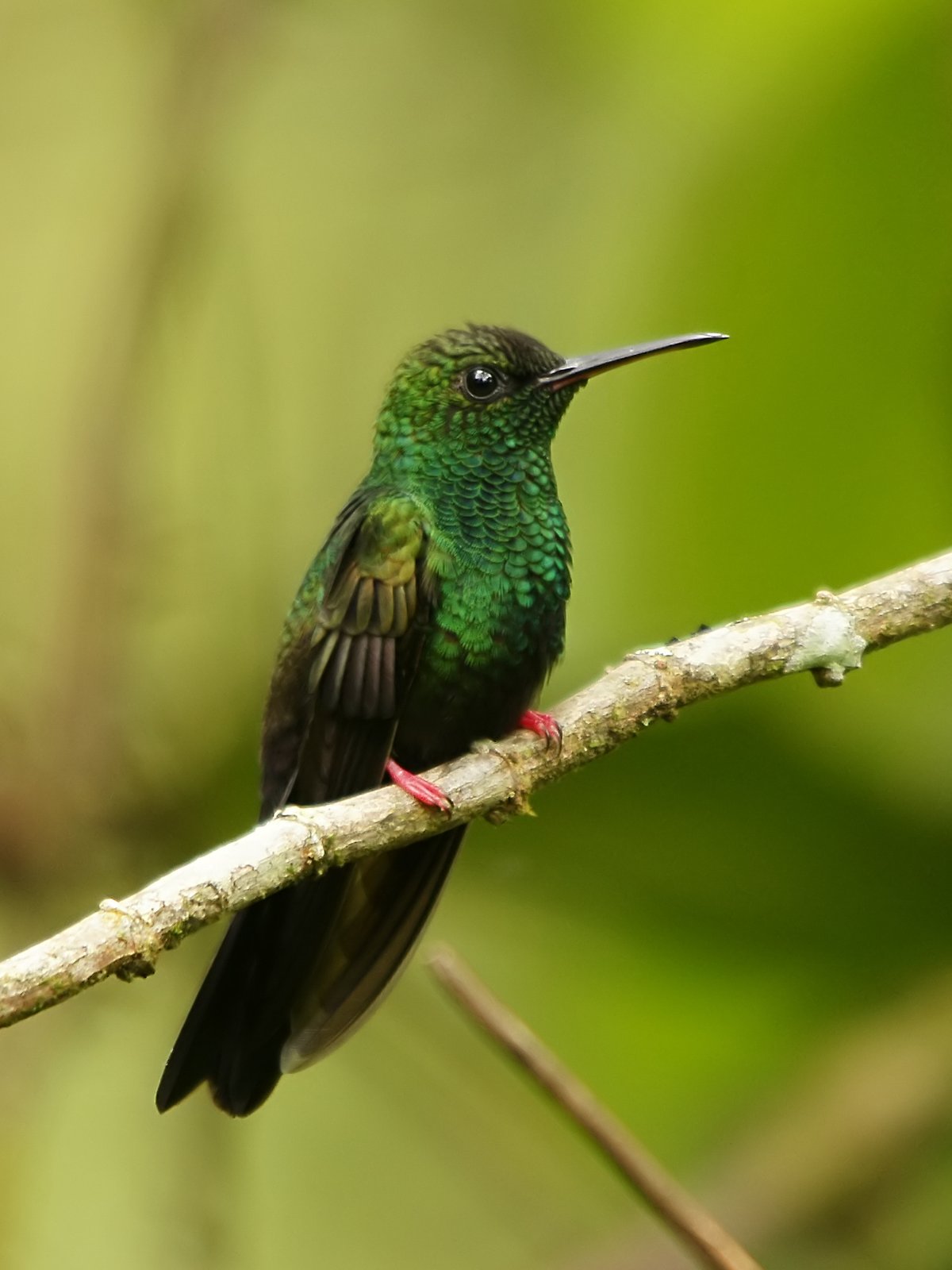
The Bronze-tailed Plumeleteer is a medium-sized, dark green hummingbird of the humid forests on the Caribbean side of Central America, from Honduras to Panama. Its pink feet and bronze tail are distinctive. It feeds mainly in the understorey and middle strata and defends flowering plants against other hummingbirds.
Voice
A sharp, repeated tsik and in chases a dry, rattling twitter.
Recording: Olaf Jahn — CC BY-NC-SA 4.0 · converted to mono · xeno-canto
Identification
11–12 cm, with a straight to slightly decurved black bill and pink to reddish feet. The male is glossy dark green, glittering blue-green on the throat and breast, with a bronze to coppery-purple tail and greyish undertail coverts with pale edges. The female is green above and grey below, with a bronze tail with grey tips to the outer feathers.
Confusion species
White-vented Plumeleteer Chalybura buffonii has a blue-black tail, long, pure white undertail coverts and dark feet. The male Crowned Woodnymph Thalurania colombica has a violet belly and a deeply forked tail. Rufous-tailed Hummingbird Amazilia tzacatl has a red bill and a rufous tail.
Habitat
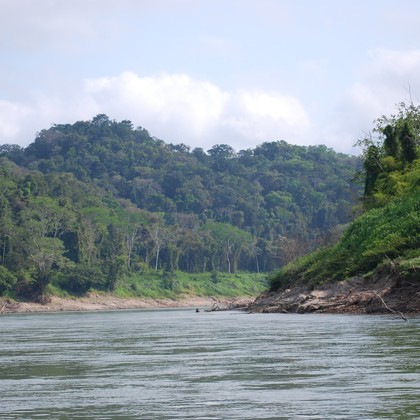
Humid lowland and foothill forest, mainly in the understorey and along edges, clearings and streams, and old secondary forest, from sea level to about 900 m. It feeds at heliconias and other understorey flowers and catches small insects.
Where the bird is most at home, classified by the vegetation units of Mexico and Central America.



Range and movements
In the guide area in the Caribbean lowlands and foothills of eastern Honduras, Nicaragua and Costa Rica, and in Panama on the Caribbean slope and in the east on both slopes to Darién. Outside the guide area in western Colombia and north-western Ecuador.
- Resident
- dark = core range, pale = thinly spread
How and when to look
In Costa Rica in the Caribbean lowlands, for example around Sarapiquí, at heliconias along forest trails and edges. Often low in the understorey, where the bronze tail shows as the bird hovers at a flower.
Conservation status
Not threatened. Fairly common in suitable forest. Clearance of lowland forest affects the species, but it also occurs in old secondary forest and along forest edges.
Scientific name
Chalybura urochrysia | (Gould, 1861)
Gould described the species in 1861 as Hypuroptila urochrysia; because it was later moved to another genus, the author and year stand in brackets. The genus Chalybura was introduced in 1854 by Reichenbach. Chalybura is Greek, from khalups, khalubos 'steel' and oura 'tail', after the steel-blue glossy tail. urochrysia is Greek, from oura 'tail' and khrusos 'gold', after the bronzy to golden tail. The specimen the first description was based on came from western Colombia.