All species › Passerines › New World blackbirds, troupials and allies › Bronzed Cowbird
Position in the tree Birds Aves › Birds with a flexible palate Neognathae › All other modern birds Neoaves › Landbirds Telluraves › Falcons, parrots and passerines Australaves › Falcons and passerines Eufalconimorphae › Parrots and passerines Psittacopasserae
Bronzed Cowbird | Molothrus aeneus
Roodoogkoevogel | Tordo ojo rojo
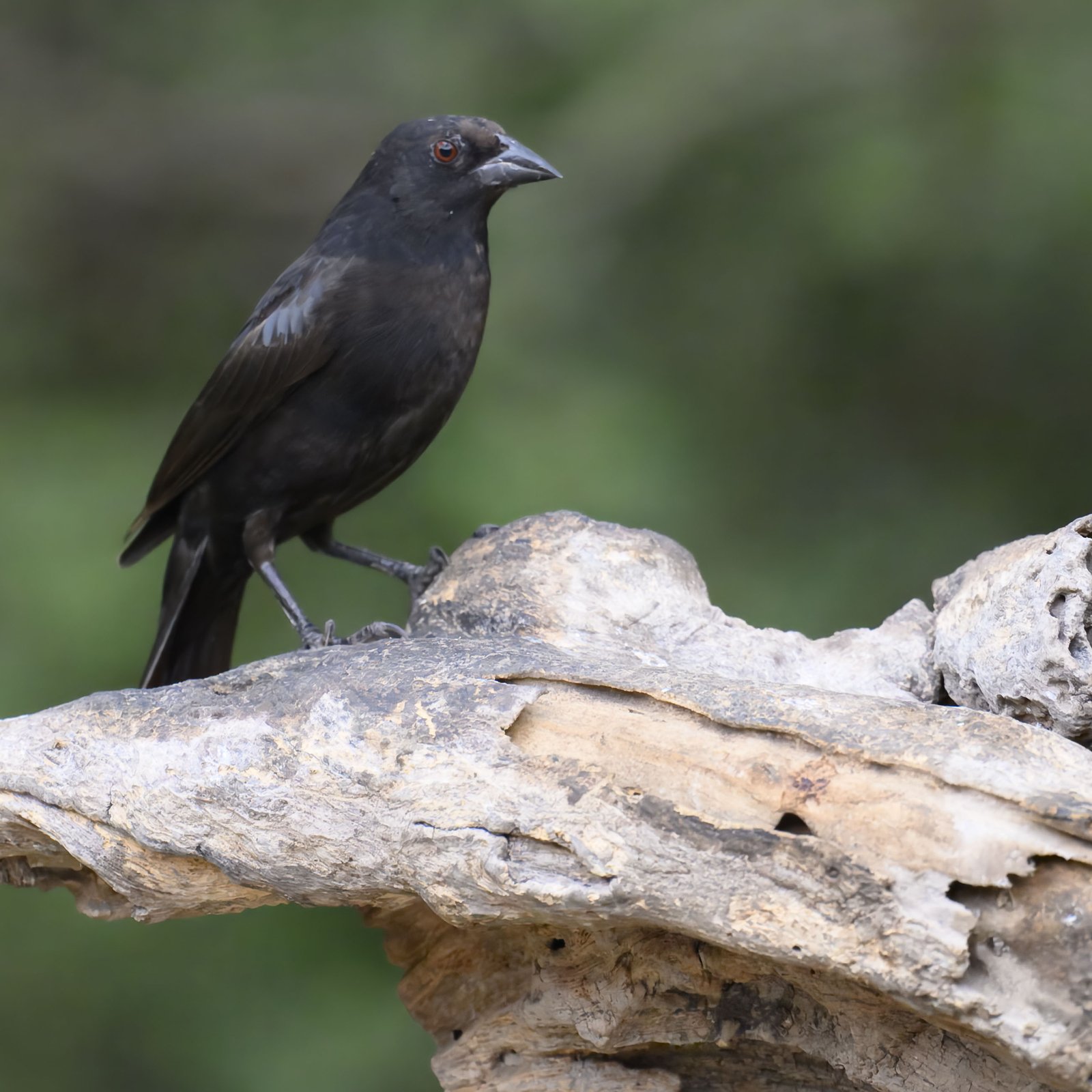
The Bronzed Cowbird is the most widespread cowbird of Mexico and Central America. Like other cowbirds it builds no nest of its own but lets other birds, often orioles, raise its young. In the breeding season the male raises a neck ruff and performs a display flight in which it seems to hover over the female.
Voice
The song is a soft, bubbling warble followed by high, thin, squealing notes, given during display. The call is a low, dry chuk or rattle.
Recording: Richard E. Webster — CC BY-NC-SA 4.0 · shortened to the first 60 s, mono · xeno-canto
Identification
18–22 cm. Male black with a bronze-green gloss on body and head and bluer wings and tail; eye bright red. Neck thick, with a ruff of elongated feathers raised in display. Bill fairly long, thick and conical. Female over most of the guide area duller blackish-brown, also with a red eye; in western Mexico females are grey-brown. Juveniles browner with a dark eye.
Confusion species
Shiny Cowbird Molothrus bonariensis is slimmer, with a dark eye, a purple-blue gloss and a finer bill. Brown-headed Cowbird Molothrus ater is smaller, the male with a brown head and a dark eye. Giant Cowbird Molothrus oryzivorus is much larger, with a small head, a long tail and a different, undulating flight.
Habitat
Open country with scattered trees: pastures, fields, villages, gardens, parks, forest edges and open dry forest; also semi-desert in northern Mexico. It forages on the ground, often in groups and with cattle or horses. It parasitises many species, with a preference for orioles Icterus.
Where the bird is most at home, classified by the vegetation units of Mexico and Central America.





Range and movements
From the south-western United States to north-western Colombia. In the guide area common over almost all of Mexico below the high mountains, in Belize, Guatemala, El Salvador, Honduras, Nicaragua and Costa Rica, and locally in western and central Panama. In northern Mexico and the southern United States part of the population moves away in winter.
- Resident
- Summer visitor (c. Apr–Sep)
- Winter visitor (c. Oct–Mar)
- Passage (Mar–Apr, Oct–Nov)
- dark = core range, pale = thinly spread
How and when to look
In the breeding season the display is best seen on lawns and pastures: the male raises its ruff and flutters or hangs just above a female. The red eye is visible even at a distance.
Conservation status
Not threatened (LC). Common and benefits from forest clearance and the spread of pastures; as a result it is reaching areas where native birds are not adapted to brood parasitism.
Scientific name
Molothrus aeneus | (Wagler, 1829)
Wagler described the species in 1829 as Ps[arocolius] aeneus; because it was later moved to another genus, the author and year stand in brackets. The genus Molothrus was introduced in 1832 by Swainson. Molothrus is Greek, from mōlos 'struggle' and thrōskō 'to impregnate', perhaps after the brood parasitism or the males' courtship contests. aeneus is Latin for 'bronze', after the bronzy gloss of the male. The specimen the first description was based on came from Laguna, Veracruz (Mexico).