All species › Passerines › Ovenbirds and woodcreepers › Brown-billed Scythebill
Position in the tree Birds Aves › Birds with a flexible palate Neognathae › All other modern birds Neoaves › Landbirds Telluraves › Falcons, parrots and passerines Australaves › Falcons and passerines Eufalconimorphae › Parrots and passerines Psittacopasserae
Brown-billed Scythebill | Campylorhamphus pusillus
Bruinsnavelmuisspecht | Picoguadaña piquipardo
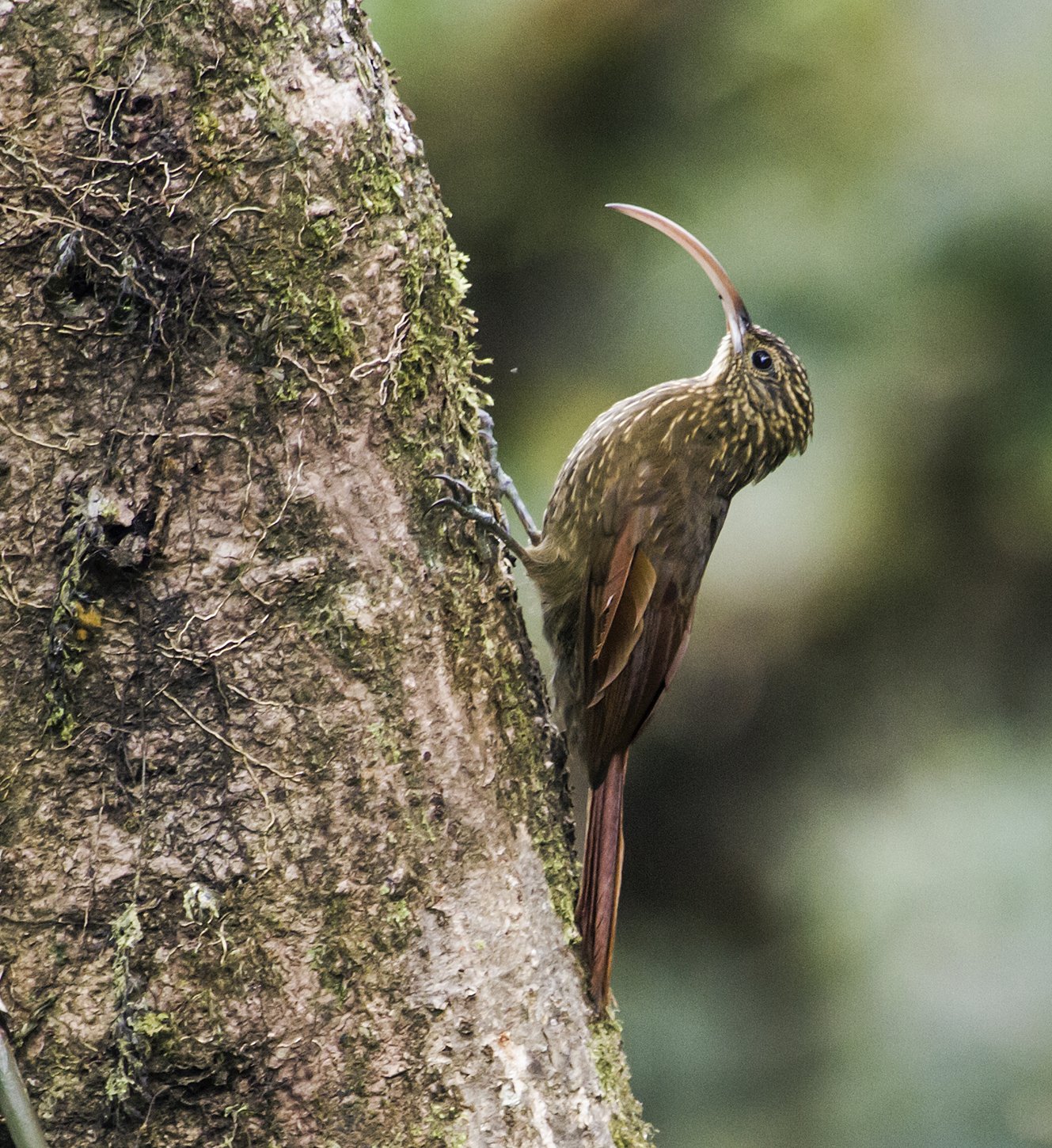
The Brown-billed Scythebill is a woodcreeper with a very long, strongly sickle-shaped, brown bill. It lives in humid forest of the foothills and lower mountains and is usually seen alone or in mixed-species flocks.
Voice
A series of clear, somewhat quavering whistles that rise and fall in pitch.
Recording: Juan Freile — CC BY-NC-SA 4.0 · converted to mono · xeno-canto
Identification
22–24 cm, a large part of which is bill. Bill long, thin and strongly decurved, brown, sometimes slightly reddish. Head, nape, mantle and underparts brown with narrow pale buff streaks; throat pale buff. Wings and tail rufous. Male and female are alike.
Confusion species
Red-billed Scythebill Campylorhamphus trochilirostris, in the guide area only in the lowlands of eastern Panama, has a redder bill. Other woodcreepers have a much shorter, less curved bill.
Habitat
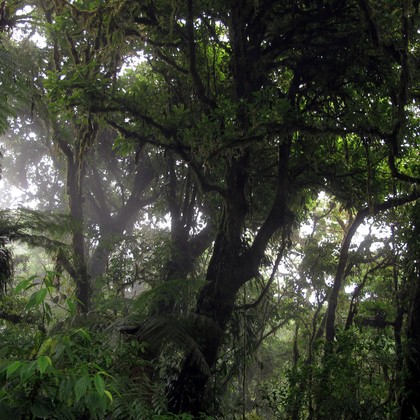
Humid forest in the foothills and lower mountains, mostly between about 600 and 2000 m, also forest edge and mature secondary forest. It probes the curved bill into bark crevices, bromeliads and moss for insects and spiders. It often joins mixed-species foraging flocks.
Where the bird is most at home, classified by the vegetation units of Mexico and Central America.



Range and movements
In the guide area in Costa Rica and Panama. Outside the guide area in the Andes and adjacent ranges from Colombia and Venezuela to Ecuador and Peru.
- Resident
- dark = core range, pale = thinly spread
How and when to look
The striking bill makes the species unmistakable once it is in view; in the montane forest of Costa Rica and Panama watch mixed flocks.
Conservation status
Not threatened. Uncommon to fairly common and often inconspicuous; dependent on forest.
Scientific name
Campylorhamphus pusillus | (Sclater, 1860)
Sclater described the species in 1860 as Xiphorhynchus pusillus; because it was later moved to another genus, the author and year stand in brackets. The genus Campylorhamphus was introduced in 1901 by Bertoni. Campylorhamphus is Greek, from kampulos 'curved' and rhamphos 'bill', after the long, strongly decurved bill. pusillus is Latin for 'very small', as it is smaller than related scythebills. The specimen the first description was based on came from Bogotá, Colombia.