All species › Passerines › Treecreepers › Brown Creeper
Position in the tree Birds Aves › Birds with a flexible palate Neognathae › All other modern birds Neoaves › Landbirds Telluraves › Falcons, parrots and passerines Australaves › Falcons and passerines Eufalconimorphae › Parrots and passerines Psittacopasserae
Brown Creeper | Certhia americana
Amerikaanse boomkruiper | Trepador americano
The Brown Creeper is a small, brown-streaked bird with a thin, decurved bill and stiff tail feathers. It climbs trunks in a spiral and then flies down to the base of the next tree. In the guide area it lives in montane forest from Mexico to Nicaragua.

Voice
The call is a very high, thin sreee. The song is a short, high series of notes that varies from region to region.
Recording: Rachel Hudson — CC BY-NC-SA 4.0 · converted to mono · xeno-canto
Identification
12–14 cm. Upperparts brown with whitish and rufous streaks and spots, rump rufous. White supercilium. Underparts white to greyish white, often darker and greyer in birds from the south of the guide area. Tail fairly long, with stiff, pointed feathers used as a prop. Bill thin and distinctly decurved.
Confusion species
Woodcreepers such as Spot-crowned Woodcreeper Lepidocolaptes affinis and Olivaceous Woodcreeper Sittasomus griseicapillus climb in the same way, but are larger and lack white streaks on the back. Nuthatches (Sitta) have a straight bill and also climb head-first downwards.
Habitat
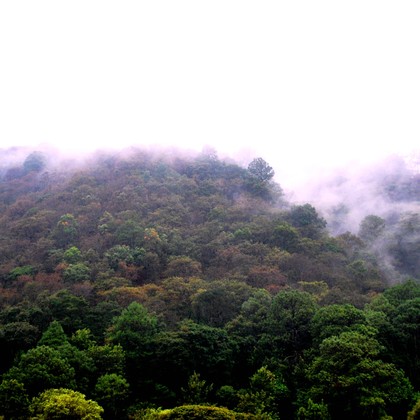
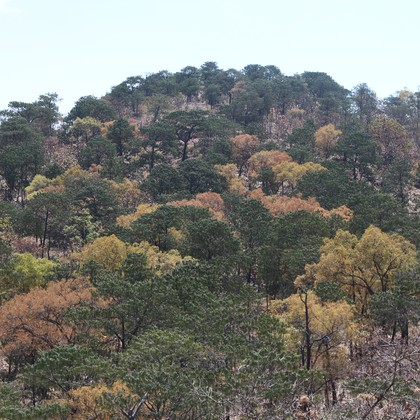
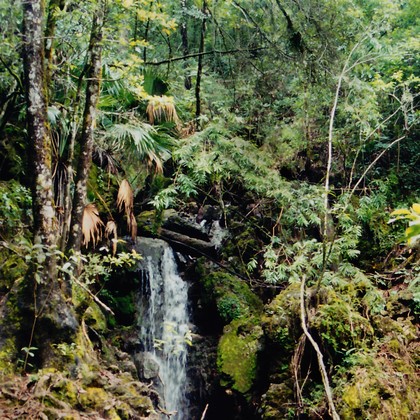
Humid, high-elevation conifer forest, pine-oak forest and cloud forest in the mountains, mostly above 1500 m. It probes bark crevices for insects and spiders. The nest is placed behind a loose flap of bark.
Where the bird is most at home, classified by the vegetation units of Mexico and Central America.

Range and movements
In the guide area in the mountains of Mexico, from the Sierra Madre Occidental and Sierra Madre Oriental through the Trans-Mexican Volcanic Belt to Oaxaca and Chiapas, and on through the highlands of Guatemala, El Salvador and Honduras to northern Nicaragua. In winter also in northern Mexico outside the mountains. Outside the guide area in Canada, Alaska and the United States.
- Resident
- Summer visitor (c. Apr–Sep)
- Winter visitor (c. Oct–Mar)
- Passage (Mar–Apr, Oct–Nov)
- dark = core range, pale = thinly spread
How and when to look
Hard to see against the bark. Look for a small brown bird climbing up from the base of a trunk, and listen for the very high call.
Conservation status
Not threatened. Widespread, but in the guide area restricted to montane forest and therefore local.
Scientific name
Certhia americana | Bonaparte, 1838
Bonaparte described the species in 1838 and placed it straight away in the genus where it still stands. The genus Certhia was introduced in 1758 by Linnaeus. Certhia is from Ancient Greek kerthios, a small tree-dwelling bird described by Aristotle and others. americana means 'American', distinguishing it from the European treecreepers. The specimen the first description was based on came from eastern and northern North America.