All species › Passerines › Nuthatches › Red-breasted Nuthatch
Position in the tree Birds Aves › Birds with a flexible palate Neognathae › All other modern birds Neoaves › Landbirds Telluraves › Falcons, parrots and passerines Australaves › Falcons and passerines Eufalconimorphae › Parrots and passerines Psittacopasserae
Red-breasted Nuthatch | Sitta canadensis
Canadese boomklever | Sita canadiense
The Red-breasted Nuthatch is a small nuthatch of conifer forest with a black eyestripe, a white supercilium and rusty underparts. It breeds in North America and reaches northern Mexico only in winter, in much larger numbers in some years than in others.

Voice
A high, nasal ink or enk, often repeated, higher and softer than the call of White-breasted Nuthatch.
Recording: Don Profota — CC BY-NC-SA 4.0 · converted to mono · xeno-canto
Identification
11–12 cm. Crown black in the male, dark grey in the female; below it a white supercilium and a broad black eyestripe. Throat white, underparts rusty, paler in the female. Back blue-grey, tail short. Bill fairly long and pointed.
Confusion species
White-breasted Nuthatch Sitta carolinensis is larger, with a white face lacking a black eyestripe and white underparts. Pygmy Nuthatch Sitta pygmaea has a greyish-brown cap without a white supercilium and buffy underparts.
Habitat
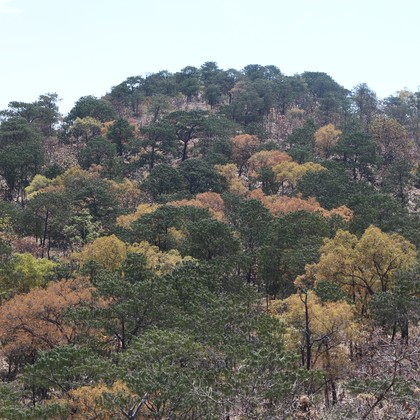
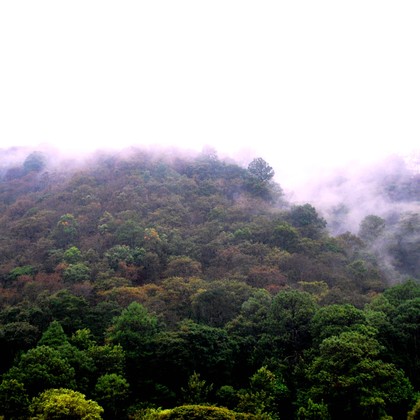
In winter mainly in conifer forest and montane pine-oak forest, sometimes also in parks and gardens with conifers. It searches trunks, branches and cones for insects and seeds.
Where the bird is most at home, classified by the vegetation units of Mexico and Central America.

Range and movements
Breeds in the conifer forests of Canada, Alaska and the northern and western United States. Moves south in winter; in the guide area mainly in north-western Mexico, such as Baja California, Sonora and Chihuahua, and rare further south.
- Resident
- Summer visitor (c. Apr–Sep)
- Winter visitor (c. Oct–Mar)
- Passage (Mar–Apr, Oct–Nov)
- dark = core range, pale = thinly spread
How and when to look
Most likely in winters when many northern birds move south. Search conifer forest in the mountains of north-western Mexico and listen for the nasal call.
Conservation status
Not threatened. Widespread and common in North America; an irregular winter visitor to the guide area.
Scientific name
Sitta canadensis | Linnaeus, 1766
Linnaeus described the species in 1766 and placed it straight away in the genus where it still stands. The genus Sitta was introduced in 1758 by Linnaeus. Sitta is the Ancient Greek name sittē for the nuthatch. canadensis means 'of Canada', after the origin of the type material. The specimen the first description was based on came from Canada.