All species › Passerines › Crows, jays and magpies › Brown Jay
Position in the tree Birds Aves › Birds with a flexible palate Neognathae › All other modern birds Neoaves › Landbirds Telluraves › Falcons, parrots and passerines Australaves › Falcons and passerines Eufalconimorphae › Parrots and passerines Psittacopasserae
Brown Jay | Cyanocorax morio
Bruine gaai | Chara pea
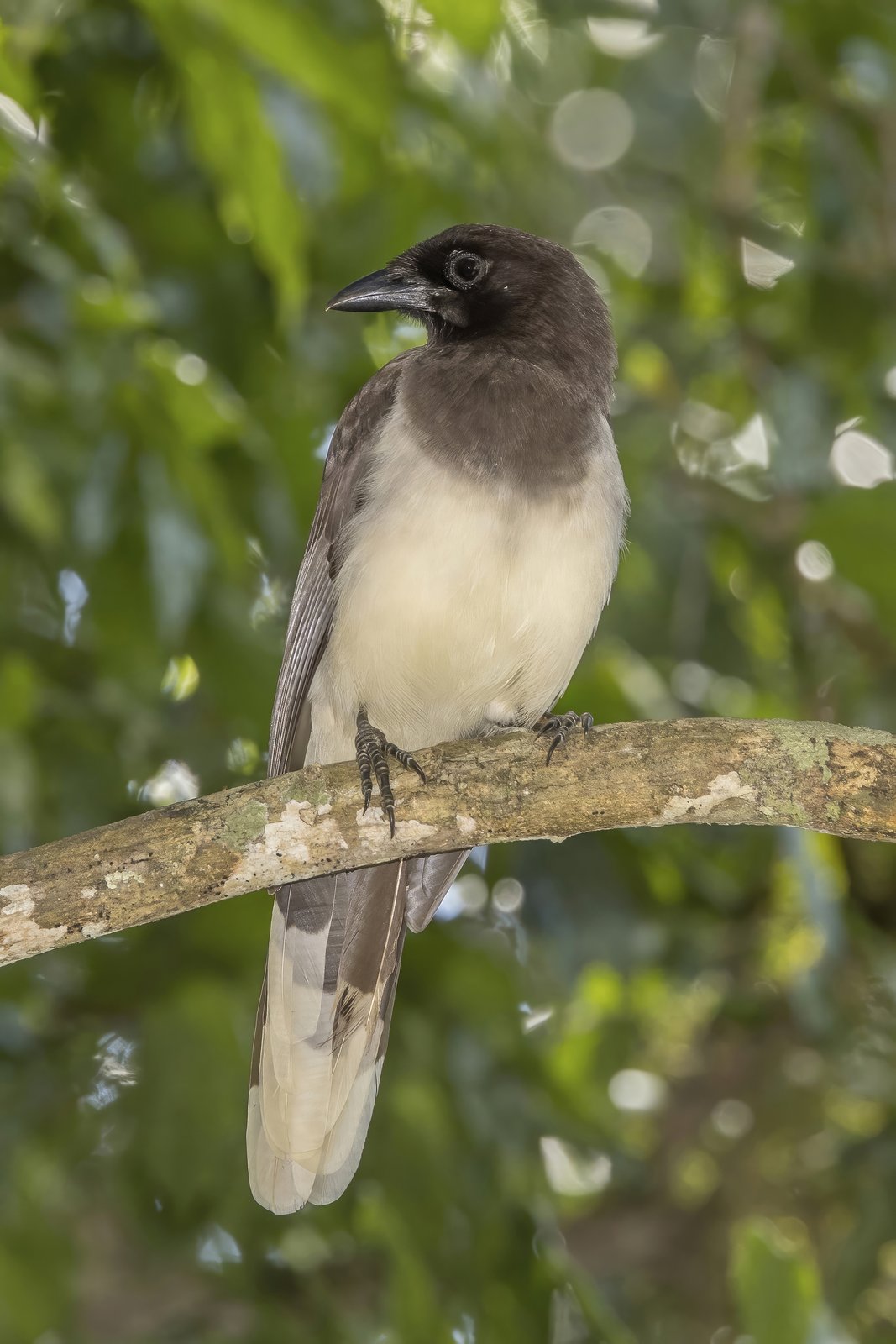
The Brown Jay is a large, noisy, long-tailed jay that moves in groups through forest edges, plantations and villages. It is one of the best-known birds of the lowlands on the Caribbean side of Central America. In the guide area it lives from north-eastern Mexico to western Panama.
Voice
A loud, shrill pyaah or chaah, often given by several birds at once as the group raises the alarm. It is often accompanied by a short, dry popping sound produced in an air sac in the chest, easily heard at close range.
Recording: Richard E. Webster — CC BY-NC-SA 4.0 · shortened to the first 60 s, mono · xeno-canto
Identification
38–44 cm, almost half of it tail. Head, breast and upperparts dark sooty brown, belly paler. Birds in north-eastern Mexico are almost entirely brown; further south they have a white belly and broad white tips to the outer tail feathers, with intermediate birds in between. Adults have a black bill; young birds have a yellow bill and yellow eye-ring that gradually turn black, so many birds show a mottled bill. Male and female are alike.
Confusion species
No other jay in the guide area is as large and brown. Plain Chachalaca Ortalis vetula is of similar size and colour and lives in the same habitat, but is a gamebird with a small head, bare throat and a very different call. Common Squirrel Cuckoo Piaya cayana is rufous with a grey belly and a long black-and-white patterned tail.
Habitat
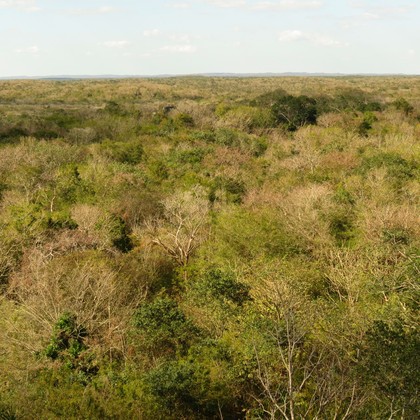
Forest edges, secondary forest, clearings and semi-open country with trees, plantations, pasture with trees and villages, mainly in the lowlands and lower mountains; locally higher in cleared areas. It avoids the interior of closed forest. It eats insects, small vertebrates, eggs, fruit and nectar. It often breeds cooperatively, with other group members helping to feed the young.
Where the bird is most at home, classified by the vegetation units of Mexico and Central America.





Range and movements
On the Atlantic slope of Mexico from Nuevo León and Tamaulipas across the Yucatán Peninsula and through Belize, Guatemala, Honduras and Nicaragua to Costa Rica and western Panama; in Costa Rica and Nicaragua also on the Pacific slope. Outside the guide area formerly in small numbers along the Rio Grande in extreme southern Texas, where it is now very rare or gone.
- Resident
- dark = core range, pale = thinly spread
How and when to look
Common and easy to see at Tikal in Guatemala and at La Selva in Costa Rica. Groups give themselves away with their loud alarm calls.
Conservation status
Not threatened. Common and benefits from deforestation and the creation of pasture and plantations.
Scientific name
Cyanocorax morio | (Wagler, 1829) (GBIF: Psilorhinus morio)
Wagler described the species in 1829 as Pica morio; because it was later moved to another genus, the author and year stand in brackets. The genus Cyanocorax was introduced in 1826 by Boie. Cyanocorax is Greek, from kuanos 'dark blue' and korax 'raven': a 'blue raven', after the blue colours of many species. morio is Latin for 'fool, jester', in later Latin also 'Moor, dark man'; probably after the dark brown plumage, but Wagler's intention is uncertain. The specimen the first description was based on came from Alvarado, Veracruz, Mexico.