All species › Passerines › Crows, jays and magpies › Green Jay
Position in the tree Birds Aves › Birds with a flexible palate Neognathae › All other modern birds Neoaves › Landbirds Telluraves › Falcons, parrots and passerines Australaves › Falcons and passerines Eufalconimorphae › Parrots and passerines Psittacopasserae
Green Jay | Cyanocorax yncas
Incagaai | Chara verde
The Green Jay is a medium-sized green-and-yellow jay with a blue head and black throat that moves through scrub and forest edges in noisy small groups. Despite its bright colours it is often inconspicuous in foliage. In the guide area it lives in Mexico, Belize, Guatemala and Honduras.

Voice
Very varied. A rapid, rasping chet-chet-chet, dry rattles, a metallic, ringing cling and a range of nasal and squeaky notes; groups are very noisy.
Recording: Juan Freile — CC BY-NC-SA 4.0 · converted to mono · xeno-canto
Identification
25–29 cm, with a fairly long tail. Upperparts bright green, underparts yellow to greenish yellow. Crown and nape blue, often paler blue to whitish at the front of the head; a blue patch above and below the eye. Throat, bib and sides of the head black. Central tail feathers green, outer tail feathers yellow, conspicuous especially in flight. Bill and legs dark; iris dark in birds of Mexico and Central America. Male and female are alike.
Confusion species
No other jay in the guide area is green and yellow. The combination of black throat, blue head and yellow outer tail feathers is distinctive. Green parrots and parakeets have a short, hooked bill and a different flight.
Habitat
Forest edges, thickets, secondary forest and open parts of humid and dry forest, riparian woodland, thorn scrub and gardens, from the coast into the lower mountains. It eats insects and other invertebrates, small vertebrates, eggs, seeds, acorns and fruit, and visits feeders. It lives in family groups year-round.
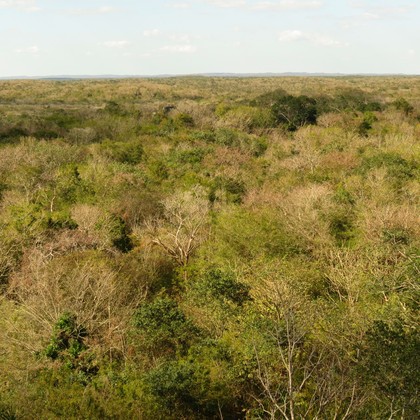
Where the bird is most at home, classified by the vegetation units of Mexico and Central America.






Range and movements
In Mexico on the Atlantic slope from Nuevo León and Tamaulipas and on the Pacific slope from Nayarit, south to Chiapas and across the Yucatán Peninsula; also in Belize, northern Guatemala and Honduras. Outside the guide area in extreme southern Texas and, in a separate range, in the Andes from Venezuela to Bolivia. Those South American birds have a yellow iris and are treated as a separate species in some classifications; the range map may then show both together.
- Resident
- dark = core range, pale = thinly spread
How and when to look
Often seen at feeders of lodges and nature reserves in eastern Mexico and on the Yucatán Peninsula. Groups are usually heard first.
Conservation status
Not threatened. Common and adapts well to secondary forest and settlements with trees.
Scientific name
Cyanocorax yncas | (Boddaert, 1783)
Boddaert described the species in 1783 as Corvus yncas; because it was later moved to another genus, the author and year stand in brackets. The genus Cyanocorax was introduced in 1826 by Boie. Cyanocorax is Greek, from kuanos 'dark blue' and korax 'raven': a 'blue raven', after the blue colours of many species. yncas refers to the Incas, after the original source area, Peru. The specimen the first description was based on came from Chilpes, Junín, Peru.