All species › New World vultures › New World vultures › California Condor
Position in the tree Birds Aves › Birds with a flexible palate Neognathae › All other modern birds Neoaves › Landbirds Telluraves › Raptors, owls, kingfishers and woodpeckers Afroaves › Hawks and owls Hieraves
California Condor | Gymnogyps californianus
Californische condor | Cóndor californiano
The California Condor is the largest land bird in North America and one of the rarest birds in the world. In 1987 the last wild birds were captured for a breeding programme; since 1992 birds have been released again, first in California, later in Arizona and since 2002 also in the Sierra San Pedro Mártir in Baja California. In the guide area it lives only in northern Baja California, where it has been brought back after an absence of more than sixty years.
Voice
Lacks a syrinx; almost silent. Hisses and grunts at carcasses and at the nest.
Recording: bukva14 — CC BY-NC 4.0 · Converted to mp3, mono, shortened to 60 s · iNaturalist
Identification
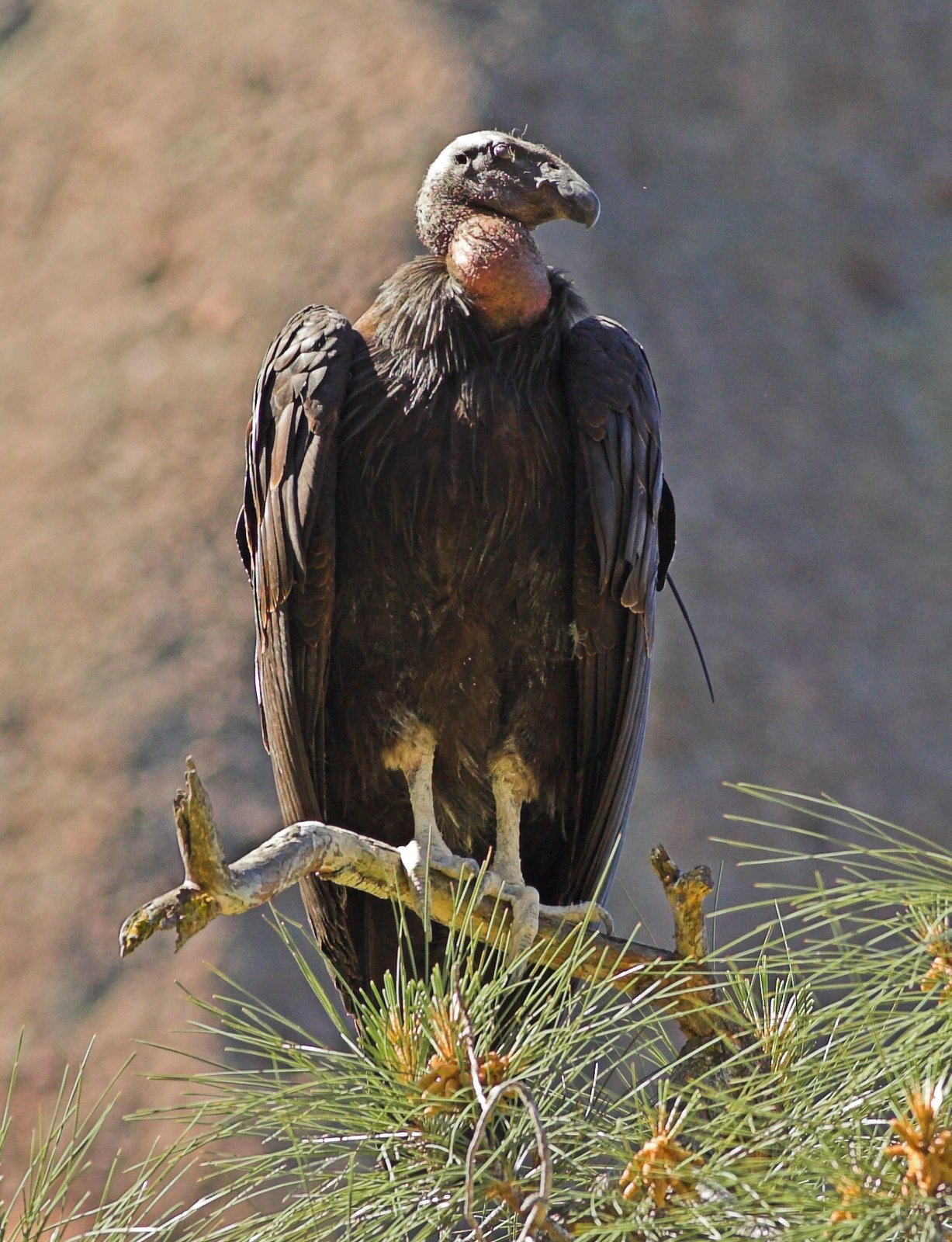
117–134 cm, with a wingspan of almost 3 metres. The plumage is black; adults show a broad white triangle on the underwing coverts below and a narrow white wing bar above. The head and neck are bare, orange-red to pink in adults, with a ruff of black feathers at the base of the neck. Juveniles have a dark grey head and mottled, greyish underwing coverts; adult plumage is reached only after six to eight years. Soars on flat, broad wings with widely spread primaries and rarely flaps. Almost all released birds carry numbered wing tags.
Confusion species
The Turkey Vulture Cathartes aura is much smaller, holds its wings in a V, has silvery grey flight feathers instead of white underwing coverts and a small red head. The Golden Eagle Aquila chrysaetos has a feathered head, is smaller and, as a juvenile, has white patches at the base of the primaries and a white tail base, not on the underwing coverts. The Black Vulture Coragyps atratus, at most a vagrant in northern Baja California, is much smaller and has white patches only at the wingtip.
Habitat
Mountains with cliffs and rock faces, conifer forest on the high plateau, chaparral and open, hilly country with cattle and deer. Nests in a cavity or on a ledge in a cliff and lays a single egg, usually every other year. Searches mainly by sight for carcasses of large mammals, often covering more than a hundred kilometres a day.
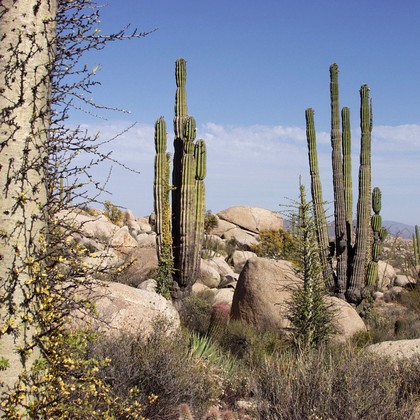
Where the bird is most at home, classified by the vegetation units of Mexico and Central America.



Range and movements
In the guide area only in northern Baja California, centred on the Sierra San Pedro Mártir, where birds have been released since 2002 and young have been raised in the wild since 2007. Birds wander over the Sierra Juárez and the surrounding plateaus and descend towards the Pacific coast. Formerly the species occurred in northern Baja California until the 1930s. Outside the guide area it lives in the coastal ranges and mountains of southern and central California, in northern Arizona and southern Utah, and recently also in northern California.
- Resident
- dark = core range, pale = thinly spread
How and when to look
The best site is Parque Nacional Sierra de San Pedro Mártir, especially around the viewpoints near the astronomical observatory and on the high plateau. Birds usually leave their roost on the cliffs only in the course of the morning, once thermals develop. The wing tags make it possible to recognise individual birds.
Conservation status
Critically Endangered. The world population numbers a few hundred birds, part of them in captivity; in Baja California a few dozen. The main threat is lead poisoning from bullet fragments in carcasses and gut piles; in addition, chicks swallow litter such as pieces of plastic and glass. The species' survival depends on continued releases, supplementary feeding and the capture and treatment of poisoned birds.
Scientific name
Gymnogyps californianus | (Shaw, 1797)
Shaw described the species in 1797 as Vultur californianus; because it was later moved to another genus, the author and year stand in brackets. The genus Gymnogyps was introduced in 1842 by Lesson. Gymnogyps is Greek, from gumnos 'naked' and gups 'vulture', after the bare head. californianus is Latin for 'of California', after the type locality. The specimen the first description was based on came from the coast of California.