All species › Passerines › Shrike-babblers, Erpornis and vireos › Cassin's Vireo
Position in the tree Birds Aves › Birds with a flexible palate Neognathae › All other modern birds Neoaves › Landbirds Telluraves › Falcons, parrots and passerines Australaves › Falcons and passerines Eufalconimorphae › Parrots and passerines Psittacopasserae
Cassin's Vireo | Vireo cassinii
Cassins vireo | Vireo de Cassin
Cassin's Vireo is a greyish vireo with white spectacles, the western counterpart of Blue-headed Vireo. It breeds in western North America, including the mountains of northern Baja California, and winters mainly in western Mexico.

Voice
The song is a series of short, somewhat hoarse phrases with pauses in between, harsher than that of Blue-headed Vireo. The call is a harsh chatter.
Recording: Scott Olmstead — CC BY-NC-SA 4.0 · converted to mono · xeno-canto
Identification
13–14 cm. Head grey, merging gradually into the dull olive-green back. White lores and eye-ring form white spectacles. Throat dingy whitish, flanks faintly yellowish olive. Two whitish wing bars. Young birds and females are often even duller.
Confusion species
Blue-headed Vireo Vireo solitarius has a bluer-grey head sharply set off from a greener back, a pure white throat and yellower flanks. Plumbeous Vireo Vireo plumbeus is grey without green or yellow tones. Hutton's Vireo Vireo huttoni is smaller, with a broken eye-ring.
Habitat
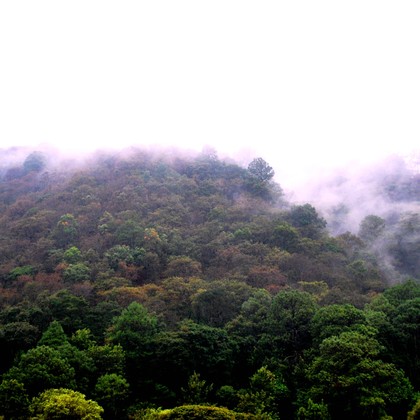
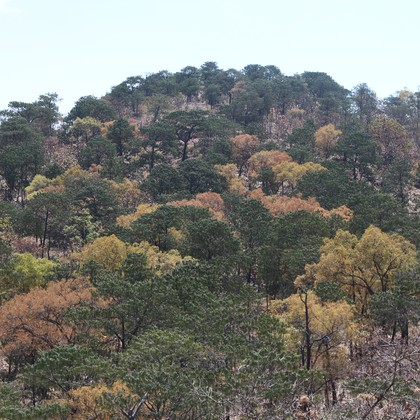
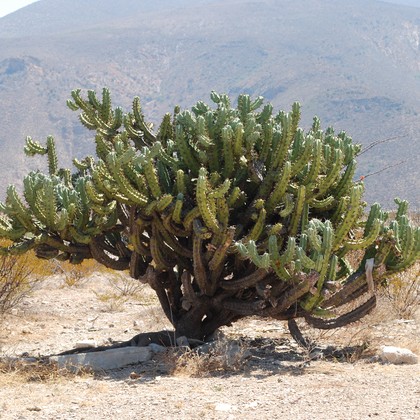
Breeds in open conifer and oak forest in the mountains. In winter and on migration in oak and pine-oak woodland, dry forest, thorn scrub and riparian woodland, from the lowlands into the mountains. It forages deliberately among the foliage for insects, often in mixed flocks.
Where the bird is most at home, classified by the vegetation units of Mexico and Central America.



Range and movements
In the guide area it breeds in the mountains of northern Baja California. Winters mainly in western Mexico, from Sonora and southern Baja California south to about Oaxaca, in small numbers further south to Guatemala. Breeds outside the guide area in the western United States and Canada.
- Resident
- Summer visitor (c. Apr–Sep)
- Winter visitor (c. Oct–Mar)
- Passage (Mar–Apr, Oct–Nov)
- dark = core range, pale = thinly spread
How and when to look
In winter most likely in mixed flocks in dry forest and oak woodland on the Pacific slope of Mexico.
Conservation status
Not threatened. A fairly common winter visitor in western Mexico.
Scientific name
Vireo cassinii | Xántus, 1858
Xántus described the species in 1858 and placed it straight away in the genus where it still stands. The genus Vireo was introduced in 1808 by Vieillot. Vireo was used by Latin authors for a small, green, migratory bird, probably the Eurasian golden oriole, though the European greenfinch has also been suggested. cassinii honours the American ornithologist John Cassin (1813–1869) of the Academy of Natural Sciences of Philadelphia. The specimen the first description was based on came from Fort Tejon, California (USA).