All species › Passerines › Swallows › Cave Swallow
Position in the tree Birds Aves › Birds with a flexible palate Neognathae › All other modern birds Neoaves › Landbirds Telluraves › Falcons, parrots and passerines Australaves › Falcons and passerines Eufalconimorphae › Parrots and passerines Psittacopasserae
Cave Swallow | Petrochelidon fulva
Holenzwaluw | Golondrina pueblera
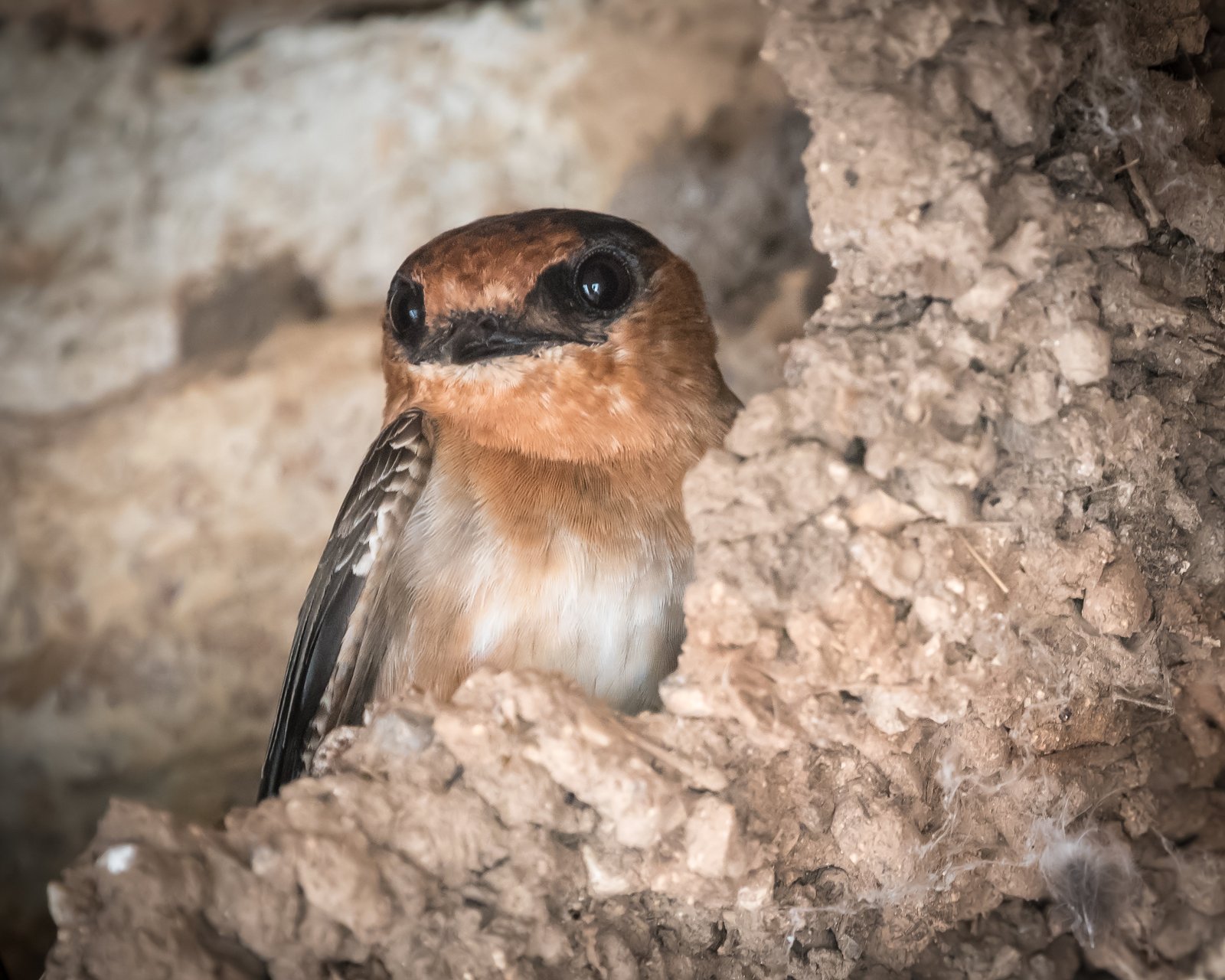
The Cave Swallow closely resembles the American Cliff Swallow but has a pale buff throat and a dark chestnut forehead. It breeds in caves, sinkholes and cenotes, and now also under bridges, in culverts and on buildings. In the guide area it lives mainly on the Yucatán Peninsula and in north-eastern Mexico.
Voice
A clear, rising chew and a short chep; the song is a series of squeaky and grating notes, higher than that of American Cliff Swallow.
Recording: Andrew Spencer — CC BY-NC-SA 3.0 · shortened to the first 60 s, mono · xeno-canto
Identification
12–14 cm, with a short, square tail. Crown and back dark blue, the back with pale streaks; rump rusty to orange-buff. Forehead dark chestnut; throat, cheeks and sides of the neck pale buff to creamy, without a dark throat patch. Breast and flanks pale orange-buff, belly whitish. Sexes alike; young birds are duller.
Confusion species
American Cliff Swallow Petrochelidon pyrrhonota has a dark chestnut throat with a blackish patch and usually a pale forehead; breeders of that species in southern and western Mexico also have a cinnamon forehead, but still the dark throat. Barn Swallow Hirundo rustica has a deeply forked tail and no pale rump.
Habitat
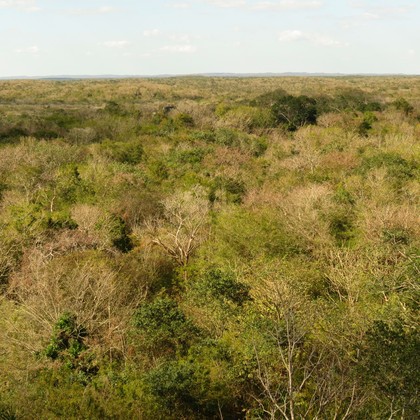
Open and semi-open country with caves, sinkholes or suitable structures: dry seasonal forest, scrub, fields, pastures, villages and towns. It hunts flying insects in the air. It builds an open, cup-shaped mud nest against the ceiling or wall of caves, cenotes, culverts, bridges and buildings, often in colonies.
Where the bird is most at home, classified by the vegetation units of Mexico and Central America.




Range and movements
Yucatán Peninsula and adjacent areas of south-eastern Mexico, and in north-eastern Mexico from Coahuila, Nuevo León and Tamaulipas to the Texas border. Rare elsewhere in Mexico and Central America. Outside the guide area in the southern United States and the Greater Antilles.
- Resident
- Summer visitor (c. Apr–Sep)
- Winter visitor (c. Oct–Mar)
- Passage (Mar–Apr, Oct–Nov)
- dark = core range, pale = thinly spread
How and when to look
On the Yucatán Peninsula often seen at cenotes and caves, where birds fly in and out of the entrance. In north-eastern Mexico it breeds under bridges and in roadside culverts.
Conservation status
Not threatened. It has expanded its range in the north by using bridges and culverts as nest sites.
Scientific name
Petrochelidon fulva | (Vieillot, 1808)
Vieillot described the species in 1808 as Hirundo fulva; because it was later moved to another genus, the author and year stand in brackets. The genus Petrochelidon was introduced in 1851 by Cabanis. Petrochelidon comes from the Greek petros, 'rock', and khelidōn, 'swallow' — for the cliff swallows' habit of building their mud nests against rock faces. fulva is Latin for 'tawny', after the warm buff throat and rump. The specimen the first description was based on came from Santo Domingo (Hispaniola).