All species › Passerines › Swallows › Southern Martin
Position in the tree Birds Aves › Birds with a flexible palate Neognathae › All other modern birds Neoaves › Landbirds Telluraves › Falcons, parrots and passerines Australaves › Falcons and passerines Eufalconimorphae › Parrots and passerines Psittacopasserae
Southern Martin | Progne elegans
Patagonische purperzwaluw | Golondrina sureña
The Southern Martin breeds in southern South America and moves north in the austral winter. In the guide area it is a very rare vagrant. Males are hardly separable in the field from those of Purple Martin, so records require good documentation.
Voice
Calls are a low, throaty twittering, similar to that of other martins.
Recording: Bernabe Lopez-Lanus — CC BY-NC-SA 4.0 · converted to mono · xeno-canto
Identification
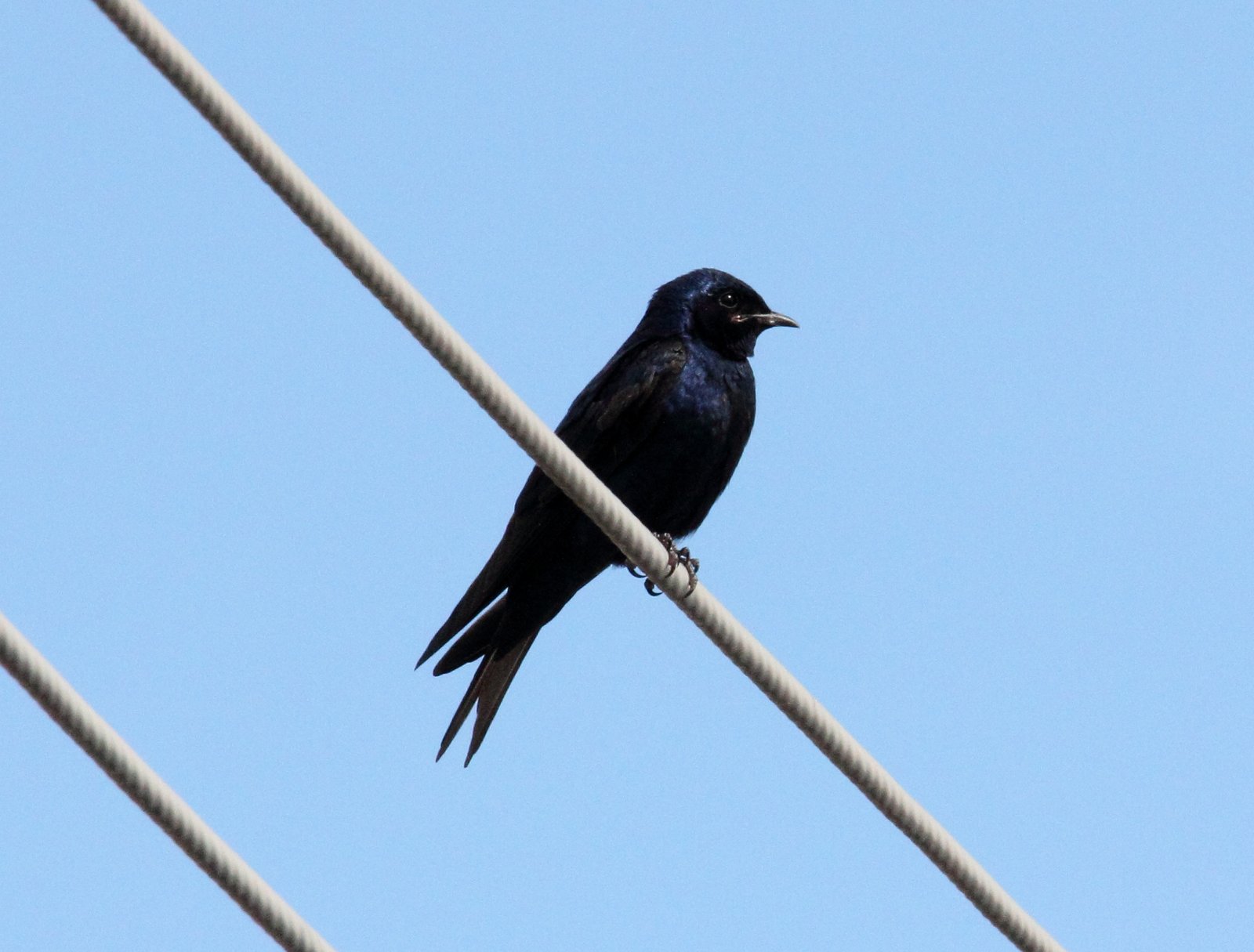
17–20 cm, with long, broad wings and a deeply forked tail. The male is entirely glossy blue-black. The female has dark, slightly glossy upperparts and dark grey-brown underparts with pale feather edges that give the belly a scaly look; she lacks a pale collar on the nape.
Confusion species
Male Purple Martin Progne subis is practically identical in the field; the female of that species has a paler throat, a grey band on the nape and a paler, often whitish belly. Grey-breasted Martin Progne chalybea has a white belly in both sexes. Male Sinaloa Martin Progne sinaloae has a white belly.
Habitat
Outside the breeding range over open country, rivers, lakes and villages, often with other martins. It hunts larger flying insects in the air.
Where the bird is most at home, classified by the vegetation units of Mexico and Central America.




Range and movements
Breeds in Argentina and southern Bolivia and moves north in the austral winter to the Amazon basin. In the guide area only as a vagrant; the few reports come almost entirely from Panama.
How and when to look
Flocks of martins over open country in Panama outside the Purple Martin season deserve a second look; females with entirely dark, scaly underparts stand out most.
Conservation status
Not threatened. An exceptional visitor in the guide area; reports are best documented with photographs.
Scientific name
Progne elegans | Baird, 1865
Baird described the species in 1865 and placed it straight away in the genus where it still stands. The genus Progne was introduced in 1826 by Boie. Progne (also Procne) is the daughter of King Pandion of Athens in Greek myth, who was turned into a swallow; in Latin also a word for 'swallow'. elegans is Latin for 'elegant, fine'. The specimen the first description was based on came from Río Bermejo, Argentina.