All species › Passerines › Waxwings › Cedar Waxwing
Position in the tree Birds Aves › Birds with a flexible palate Neognathae › All other modern birds Neoaves › Landbirds Telluraves › Falcons, parrots and passerines Australaves › Falcons and passerines Eufalconimorphae › Parrots and passerines Psittacopasserae
Cedar Waxwing | Bombycilla cedrorum
Cederpestvogel | Ampelis chinito
The Cedar Waxwing is a brown-grey bird with a crest, a black mask and a yellow tail tip that wanders in flocks in search of berries and fruit. It breeds in North America and is a winter visitor to the guide area. The number reaching the guide area varies greatly from year to year.

Voice
Very high, thin, hissing sreee notes, given constantly within a flock. There is no true song.
Recording: Rory Nefdt — CC BY-NC-SA 4.0 · converted to mono · xeno-canto
Identification
14–17 cm. Head, breast and back warm grey-brown, with a pointed crest often held half flat. Black mask through the eye, narrowly edged white above. Belly pale yellow, undertail coverts white. Wings and rump grey; adults have small red, waxy tips on the secondaries. Tail grey with a bright yellow terminal band. Juveniles greyer, with streaks on the breast and flanks.
Confusion species
Grey Silky-flycatcher Ptiliogonys cinereus also has a crest but is blue-grey or grey without a black mask, and has a longer tail with a white band and yellow undertail coverts. Other waxwings do not occur regularly in the guide area.
Habitat
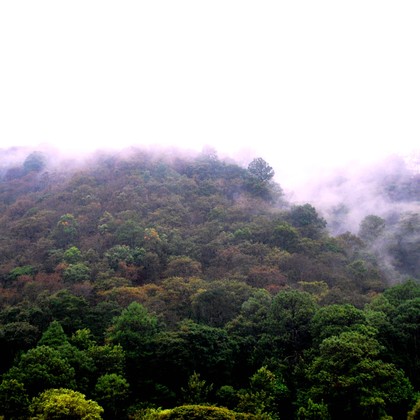
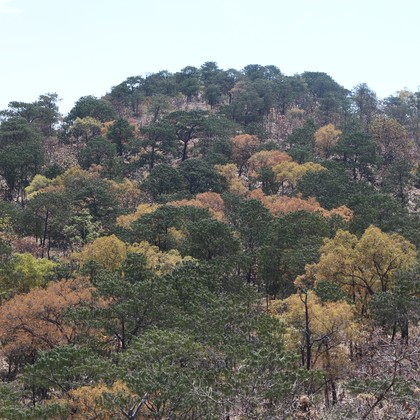
Wherever berries and fruit are found: forest edges and open woodland in the highlands, secondary forest, orchards, pasture with trees, parks and gardens in towns and villages. In winter it eats mainly fruit and berries; in warm weather it also catches insects in flight.
Where the bird is most at home, classified by the vegetation units of Mexico and Central America.



Range and movements
In the guide area in winter over much of Mexico, with most birds in the north and in the highlands, and south through Guatemala, Belize, El Salvador and Honduras to Nicaragua and Costa Rica; in Panama irregular and scarce. Breeds outside the guide area in Canada and the northern and central United States.
- Winter visitor (c. Oct–Mar)
- dark = core range, pale = thinly spread
How and when to look
Flocks often perch upright close together at the top of a bare tree next to a fruiting tree. The high calls are usually heard before the birds are seen.
Conservation status
Not threatened. Common in North America; in the guide area a winter visitor whose numbers vary strongly between years.
Scientific name
Bombycilla cedrorum | Vieillot, 1808
Vieillot described the species in 1808 and placed it straight away in the genus where it still stands. He introduced the genus Bombycilla in that same work. Bombycilla is Vieillot's coined Latin for 'silktail', a rendering of the German Seidenschwanz, from bombyx 'silk' and -cilla, which he mistakenly took to mean 'tail'. cedrorum is Latin for 'of the cedars', after the berries of eastern red cedar that the bird readily eats. The specimen the first description was based on came from eastern North America.