All species › Passerines › New World sparrows › Chestnut-capped Brushfinch
Position in the tree Birds Aves › Birds with a flexible palate Neognathae › All other modern birds Neoaves › Landbirds Telluraves › Falcons, parrots and passerines Australaves › Falcons and passerines Eufalconimorphae › Parrots and passerines Psittacopasserae
Chestnut-capped Brushfinch | Arremon brunneinucha
Bruinkapstruikgors | Atlapetes gorra castaña
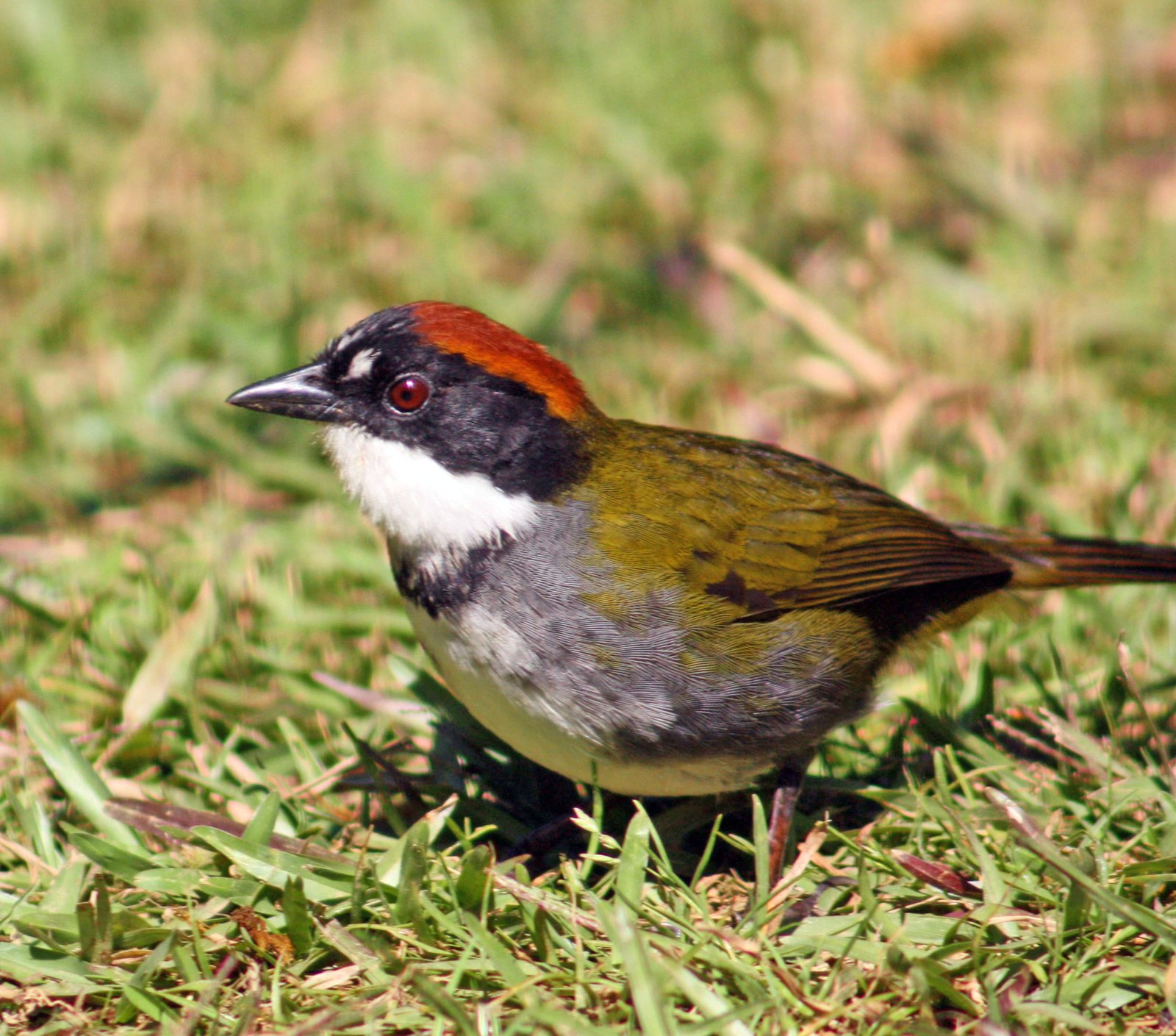
The Chestnut-capped Brushfinch is a large Arremon brushfinch of the undergrowth of montane forest, with a chestnut cap and a puffed-out white throat. It lives on the forest floor and turns over the leaf litter. In the guide area it occurs in the mountains from central Mexico to Panama.
Voice
Very high, thin and sibilant notes such as tseet; the song is a short series of high, faint whistles, often at dawn and dusk.
Recording: Scott Olmstead — CC BY-NC-SA 4.0 · converted to mono · xeno-canto
Identification
18–20 cm. Crown and nape chestnut, narrowly edged golden-yellow at the sides. Forehead and face black, with small white spots on the forehead. Throat white and often puffed out, with a narrow black breast band below it. Upperparts dark olive-green. Flanks grey to olive-grey, centre of the belly white. Bill black. The sexes are alike; juveniles are duller, with a brown head and a yellowish throat without a breast band.
Confusion species
Green-striped Brushfinch Arremon virenticeps has a black head with olive-green stripes and no breast band. Costa Rican Brushfinch Arremon costaricensis has a black head with a grey central crown stripe and grey supercilium. Orange-billed Sparrow Arremon aurantiirostris is smaller and has an orange bill. Large-footed Finch Pezopetes capitalis in the high mountains of Costa Rica and western Panama is larger and greyer, without a white throat.
Habitat
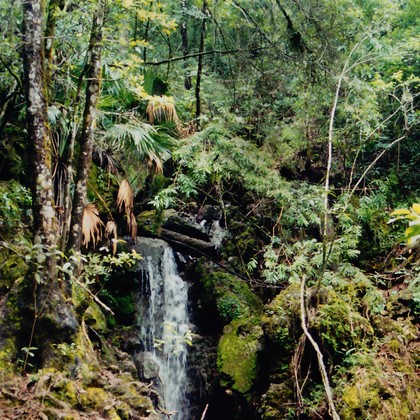
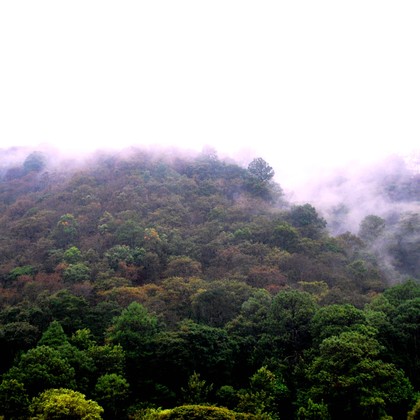
Undergrowth of humid montane forest and cloud forest, also pine-oak forest, mature secondary forest and shady ravines, mostly between about 900 and 2500 m, locally lower or higher. It searches the ground for insects and seeds by scratching backwards in the leaf litter with both feet at once.
Where the bird is most at home, classified by the vegetation units of Mexico and Central America.


Range and movements
In the guide area in the mountains of Mexico, from San Luis Potosí and Guerrero southwards through Veracruz, Oaxaca and Chiapas, and on through the highlands of Guatemala, El Salvador, Honduras, Nicaragua and Costa Rica to Panama. Outside the guide area in the Andes from Venezuela to Peru.
- Resident
- dark = core range, pale = thinly spread
How and when to look
Often seen on shady forest trails in cloud forest early in the morning, for example in the mountains at Monteverde and Savegre in Costa Rica and at El Triunfo in Chiapas. It gives itself away by rustling in the leaf litter.
Conservation status
Not threatened (LC). Fairly common in well-forested mountains; declines where montane forest is cleared or fragmented.
Scientific name
Arremon brunneinucha | (de Lafresnaye, 1839)
De Lafresnaye described the species in 1839 as Embernagra brunnei-nucha; because it was later moved to another genus, the author and year stand in brackets. The genus Arremon was introduced in 1816 by Vieillot. Arremon is Greek, from arrhēmōn 'silent, speechless', after Buffon's 'Oiseau silencieux', a bird said to be rarely heard. brunneinucha is Latin, from brunneus 'brown' and nucha 'nape', after the chestnut crown and nape. The specimen the first description was based on came from Xalapa, Veracruz, Mexico.