All species › Owls › Owls › Choco Screech Owl
Position in the tree Birds Aves › Birds with a flexible palate Neognathae › All other modern birds Neoaves › Landbirds Telluraves › Raptors, owls, kingfishers and woodpeckers Afroaves › Hawks and owls Hieraves
Choco Screech Owl | Megascops centralis
Chocóschreeuwuil | Autillo del Chocó
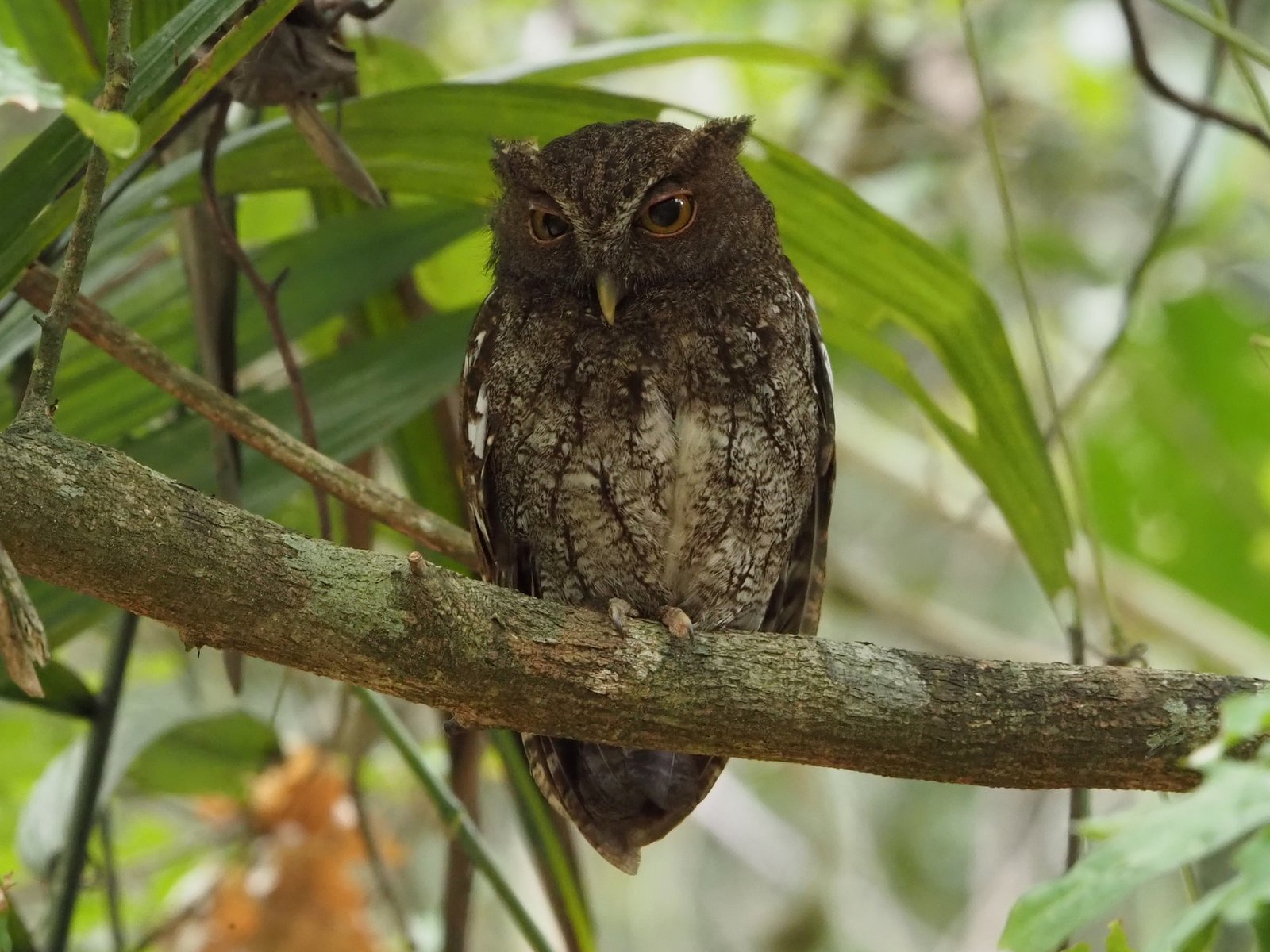
The Choco Screech Owl is a screech owl of humid lowland forest in Panama, western Colombia and northwestern Ecuador. It was long included in a broader species that also contained the Middle American Screech Owl, but on the basis of differences in DNA and voice it is now treated as a separate species. In the guide area it lives mainly in central and eastern Panama.
Voice
A long, purring trill of short notes, a few seconds long, swelling slightly and then ending abruptly; very similar to the song of the Middle American Screech Owl. Also a shorter, stuttering series of notes. Heard mainly shortly after sunset and before dawn.
Recording: Juan Freile — CC BY-NC-SA 4.0 · shortened to the first 60 s, mono · xeno-canto
Identification
20–23 cm, with short ear tufts, yellow eyes and feathered legs. There are grey-brown and rufous birds. The plumage is finely vermiculated, with little contrast; the facial disc has a weak dark rim. A row of white spots runs across the scapulars; the underparts are pale with thin dark streaks and fine cross-lines. Male and female are alike.
Confusion species
Middle American Screech Owl Megascops guatemalae is very similar and in the field is best distinguished by range; it lives from Mexico to Costa Rica and western Panama. Tropical Screech Owl Megascops choliba has a distinct black rim to the facial disc, a herringbone pattern on the underparts and a short trill with closing notes, and lives in semi-open country. Bare-shanked Screech Owl Megascops clarkii is warmer cinnamon-brown, has large white spots on the underparts and lives in the mountains.
Habitat
Humid lowland and foothill forest, including Chocó-Darién rainforest, old secondary forest and forest edges, from sea level to about 1500 metres. It nests in tree cavities. At night it hunts from a low branch in the lower and middle storeys of the forest for large insects, spiders and small vertebrates.
Where the bird is most at home, classified by the vegetation units of Mexico and Central America.




Range and movements
Resident in Panama, mainly on the Caribbean slope of Coclé and Colón, in the Canal Area and Panamá province, and east through Guna Yala, the Emberá region and Darién. A few reports from southwestern Costa Rica, in Puntarenas, are uncertain and may refer to Middle American Screech Owl. Outside the guide area in western Colombia and northwestern Ecuador.
- Resident
- dark = core range, pale = thinly spread
How and when to look
Most often reported along Pipeline Road in Soberanía National Park and in the forests around Gamboa in the Canal Area, where the song can be heard along the forest road after sunset. In Darién it occurs in the forests around Cerro Pirre. By day it hides in dense vegetation or against a trunk.
Conservation status
Not evaluated separately; the IUCN includes it in a broader species that is not threatened. In the guide area locally fairly common in large, continuous forest, but dependent on forest and therefore sensitive to deforestation.
Scientific name
Megascops centralis | (Hekstra, 1982)
Hekstra described the species in 1982 as Otus guatemalae centralis; because it was later moved to another genus, the author and year stand in brackets. The genus Megascops was introduced in 1848 by Kaup. Megascops combines the Greek megas 'great' with Scops, the old genus name of the scops owls. centralis is Latin for 'central, in the middle', after the range in the middle of the Americas. The specimen the first description was based on came from Cerro Malí, Darién, Panama.