All species › Owls › Owls › Bearded Screech Owl
Position in the tree Birds Aves › Birds with a flexible palate Neognathae › All other modern birds Neoaves › Landbirds Telluraves › Raptors, owls, kingfishers and woodpeckers Afroaves › Hawks and owls Hieraves
Bearded Screech Owl | Megascops barbarus
Santa-Barbaraschreeuwuil | Tecolote barbudo
The Bearded Screech Owl is a small screech owl of the montane forests of Chiapas and Guatemala. Its entire range lies within the guide area, in a narrow band of highlands between about 1350 and 2500 m. It is active only at night, hides by day in dense foliage and is detected almost exclusively by its soft, cricket-like song.

Voice
The song is a soft, fairly low, cricket-like trill of three to five seconds that briefly rises and falls again at the end. The male sings lower than the female; both sing, but the male more often. Also a soft, ventriloquial hoo. The song does not carry far and is easily lost among the sounds of insects.
Recording: GABRIEL LEITE — CC BY-NC-SA 4.0 · shortened to the first 60 s, mono · xeno-canto
Identification
16–20 cm, one of the smallest screech owls in the guide area, with short ear tufts, yellow eyes, a greenish bill and bare, pink toes. Most birds are grey-brown, with a whitish-grey collar on the hindneck, pale spots on the shoulder and wing and pale underparts with dark, eye-shaped spots. A dark rufous morph also occurs. Male and female are alike.
Confusion species
The Whiskered Screech Owl Megascops trichopsis lives in the same montane forests but is slightly larger, has coarser black streaks and bars on the underparts and sings series of short toots instead of a trill. The Middle American Screech Owl Megascops guatemalae is larger, lives mainly lower on the slopes and has finely vermiculated underparts without eye-shaped spots. The Northern Pygmy Owl Glaucidium gnoma lacks ear tufts, has a longer tail and false eyes on the nape, and is also active by day.
Habitat
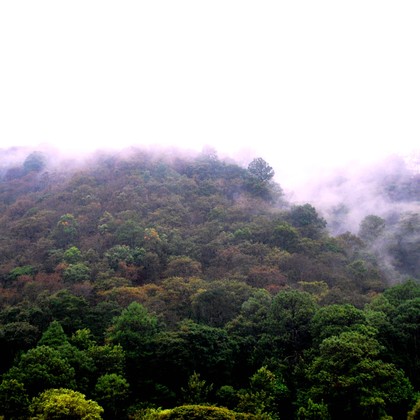
Humid montane forest between about 1350 and 2500 m, mainly around 1800–2000 m: pine-oak forest, oak forest and cloud forest rich in epiphytes, also forest edges and older secondary forest. It hunts at night from a low perch, mainly for insects and other invertebrates. Little is known about its breeding; it probably nests in tree cavities.
Where the bird is most at home, classified by the vegetation units of Mexico and Central America.


Range and movements
Resident in the highlands of central Chiapas, for example around San Cristóbal de las Casas, and southeast into the highlands of western and central Guatemala. It does not occur outside the guide area.
- Resident
- Winter visitor (c. Oct–Mar)
- dark = core range, pale = thinly spread
How and when to look
The song can be heard at night in pine-oak and cloud forest on the slopes around San Cristóbal de las Casas and in the highlands of Guatemala. Because of its soft, cricket-like sound it is noticed only on still nights in places with little insect noise. By day it is almost never found.
Conservation status
Not threatened, but its range is small and the montane forest of Chiapas and Guatemala is shrinking through logging, agriculture and forest fires. Little is known about its numbers.
Scientific name
Megascops barbarus | (Sclater & Salvin, 1868)
Sclater & Salvin described the species in 1868 as Scops barbarus; because it was later moved to another genus, the author and year stand in brackets. The genus Megascops was introduced in 1848 by Kaup. Megascops combines the Greek megas 'great' with Scops, the old genus name of the scops owls. barbarus refers to Santa Bárbara in the Verapaz (Guatemala), the type locality. The specimen the first description was based on came from Santa Bárbara, Verapaz, Guatemala.