All species › Owls › Owls › Cinereous Owl
Position in the tree Birds Aves › Birds with a flexible palate Neognathae › All other modern birds Neoaves › Landbirds Telluraves › Raptors, owls, kingfishers and woodpeckers Afroaves › Hawks and owls Hieraves
Cinereous Owl | Strix sartorii
Mexicaanse bosuil | Búho barrado mexicano
The Cinereous Owl is a large, grey-brown forest owl with dark eyes and a round head without ear tufts. It occurs only in Mexico and lives in humid pine-oak and cloud forest in the mountains. It was long treated as a subspecies of the North American Barred Owl Strix varia; because of differences in song and plumage it is now usually regarded as a separate species. It is active at night and little known.

Voice
The song is a rapid, rhythmic series of deep, barking hoots that often ends in a drawn-out note; it sounds more even and less phrased than the song of the Barred Owl. Pairs often call together in duet. Also hoarse screams and a rising, wailing call. Heard mainly in the first hours after sunset, most often in the dry season.
Recording: Richard E. Webster — CC BY-NC-SA 4.0 · shortened to the first 60 s, mono · xeno-canto
Identification
43–50 cm, with a round head without ear tufts and dark brown eyes. The plumage is cooler and greyer brown than that of the Barred Owl. The facial disc is grey-brown with dark concentric rings and a dark rim. Neck and upper breast are densely barred brown and white; breast and belly are whitish with broad dark brown streaks. The upperparts are grey-brown with white spots and bars on wings and mantle. The bill is yellow. Male and female are alike; the female is larger.
Confusion species
The Spotted Owl Strix occidentalis is darker chocolate brown, with round white spots on the underparts instead of streaks. The Fulvous Owl Strix fulvescens, found farther south, is smaller and warm orange-brown. The Mottled Owl Strix virgata is much smaller and browner and lacks bars on the upper breast. The Great Horned Owl Bubo virginianus has ear tufts and yellow eyes.
Habitat
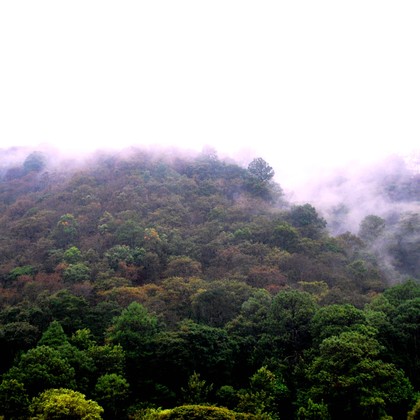
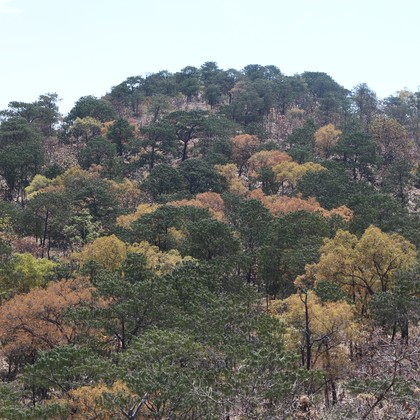
Humid, closed pine-oak forest, oak forest, cloud forest and pine forest in the mountains, often in ravines and on slopes with old trees and dense undergrowth; also at the edges of clearings. It occurs from about 1,000 to 3,000 metres. It hunts small mammals, birds, frogs and large insects from a perch and nests in large tree cavities.
Where the bird is most at home, classified by the vegetation units of Mexico and Central America.


Range and movements
Endemic to Mexico. Resident in the mountains of the west and centre of the country, from Durango and Nayarit south through Jalisco, Colima, Michoacán and Guerrero to Oaxaca; scattered records also in the mountains of Veracruz and Chiapas. The boundary with the range of the Fulvous Owl in southern Mexico is poorly known. Most records come from the Sierra de San Juan near Tepic and from the Nevado de Colima.
- Resident
- Winter visitor (c. Oct–Mar)
- Passage (Mar–Apr, Oct–Nov)
- dark = core range, pale = thinly spread
How and when to look
The Sierra de San Juan near Tepic in Nayarit is the best-known site; after sunset the birds can be heard there in the forest on the slopes, most often from December to April. There are also records from the cloud and pine forests on the slopes of the Nevado de Colima. By day it roosts high in dense trees and is then rarely found.
Conservation status
Not evaluated as a separate species; the IUCN includes it in the Barred Owl, which is not threatened. The range is small and fragmented, and the species depends on old montane forest that is being lost to logging, wildfires and the clearing of land for crops and avocado orchards.
Scientific name
Strix sartorii | (Ridgway, 1874)
Ridgway described the species in 1874 as Syrnium nebulosum var. Sartorii; because it was later moved to another genus, the author and year stand in brackets. The genus Strix was introduced in 1758 by Linnaeus. Strix is the Latin word for 'owl'; in classical lore the strix was a night bird said to suck the blood of infants. sartorii honours the German planter and naturalist Carl Christian Sartorius (1796–1872), owner of the El Mirador hacienda in Veracruz. The specimen the first description was based on came from Mirador, Veracruz, Mexico.