All species › Passerines › Ovenbirds and woodcreepers › Coiba Spinetail
Position in the tree Birds Aves › Birds with a flexible palate Neognathae › All other modern birds Neoaves › Landbirds Telluraves › Falcons, parrots and passerines Australaves › Falcons and passerines Eufalconimorphae › Parrots and passerines Psittacopasserae
Coiba Spinetail | Cranioleuca dissita
Coibastekelstaart | Colaespina de Coiba
The Coiba Spinetail is a rufous spinetail that lives only on Coiba Island off the Pacific coast of Panama. It was formerly regarded as a subspecies of the South American Rusty-backed Spinetail Cranioleuca vulpina. It searches vines and dense foliage for insects.
Voice
Poorly described; probably, as in related species, a fast series of high, somewhat nasal notes.
Recording: Guy Kirwan — CC BY-NC-SA 4.0 · shortened to the first 60 s, mono · xeno-canto
Identification
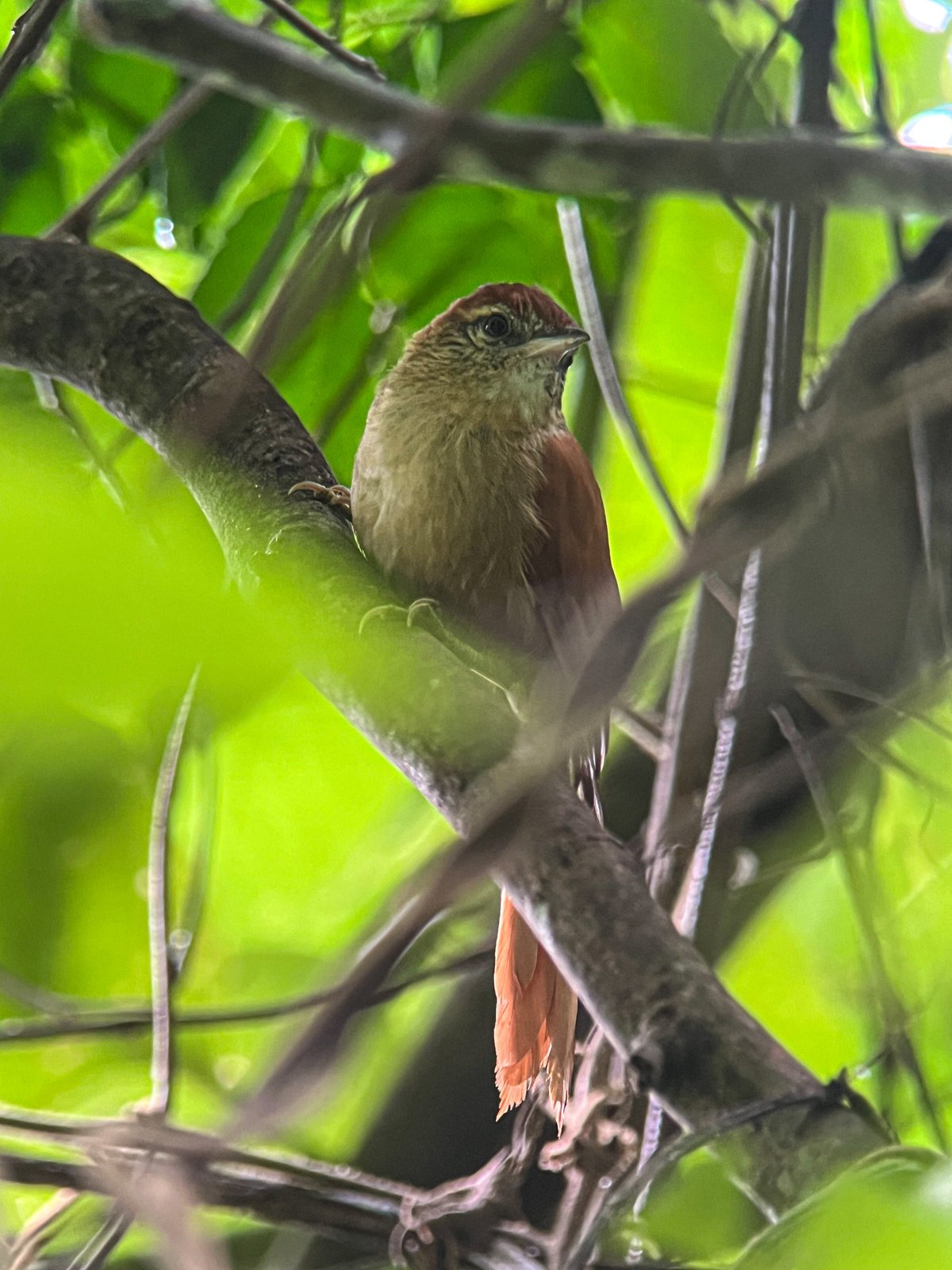
14–15 cm, about half of which is tail; tail rufous, with pointed feather tips. Crown, back and wings warm rufous-brown. Faint pale supercilium. Throat whitish, rest of the underparts dull greyish-brown to buffy. Bill fairly short and pointed.
Confusion species
On Coiba confusion with other spinetails is hardly possible. Red-faced Spinetail Cranioleuca erythrops of mainland montane forest has a rufous face and an olive-brown back.
Habitat
Forest and forest edges on Coiba, mainly in vines and dense growth at low to middle heights. Forages actively among leaves, twigs and vines for insects, singly or in pairs.
Where the bird is most at home, classified by the vegetation units of Mexico and Central America.


Range and movements
Only on Coiba, an island off the Pacific coast of western Panama. Found nowhere else.
- Resident
- dark = core range, pale = thinly spread
How and when to look
Coiba lies within a national park and can be reached by boat, usually from Santa Catalina; look for the bird along forest edges around the park station.
Conservation status
Not threatened according to the current assessment. The range is very small, but the island is largely forested and protected.
Scientific name
Cranioleuca dissita | Wetmore, 1957 (GBIF: Cranioleuca vulpina)
Wetmore described the species in 1957 and placed it straight away in the genus where it still stands. The genus Cranioleuca was introduced in 1853 by Reichenbach. Cranioleuca is Greek, from kranion 'skull, head' and leukos 'white', after the white crown of the type species C. albiceps. dissita is Latin for 'separated, remote', after its range on Coiba Island. The specimen the first description was based on came from Coiba Island, Panama.