All species › Passerines › Ovenbirds and woodcreepers › Red-faced Spinetail
Position in the tree Birds Aves › Birds with a flexible palate Neognathae › All other modern birds Neoaves › Landbirds Telluraves › Falcons, parrots and passerines Australaves › Falcons and passerines Eufalconimorphae › Parrots and passerines Psittacopasserae
Red-faced Spinetail | Cranioleuca erythrops
Roodwangstekelstaart | Colaespina carirroja
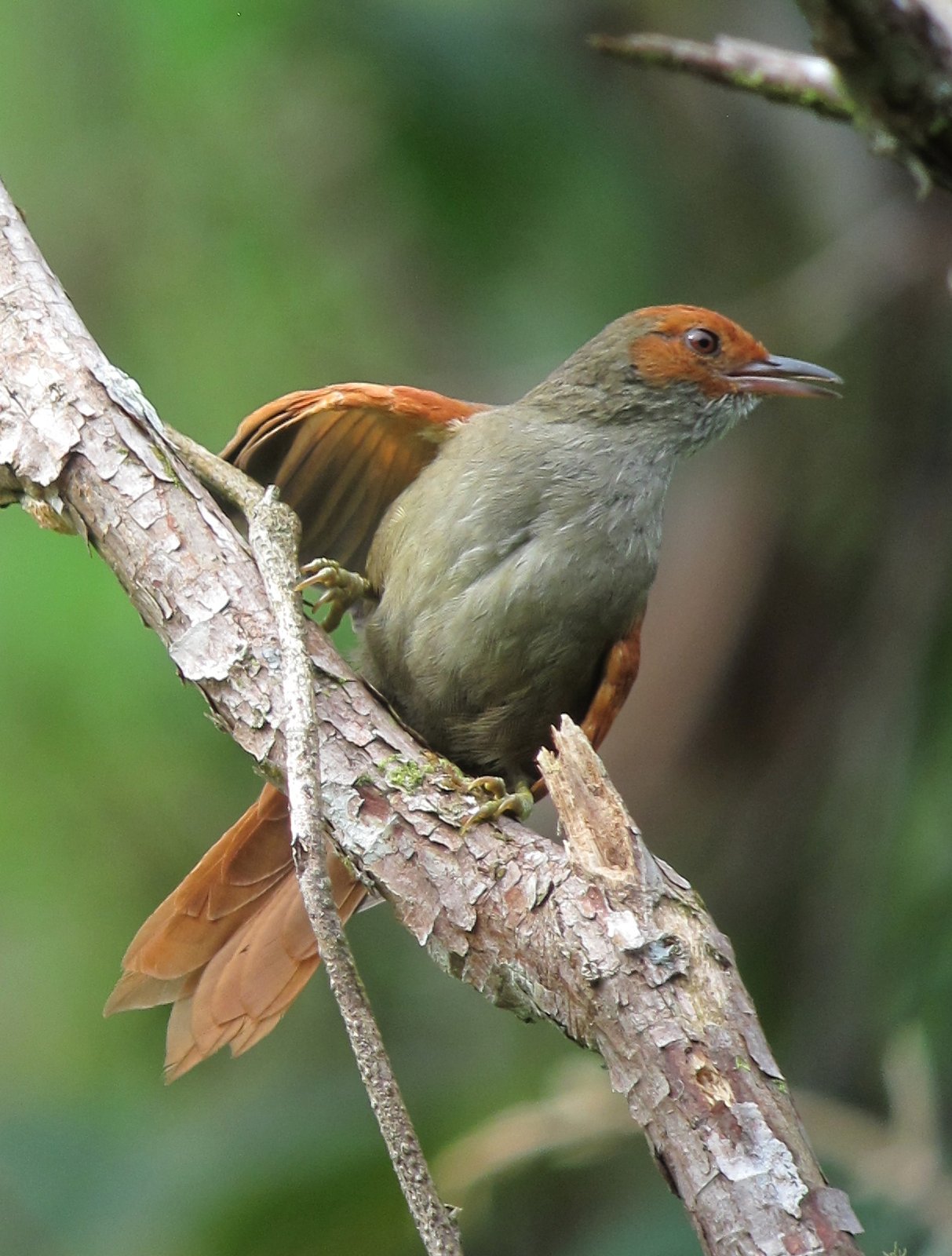
The Red-faced Spinetail is a small ovenbird of montane forest in Costa Rica and Panama, with a rufous crown and cheeks that contrast sharply with the olive-brown back. It clambers acrobatically through moss, epiphytes and clusters of dead leaves, usually in mixed flocks. It builds a conspicuous hanging nest of moss.
Voice
A high, fast series of thin, squeaky notes, often slightly descending; also sharp calls.
Recording: Juan Freile — CC BY-NC-SA 4.0 · converted to mono · xeno-canto
Identification
14–15 cm, about half of which is tail; tail rufous, with pointed feather tips. Crown and sides of the head rufous. Back olive-brown, wings rufous. Underparts dull olive-grey to brownish grey, throat slightly paler. Young birds lack the rufous on the head: crown brown and a pale buffy supercilium.
Confusion species
Other spinetails in the guide area live in scrub and open country, not in the canopy of montane forest. Ruddy Treerunner Margarornis rubiginosus is entirely rufous with a white throat and climbs along trunks and branches. Spotted Barbtail Premnoplex brunnescens is dark brown with pale spots.
Habitat
Humid foothill and montane forest and cloud forest, also mature secondary forest and forest edges, mainly between about 1000 and 2500 m. Searches moss, epiphytes, vines and hanging dead leaves for insects and spiders, often hanging or upside down. The nest is a large ball of moss suspended from the end of a branch.
Where the bird is most at home, classified by the vegetation units of Mexico and Central America.



Range and movements
Costa Rica and Panama. Outside the guide area in western Colombia and Ecuador.
- Resident
- dark = core range, pale = thinly spread
How and when to look
One of the regular members of mixed flocks in Costa Rican montane forest; the rufous face is easy to see when the bird hangs from a branch.
Conservation status
Not threatened. Fairly common in montane forest; disappears where forest is cleared.
Scientific name
Cranioleuca erythrops | (Sclater, 1860)
Sclater described the species in 1860 as Synallaxis erythrops; because it was later moved to another genus, the author and year stand in brackets. The genus Cranioleuca was introduced in 1853 by Reichenbach. Cranioleuca is Greek, from kranion 'skull, head' and leukos 'white', after the white crown of the type species C. albiceps. erythrops is Greek, from eruthros 'red' and ōps 'face', after the rufous face. The specimen the first description was based on came from Pallatanga, Ecuador.