All species › Pigeons and doves › Doves and pigeons › Common Ground Dove
Position in the tree Birds Aves › Birds with a flexible palate Neognathae › All other modern birds Neoaves › Doves, turacos and allies Columbaves › Doves and sandgrouse Columbimorphae
Common Ground Dove | Columbina passerina
Musduif | Tórtola coquita
The Common Ground Dove is the smallest dove in the guide area, barely larger than a sparrow, stocky and short-tailed. It lives in open, dry country, from the deserts of northern Mexico to the Pacific lowlands of Costa Rica and, locally, Panama. Outside the guide area it occurs in the southern United States, the West Indies and northern South America.

Voice
The call is a soft, short, rising woo-oop or woop, repeated about once a second, sometimes dozens of times in a row. The sound seems to come from further away than the bird actually sits. It calls from a low branch, a post, a wire or the ground, mostly in the morning and towards evening.
Recording: Richard E. Webster — CC BY-NC-SA 4.0 · shortened to the first 60 s, mono · xeno-canto
Identification
15–18 cm, small and compact, with a proportionately large head and a short dark tail. The plumage is grey-brown to sandy brown, with scattered black, sometimes purple-glossed spots on the wing coverts. Head, neck and breast are finely scaled by dark feather edges; the back is plain. The male has a pinkish wash over face, neck and breast and a blue-grey crown and nape; the female is greyer and plainer. The bill is pinkish red to orange-red at the base with a dark tip. In flight the primaries and underwing flash rufous. The subspecies in the guide area differ slightly in tone and bill colour.
Confusion species
Ruddy Ground Dove Columbina talpacoti is slightly larger, with a plain, unscaled breast, a grey bill and black underwing coverts; the male is warm cinnamon with a grey head. Plain-breasted Ground Dove Columbina minuta is a little smaller still, likewise plain-breasted, with a grey bill lacking red. Inca Dove Columbina inca is scaled all over and has a long tail with white sides.
Habitat
Open and half-open country with bare or sandy patches: dry scrub, thorn and cactus scrub, dry forest with clearings, savanna, pasture, field margins, road verges, coastal scrub and dunes, and the edges of villages; mainly in the lowlands, locally up to about 1500 m. It forages walking on the ground, singly, in pairs or in small groups, on small seeds and sometimes insects. The nest is placed low in a shrub, on a cactus or on the ground.
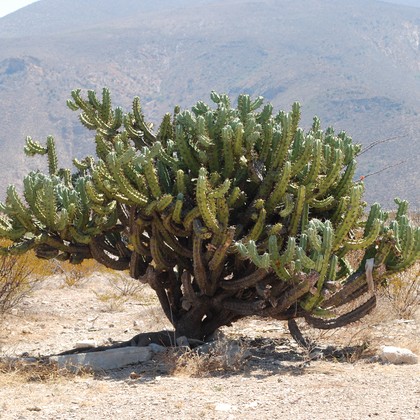
Where the bird is most at home, classified by the vegetation units of Mexico and Central America.


Range and movements
Almost all of Mexico, including Baja California, Sonora and the Yucatán Peninsula, mainly in the lower, drier regions; also on Socorro (Revillagigedo Islands). Further in Belize, Guatemala, El Salvador, Honduras and Nicaragua, in Central America mainly on the dry Pacific side, in dry interior valleys and in pine savanna, south to north-western Costa Rica; in Panama only locally in the Pacific lowlands. Outside the guide area in the southern United States, the West Indies and northern South America.
- Resident
- dark = core range, pale = thinly spread
How and when to look
Easiest to find in dry scrub and along unpaved roads in northern and western Mexico, on the Yucatán Peninsula and in Guanacaste, early in the morning when the birds search bare ground for seed. They flush only when someone comes close; the rufous that then opens in the wing and the short tail without white sides confirm the identification. The reddish bill base and scaled breast separate it from Ruddy and Plain-breasted Ground Doves.
Conservation status
Not threatened. The species is common in most of the guide area and has adapted well to land altered by people.
Scientific name
Columbina passerina | (Linnaeus, 1758)
Linnaeus described the species in 1758 as Columba passerina; because it was later moved to another genus, the author and year stand in brackets. The genus Columbina was introduced in 1825 by Spix. Columbina is Latin for 'little dove', a diminutive of columba 'dove'. passerina is Latin for 'sparrow-like', after the small size. The specimen the first description was based on came from South Carolina, United States.