All species › Pigeons and doves › Doves and pigeons › Plain-breasted Ground Dove
Position in the tree Birds Aves › Birds with a flexible palate Neognathae › All other modern birds Neoaves › Doves, turacos and allies Columbaves › Doves and sandgrouse Columbimorphae
Plain-breasted Ground Dove | Columbina minuta
Dwergduif | Tórtola pecho liso
The Plain-breasted Ground Dove is a very small, plainly coloured ground dove of grassland and savanna in the humid lowlands, from southern Mexico to Panama. It is less conspicuous and more local than Ruddy and Common Ground Doves, with which it is often confused. Outside the guide area it occurs over much of tropical South America.
Voice
A long series of soft, short, monotonous woop or poo-oop notes, repeated at an even pace for long periods. The bird often calls from a shrub or low in a tree and is therefore easier to hear than to see.
Recording: Fernando Igor de Godoy — CC BY-NC-SA 4.0 · converted to mono · xeno-canto
Identification
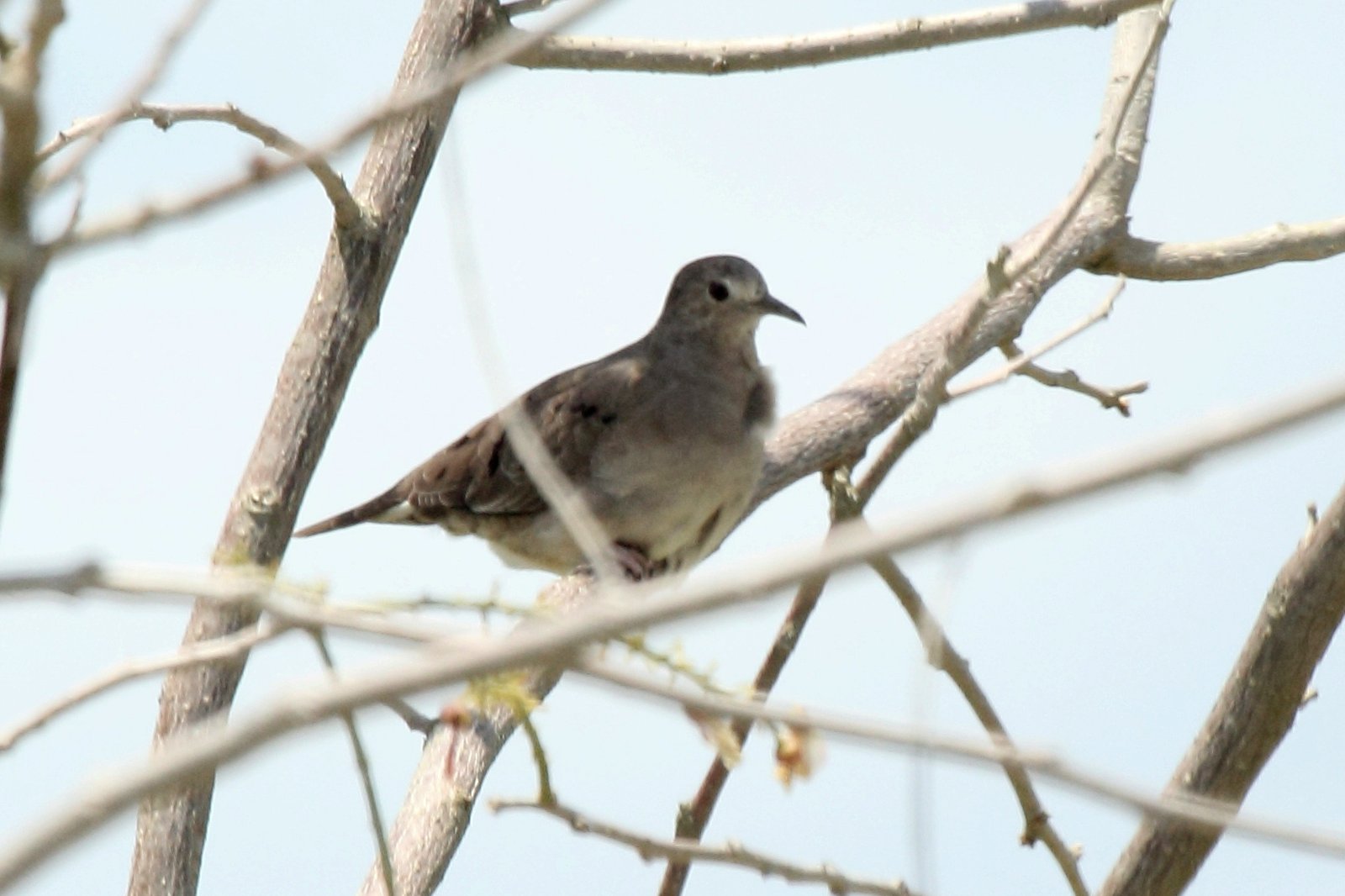
14–16 cm, small and compact, with a short tail. The male has a blue-grey crown and nape and a plain, unscaled, pinkish-grey breast; back and wings are grey-brown. The female is plainer grey-brown, with a paler belly. Both have a few violet- to chestnut-glossed spots on the wing coverts, rufous primaries and underwing in flight, and blackish outer tail feathers with narrow white tips. The bill is grey to dark, without red.
Confusion species
The female Ruddy Ground Dove Columbina talpacoti is very similar, but slightly larger, with black (not violet-glossed) wing spots and black underwing coverts; the male Ruddy Ground Dove is cinnamon-rufous. Common Ground Dove Columbina passerina has a scaled breast and a reddish bill base. The female Blue Ground Dove Claravis pretiosa is larger and warmer brown, with chestnut wing bars, and lives at forest edges.
Habitat
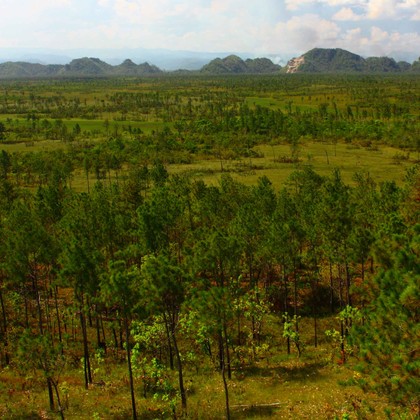
Open grassland, savanna and pine savanna, pasture, field margins, road verges and grassy areas with scattered shrubs, also short grass at farms and airfields; mainly in the lowlands, locally up to about 1200 m. It lives singly, in pairs or in small groups on the ground, where it searches for small seeds. The nest is a small cup low in a shrub or in grass.
Where the bird is most at home, classified by the vegetation units of Mexico and Central America.




Range and movements
In Mexico from southern Veracruz and Oaxaca through Tabasco and Chiapas to the Yucatán Peninsula. Further scattered and local in Belize, Guatemala, Honduras, Nicaragua, Costa Rica and Panama, mainly in the savannas on the Caribbean side and in open lowlands of Costa Rica and Panama. Outside the guide area over much of tropical South America.
- Resident
- dark = core range, pale = thinly spread
How and when to look
Chances are best in Belize and in the pine savannas of the Mosquitia in Honduras and Nicaragua. Any small, plain ground dove in humid grassland deserves a second look: in flushing birds note the colour of the underwing, which is rufous in Plain-breasted and black in Ruddy Ground Dove.
Conservation status
Not threatened. The species is locally fairly common in the guide area and benefits from the clearing of forest for pasture.
Scientific name
Columbina minuta | (Linnaeus, 1766)
Linnaeus described the species in 1766 as Columba minuta; because it was later moved to another genus, the author and year stand in brackets. The genus Columbina was introduced in 1825 by Spix. Columbina is Latin for 'little dove', a diminutive of columba 'dove'. minuta is Latin for 'small', after the small size. The specimen the first description was based on came from Cayenne, French Guiana.