All species › Pigeons and doves › Doves and pigeons › Ruddy Ground Dove
Position in the tree Birds Aves › Birds with a flexible palate Neognathae › All other modern birds Neoaves › Doves, turacos and allies Columbaves › Doves and sandgrouse Columbimorphae
Ruddy Ground Dove | Columbina talpacoti
Steenduif | Tórtola rojiza
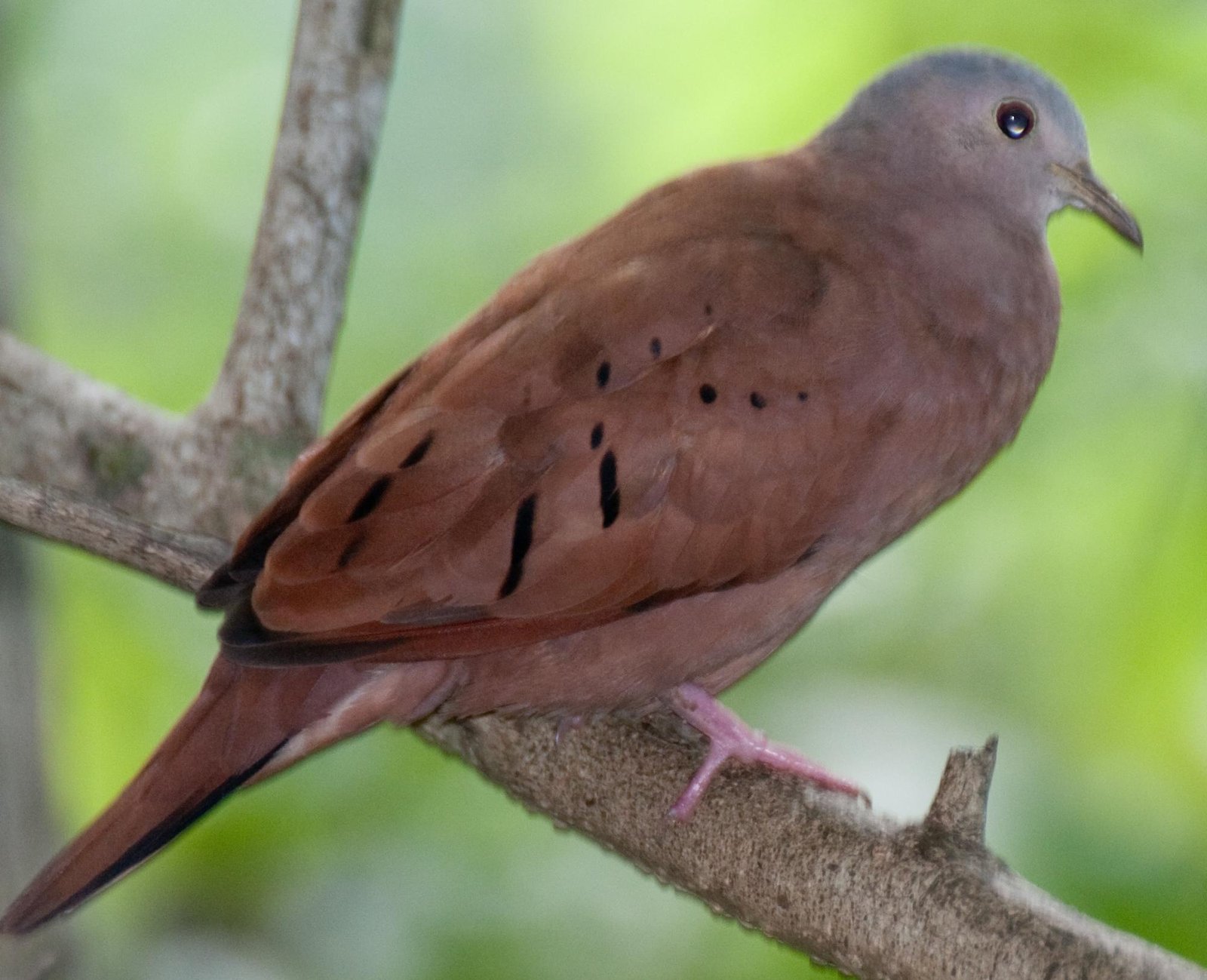
The Ruddy Ground Dove is the commonest small ground dove in the humid lowlands of the guide area, a familiar sight in villages, pasture and along roads. The male is warm cinnamon with a grey head, the female much duller. The species ranges from north-western and eastern Mexico to Panama and on through much of South America.
Voice
A rhythmic, often long-repeated series of soft two-syllable notes, ka-woop ka-woop or pe-woo, stressed on the second syllable. It calls from a branch, a wire or a roof through much of the day.
Recording: Juan Freile — CC BY-NC-SA 4.0 · converted to mono · xeno-canto
Identification
16–18 cm, small and compact, with a short tail. The male is cinnamon to rusty red, slightly paler below, with a pale blue-grey crown and nape that stand out strongly. The wing coverts and inner secondaries bear small black spots and streaks. The female is grey-brown, with a rufous tinge to the wing and rump and the same black wing spots. The breast is plain, not scaled, in both sexes. In flight the rufous primaries and black underwing coverts stand out; the outer tail feathers are black. The bill is grey and the legs pink.
Confusion species
Plain-breasted Ground Dove Columbina minuta closely resembles the female, but is smaller, with violet-glossed wing spots and a rufous underwing. Common Ground Dove Columbina passerina has a scaled breast and a reddish bill base. The female Blue Ground Dove Claravis pretiosa is larger, with chestnut wing bars and a rufous rump and tail.
Habitat
Half-open country in humid and semi-humid regions: villages, gardens, yards, pasture, fields, plantations, forest edges, road verges and savanna, and clearings in secondary forest; from sea level to about 1500 m. It searches bare or short-grassed ground on foot for seeds, often in pairs or small groups. The nest is a shallow cup of stems and grass in a shrub, a tree or on a building.
Where the bird is most at home, classified by the vegetation units of Mexico and Central America.





Range and movements
In Mexico along the Pacific side from Sinaloa southwards and along the Gulf coast from southern Tamaulipas, through Veracruz, Oaxaca, Tabasco and Chiapas to the whole Yucatán Peninsula. Further common in Belize, Guatemala, El Salvador, Honduras, Nicaragua, Costa Rica and Panama, on both sides of each country. Outside the guide area in much of South America, south to northern Argentina.
- Resident
- dark = core range, pale = thinly spread
How and when to look
In almost every lowland village from Yucatán to Panama Ruddy Ground Doves sit on the street, in yards and along the road. Pairs are useful for seeing the difference between the red male and the dull female. With a dull bird and no male nearby, the black underwing shown on take-off helps to rule out Plain-breasted Ground Dove.
Conservation status
Not threatened. The species is common and increasing as forest is cleared; in Mexico it has expanded northwards in recent decades.
Scientific name
Columbina talpacoti | (Temminck, 1810)
Temminck described the species in 1810 as Columba Talpacoti; because it was later moved to another genus, the author and year stand in brackets. The genus Columbina was introduced in 1825 by Spix. Columbina is Latin for 'little dove', a diminutive of columba 'dove'. talpacoti comes from the Nahuatl name Tlapalcocotli, from tlapalli 'red' and cocotli 'dove'. The specimen the first description was based on came from South America (not specified).