All species › Waterfowl › Ducks, swans and geese › Common Merganser
Position in the tree Birds Aves › Birds with a flexible palate Neognathae › Fowl Galloanserae
Common Merganser | Mergus merganser
Grote zaagbek | Serreta grande
The Common Merganser is the largest merganser and a bird of fresh water that breeds around the North Pole. Mexico lies at the extreme southern edge of its winter range: the species is a rare winter visitor on rivers and reservoirs in the north-west. In North America the subspecies americanus breeds.

Voice
Usually silent. The female gives a harsh, short karr karr; in display the male a soft, ringing sound reminiscent of a distant frog.
Recording: Stanislas Wroza — CC BY-NC-SA 4.0 · converted to mono · xeno-canto
Identification
54–71 cm. Large, elongated and low in the water, with a red, serrated bill with a hooked tip that is fairly thick at the base. The male is white on the breast and flanks, often with a pink or salmon wash, with a glossy dark green head without an obvious crest, a black back and a dark eye. The female and juveniles have a rufous head with a short, smooth crest on the nape, a white chin patch and a sharp border between the rufous neck and the white throat and breast; the body is grey. In flight the male shows a large white patch on the inner wing, the female a smaller white patch on the secondaries.
Confusion species
In the female Red-breasted Merganser Mergus serrator the rufous of the head merges gradually into the pale throat and neck, without a white chin patch; the bill is thinner and the crest more ragged. The male Red-breasted Merganser has a rufous streaked breast and a white collar.
Habitat
Clear rivers and reservoirs inland; rarely in sheltered coastal waters. It dives for fish.
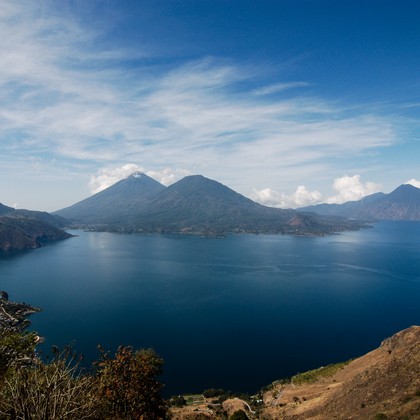
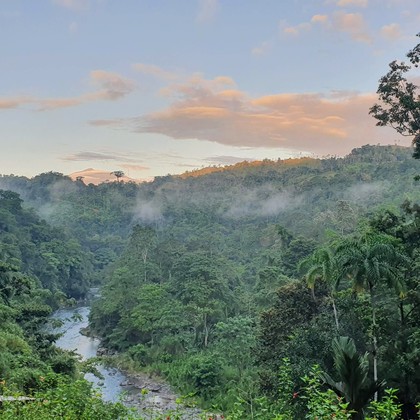
Where the bird is most at home, classified by the vegetation units of Mexico and Central America.
Range and movements
A rare winter visitor in north-western Mexico, mainly on rivers and reservoirs in Chihuahua and Sonora, with a few records in Baja California, Durango and Coahuila. Breeds in the boreal forests of North America and in the west south to the mountains of the south-western United States, and further in northern Eurasia; in North America it winters mainly in Canada and the United States.
- Winter visitor (c. Oct–Mar)
- dark = core range, pale = thinly spread
How and when to look
Large reservoirs and rivers in Chihuahua and Sonora in hard winters, when more birds from the north move south; a swimming female is recognised by the sharp border between the rufous head and the white breast.
Conservation status
Not threatened globally. The North American population is roughly stable. In the guide area a rare winter visitor in small numbers.
Scientific name
Mergus merganser | Linnaeus, 1758
Linnaeus described the species in 1758 and placed it straight away in the genus where it still stands. He introduced the genus Mergus in that same work. Mergus is the Latin word for an unidentified waterbird mentioned by Pliny the Elder and other authors; some have taken it to be a cormorant or Scopoli's shearwater. merganser is formed from mergus and anser 'goose', that is 'diving goose'. The specimen the first description was based on came from Sweden.