All species › Passerines › Mockingbirds and thrashers › Crissal Thrasher
Position in the tree Birds Aves › Birds with a flexible palate Neognathae › All other modern birds Neoaves › Landbirds Telluraves › Falcons, parrots and passerines Australaves › Falcons and passerines Eufalconimorphae › Parrots and passerines Psittacopasserae
Crissal Thrasher | Toxostoma crissale
Roodbuikspotlijster | Cuitlacoche crisal
The Crissal Thrasher is a large, plain grey-brown thrasher with a long, strongly decurved bill and rufous undertail coverts, which give the species its name. It lives hidden in dense scrub in dry regions and feeds mainly on the ground. In the guide area it occurs in northern and central Mexico.

Voice
The song is a long series of clear, varied phrases, usually repeated once or twice, less often than in Northern Mockingbird. The call is a repeated, rolling chideary or pichoory.
Recording: Scott Olmstead — CC BY-NC-SA 4.0 · shortened to the first 60 s, mono · xeno-canto
Identification
28–31 cm. Large and slender, with a long tail and a long, strongly decurved black bill. Upperparts plain grey-brown, underparts slightly paler grey, without spots. Throat white with a narrow dark malar stripe on each side. Undertail coverts deep rufous, easy to see when the bird cocks its tail. Iris pale yellow to straw-coloured. The sexes are alike.
Confusion species
Curve-billed Thrasher Toxostoma curvirostre has a shorter, less strongly curved bill, an orange iris, a faintly spotted breast and no rufous undertail. LeConte's Thrasher Toxostoma lecontei is much paler and sandy, with a dark tail and pale undertail, and lives in open, bare desert. Bendire's Thrasher Toxostoma bendirei is smaller, with a shorter, almost straight bill and fine arrowhead spots on the breast.
Habitat
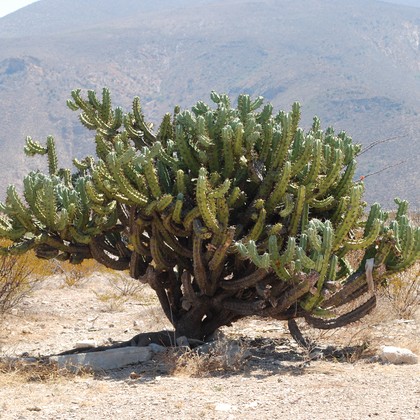
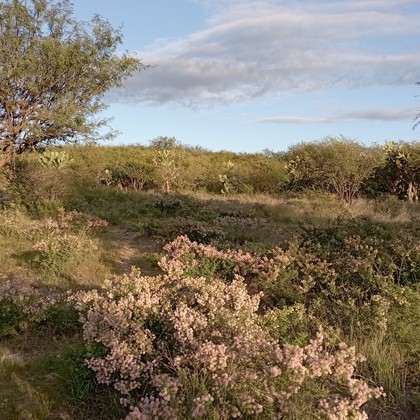
Dense mesquite and other thorny scrub along dry riverbeds and arroyos, riparian growth in desert regions and, higher up, juniper and oak scrub on dry slopes, to about 2000 m. It usually stays in or under the bushes and prefers to run rather than fly. It probes litter and loose soil with its bill for insects, spiders and larvae, and also eats berries and seeds.
Where the bird is most at home, classified by the vegetation units of Mexico and Central America.


Range and movements
South-western United States and northern and central Mexico. In the guide area in north-eastern Baja California (the Colorado River delta), in Sonora and across the plateau of Chihuahua, Coahuila, Durango, Zacatecas, San Luis Potosí and Nuevo León south to about Hidalgo.
- Resident
- dark = core range, pale = thinly spread
How and when to look
Best found early in the morning in the breeding season, when males sing from a bush top; at other times mainly detected by the rustling in the litter beneath dense scrub.
Conservation status
Not threatened (LC). Locally fairly common, but easily overlooked because of its secretive habits. Loss of riparian scrub and mesquite thickets through clearance and water extraction is the main threat.
Scientific name
Toxostoma crissale | Henry, 1858
Henry described the species in 1858 and placed it straight away in the genus where it still stands. The genus Toxostoma was introduced in 1831 by Wagler. Toxostoma is Greek, from toxon 'bow' and stoma 'mouth', after the long, curved bill. crissale comes from crissum, the undertail coverts around the vent, after the striking rufous undertail. The specimen the first description was based on came from Fort Thorn, New Mexico.