All species › Grebes › Grebes › Eared Grebe
Position in the tree Birds Aves › Birds with a flexible palate Neognathae › All other modern birds Neoaves › Flamingos and grebes Mirandornithes
Eared Grebe | Podiceps nigricollis
Geoorde fuut | Zampullín cuellinegro
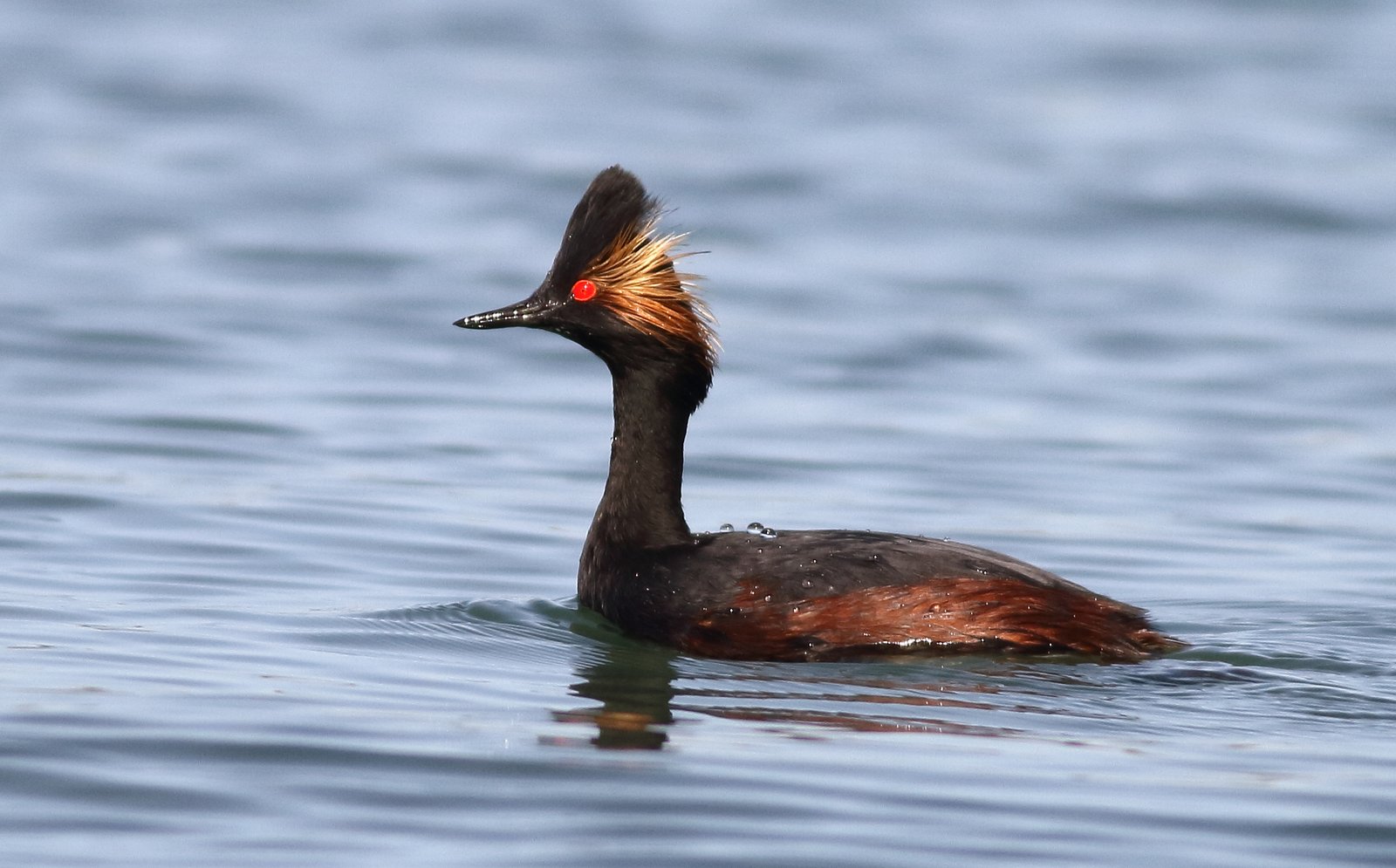
The Eared Grebe is a small, dark grebe with a red eye and a thin bill. It breeds in colonies on the lakes of the Mexican plateau; in winter large numbers arrive from North America and gather mainly in the Gulf of California and on the lakes of northern and central Mexico.
Voice
On the breeding grounds a soft, rising whistled poo-eep and a rapid, rolling trill; usually silent in winter.
Recording: Julien Piette — CC BY-NC-SA 4.0 · converted to mono · xeno-canto
Identification
28–34 cm, with a steep forehead, a high, peaked crown and a thin bill that looks slightly upturned; the eye is bright red. In breeding plumage head, neck and back black, with a fan of golden-yellow feathers behind the eye and rufous flanks. In winter plumage dark grey on crown, cheek and hindneck, with a white throat, a white patch behind the cheek and a dusky grey foreneck; the border between dark and white is blurred. Often sits on the water with a high, fluffy rear end.
Confusion species
Horned Grebe Podiceps auritus has a flatter crown, a straight bill with a pale tip and, in winter plumage, a sharply defined white cheek and foreneck. Least Grebe Tachybaptus dominicus is smaller, with a yellow eye and no black-and-white contrast. Pied-billed Grebe Podilymbus podiceps is brown with a thick bill and a dark eye.
Habitat
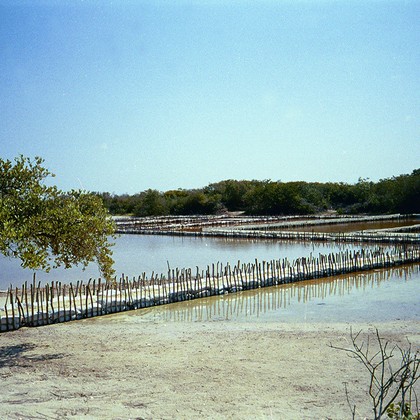
Shallow, nutrient-rich freshwater lakes with fringing vegetation, reservoirs and inland salt and soda lakes; in winter also lagoons, coastal bays and open sea close to the coast, where large, dense flocks sometimes gather. It eats aquatic insects, crustaceans such as brine shrimp and small fish. The nest is a floating platform of plant material, often in colonies.
Where the bird is most at home, classified by the vegetation units of Mexico and Central America.




Range and movements
Breeds on the lakes of the interior plateau of Mexico, including in Chihuahua, Durango, Zacatecas, Jalisco, Guanajuato, Michoacán, the State of México and Puebla. In winter widespread in northern and central Mexico, along both coasts of Baja California, in the Gulf of California and in Sonora, scarcer east to Coahuila, Nuevo León and Tamaulipas and south to Oaxaca. A scarce winter visitor to the highlands of Guatemala; exceptional further south. Outside the guide area in western North America and further in Eurasia and Africa.
- Resident
- Winter visitor (c. Oct–Mar)
- Passage (Mar–Apr, Oct–Nov)
- dark = core range, pale = thinly spread
How and when to look
In winter on almost every larger lake or reservoir on the plateau and in the bays of the Gulf of California, sometimes in flocks of hundreds to thousands of birds. In the breeding season colonies on vegetated plateau lakes, for example around Mexico City and in Jalisco and Michoacán.
Conservation status
Not threatened; the most numerous grebe in the world. The breeding lakes on the plateau are under pressure from water abstraction, silting up and pollution, but numbers in the guide area are large in winter.
Scientific name
Podiceps nigricollis | Brehm, 1831
Brehm described the species in 1831 and placed it straight away in the genus where it still stands. The genus Podiceps was introduced in 1787 by Latham. Podiceps is Latin, from podex, genitive podicis, 'rear end', and pes 'foot', after the legs set far back on the body. nigricollis is Latin, from niger 'black' and collum 'neck', after the black neck in breeding plumage. The specimen the first description was based on came from Germany.