All species › Passerines › New World blackbirds, troupials and allies › Eastern Meadowlark
Position in the tree Birds Aves › Birds with a flexible palate Neognathae › All other modern birds Neoaves › Landbirds Telluraves › Falcons, parrots and passerines Australaves › Falcons and passerines Eufalconimorphae › Parrots and passerines Psittacopasserae
Eastern Meadowlark | Sturnella magna
Witkaakweidespreeuw | Pradero tortilla con chile
The Eastern Meadowlark is a sturdy blackbird of open grassland with a large range, from eastern North America to northern South America. In the guide area it is a resident of savannas, pastures and highland grasslands, from eastern Mexico to Panama. The populations of north-western Mexico formerly included in it are now treated as a separate species: Chihuahuan Meadowlark.

Voice
The song consists of a few clear, drawn-out, slurred whistles, such as see-you see-yeer, delivered from a post, shrub or wire. The call is a buzzy dzzrt; also a dry, rapid rattle.
Recording: Manuel Grosselet — CC BY-NC-SA 4.0 · converted to mono · xeno-canto
Identification
19–26 cm. Stocky, with a long, pointed bill, a flat head and a short tail whose outer three feathers are largely white. Upperparts dark brown with black and pale streaks and bars, head with a black-and-white crown stripe and a white supercilium that is yellow in front of the eye. Throat and breast deep yellow with a broad black V on the breast; the malar area below the cheek is white. Flanks pale brown with dark streaks. The sexes are alike; the female is smaller. Central American populations are on average smaller and darker than northern ones.
Confusion species
Western Meadowlark Sturnella neglecta, which occurs in winter in northern and central Mexico, has yellow in the malar area, paler and greyer upperparts and less white in the tail; it has a bubbling song and a low chuck call. Chihuahuan Meadowlark Sturnella lilianae in north-western and western Mexico is paler above, has even more white in the tail and a whiter face. Where the species occur together, voice is the most reliable feature.
Habitat
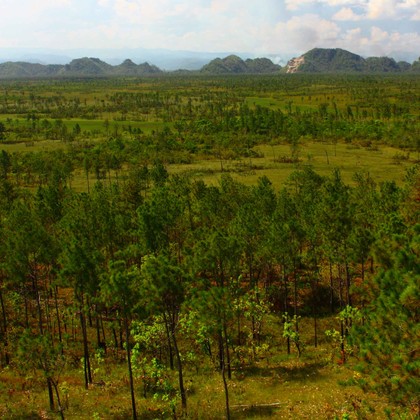
Open grassland, savanna, pine savanna, pastures, hayfields and grassy field margins, in the lowlands and in highland grasslands. It forages walking on the ground, mainly for insects, and also eats seeds.
Where the bird is most at home, classified by the vegetation units of Mexico and Central America.



Range and movements
Occurs from south-eastern Canada and the eastern United States through eastern Mexico and Central America to northern South America. In the guide area locally from Tamaulipas and Nuevo León along the slopes towards the Gulf of Mexico to the Yucatán Peninsula and Chiapas, and on through the grasslands and savannas of Central America to Panama; also in highland grasslands in Guatemala, Honduras and Costa Rica.
- Resident
- dark = core range, pale = thinly spread
How and when to look
Best found by searching open pasture country for birds singing from posts or fences; on the ground they are only noticed when they fly up and show the white tail sides.
Conservation status
Near Threatened (NT). The global assessment covers the species in the broad sense, including Chihuahuan Meadowlark. It has declined steeply over a long period in North America through the loss of grassland and hayfields and more intensive use of pastures. In Central America the species locally benefits from forest clearance for cattle ranching.
Scientific name
Sturnella magna | (Linnaeus, 1758)
Linnaeus described the species in 1758 as A[lauda] magna; because it was later moved to another genus, the author and year stand in brackets. The genus Sturnella was introduced in 1816 by Vieillot. Sturnella is a Latin diminutive of sturnus 'starling': 'little starling'. magna is Latin for 'great, large'; Linnaeus described the species as a large lark (Alauda magna). The specimen the first description was based on came from South Carolina.