All species › Passerines › New World blackbirds, troupials and allies › Western Meadowlark
Position in the tree Birds Aves › Birds with a flexible palate Neognathae › All other modern birds Neoaves › Landbirds Telluraves › Falcons, parrots and passerines Australaves › Falcons and passerines Eufalconimorphae › Parrots and passerines Psittacopasserae
Western Meadowlark | Sturnella neglecta
Geelkaakweidespreeuw | Pradero occidental
The Western Meadowlark is a sturdy, short-tailed blackbird of open grassland in western North America. It breeds locally in northern Mexico; in winter birds from the north arrive and some move as far as central Mexico.

Voice
The song is a series of seven to ten rich, fluty and bubbling notes, often falling in pitch, usually delivered from a post, shrub or wire. The call is a low, short chuck; also a dry rattle.
Recording: Ed Pandolfino — CC BY-NC-SA 4.0 · converted to mono · xeno-canto
Identification
21–26 cm. Stocky, with a long, pointed bill, a flat head and a short tail with white outer feathers. Upperparts brown with black and pale streaks and bars, head with a black-and-white crown stripe. Throat and breast yellow with a black V on the breast; the yellow of the throat extends into the malar area below the cheek. Flanks white with dark spots. Flies with fast wingbeats alternating with short glides. In winter the V is less sharply defined. The sexes are alike; the female is slightly smaller.
Confusion species
Eastern Meadowlark Sturnella magna and Chihuahuan Meadowlark Sturnella lilianae are hard to separate in the field. In both the malar area below the cheek is white rather than yellow, the outer three tail feathers show more white, and the upperparts are darker (Eastern) or paler (Chihuahuan). The most reliable feature is the voice: Western Meadowlark has a bubbling, fluty song and a low chuck call, while the other two sing clear, drawn-out whistles and give buzzy calls.
Habitat
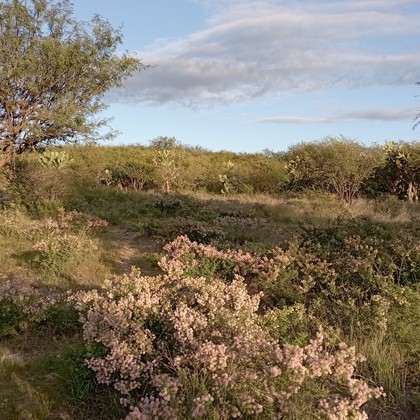
Semi-desert grassland, prairie, open highland grassland, pastures, farmland and fallow fields with short grass. It forages walking on the ground for insects and, in winter, seeds.
Where the bird is most at home, classified by the vegetation units of Mexico and Central America.


Range and movements
Breeds from south-western Canada through the western and central United States into northern Mexico, including northern Baja California, Sonora, Chihuahua, Coahuila, Durango and Nuevo León. Winters from the south of the breeding range into central Mexico, roughly to Jalisco, Guanajuato and northern Veracruz.
- Resident
- Summer visitor (c. Apr–Sep)
- Winter visitor (c. Oct–Mar)
- Passage (Mar–Apr, Oct–Nov)
- dark = core range, pale = thinly spread
How and when to look
Where several meadowlark species occur, listening is the best way to tell them apart; in winter too, the low chuck call of the Western Meadowlark is easy to recognise.
Conservation status
Not threatened (LC). Widespread and numerous, but in North America it has declined for decades through the loss of grassland and its conversion to intensive agriculture.
Scientific name
Sturnella neglecta | Audubon, 1844
Audubon described the species in 1844 and placed it straight away in the genus where it still stands. The genus Sturnella was introduced in 1816 by Vieillot. Sturnella is a Latin diminutive of sturnus 'starling': 'little starling'. neglecta is Latin for 'overlooked': Audubon felt earlier travellers had wrongly taken this species for the Eastern Meadowlark. The specimen the first description was based on came from Fort Union on the Missouri River, North Dakota (USA).