All species › Gamebirds › New World quail › Elegant Quail
Position in the tree Birds Aves › Birds with a flexible palate Neognathae › Fowl Galloanserae
Elegant Quail | Callipepla douglasii
Douglas' kuifkwartel | Codorniz cresta dorada
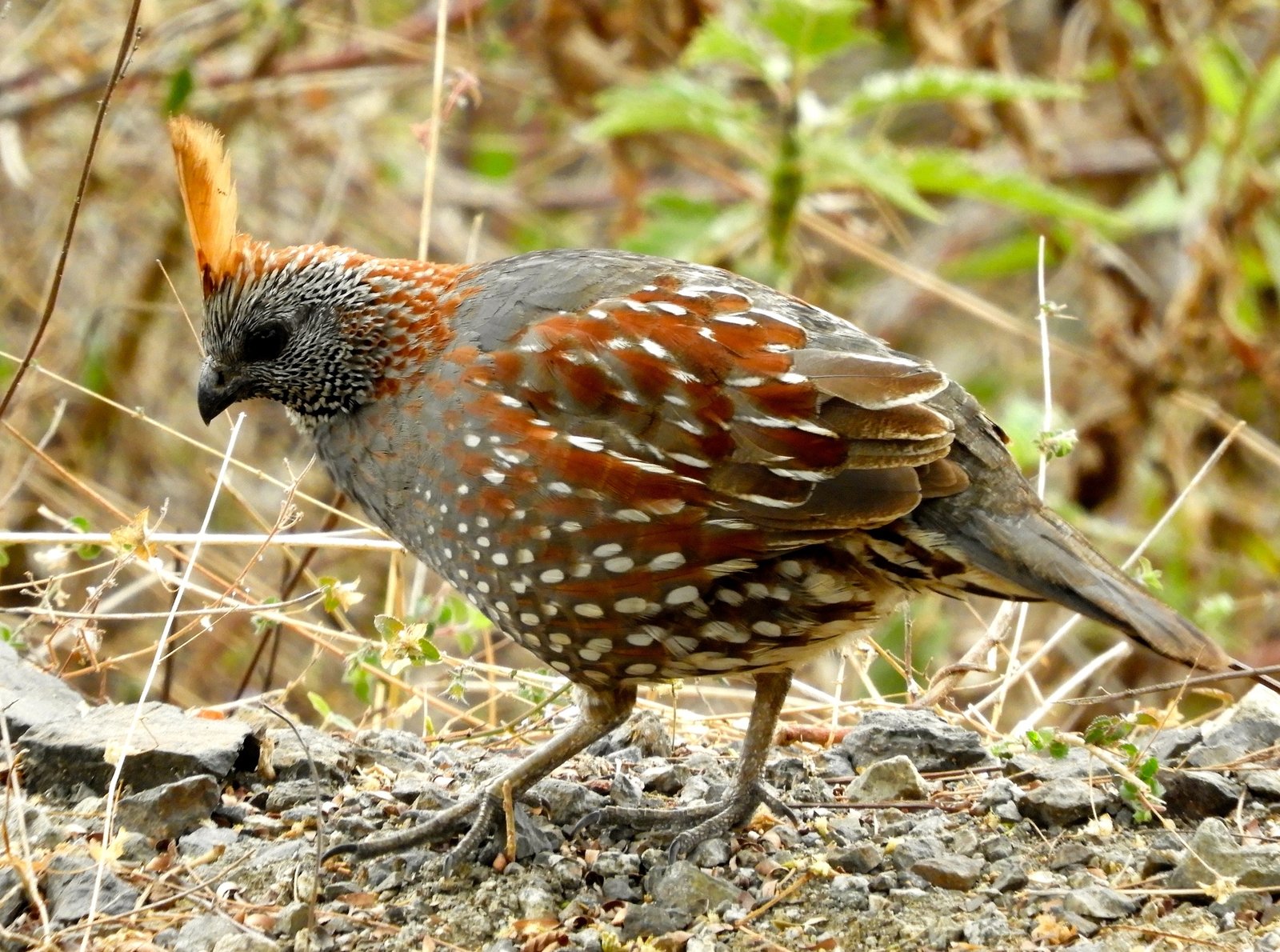
Elegant Quail is a crested quail found only in western Mexico, from Sonora to Jalisco. The male wears an upright, golden-buff crest and has grey underparts covered in white spots. Coveys live in thorn scrub and dry forest at the foot of the Sierra Madre Occidental. Its scientific name honours the Scottish plant collector David Douglas.
Voice
Covey members keep in contact while foraging with a soft chip-chip. When the covey gathers in the evening and morning a louder, crowing coo-cow is given.
Recording: Richard E. Webster — CC BY-NC-SA 4.0 · shortened to the first 60 s, mono · xeno-canto
Identification
24–27 cm; compact, with a short tail. The male has an upright, golden-yellow to buff-brown crest, a grey head finely speckled with black and white, grey-brown upperparts with rufous on the scapulars and wing coverts, and grey underparts with round white spots; the flanks are chestnut with white spots. The female is browner, with a short brown crest, a speckled head and grey-brown underparts spotted and barred with white, without chestnut.
Confusion species
Gambel's Quail Callipepla gambelii, whose range borders this one in Sonora, has a black, forward-curling plume and in the male a black face and a black belly patch. Banded Quail Philortyx fasciatus, further south from Jalisco, is finely barred black and white below and lacks the upright golden-buff crest. Northern Bobwhite Colinus virginianus has no upright crest and a clear eye-stripe.
Habitat
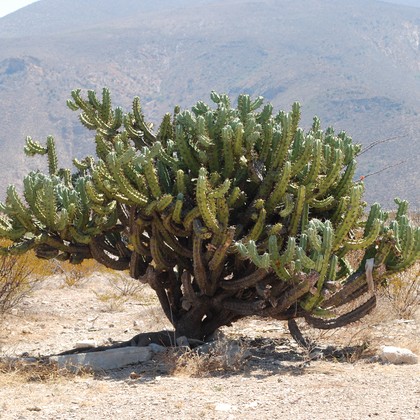
Thorn scrub, dry deciduous forest and the edges of gallery forest, also fields, pasture and shrubby fallow land with scattered trees, from sea level to about 1000 m, locally higher. It benefits from openings in logged forest. It lives in coveys on the ground; when disturbed the birds freeze or run off and only flush at the last moment.
Where the bird is most at home, classified by the vegetation units of Mexico and Central America.



Range and movements
Endemic to western Mexico: southern Sonora and south-western Chihuahua, Sinaloa, western Durango, Nayarit and northern and western Jalisco, with an extension into western Zacatecas. The species does not occur outside the guide area.
- Resident
- dark = core range, pale = thinly spread
How and when to look
Around San Blas in Nayarit, for example at Singayta, in the thorn scrub around Álamos in Sonora and in the foothills of the Sierra Madre east of Mazatlán, early in the morning. Small groups often cross dirt roads.
Conservation status
Not threatened. Fairly common within its limited range; the species appears to benefit from the opening up of dry forest.
Scientific name
Callipepla douglasii | (Vigors, 1829)
Vigors described the species in 1829 as Ortyx Douglasii; because it was later moved to another genus, the author and year stand in brackets. The genus Callipepla was introduced in 1832 by Wagler. Callipepla is Greek, from kallipeplos 'beautifully robed', from kallos 'beauty' and peplos 'robe'. douglasii honours the Scottish botanist and plant collector David Douglas (1799–1834). The specimen the first description was based on came from Mazatlán, Sinaloa, Mexico.