All species › Gamebirds › New World quail › Scaled Quail
Position in the tree Birds Aves › Birds with a flexible palate Neognathae › Fowl Galloanserae
Scaled Quail | Callipepla squamata
Geschubde kwartel | Codorniz escamosa
Scaled Quail is the quail of the Chihuahuan Desert and the dry grasslands of northern and central Mexico. It is blue-grey, with a pattern of dark-edged feathers on the breast and belly that recalls scales, and a short, white-tipped crest. Coveys prefer running to flying.

Voice
The call is a low, hoarse, two-syllable chip-chur or pe-cos, more a grunt than a whistle, heard mainly in the early morning. When alarmed, short husky chuk calls; in the breeding season the male also gives a single kerr.
Recording: Richard E. Webster — CC BY-NC-SA 4.0 · shortened to the first 60 s, mono · xeno-canto
Identification
25–31 cm; compact, with a short tail and a short, bushy crest with a white tip. Head, breast and upperparts are blue-grey; the feathers of the neck, breast and belly have a dark edge, giving the underparts a scaled look. The flanks are grey-brown with white streaks. The female closely resembles the male, but has a shorter, buffier crest and a more finely streaked head. Males of the subspecies C. s. castanogastris in north-eastern Mexico have a chestnut patch on the belly.
Confusion species
Gambel's Quail Callipepla gambelii in Sonora and Chihuahua has a black, forward-curling plume and lacks the scaling; the male has a black face. Northern Bobwhite Colinus virginianus is more rufous, with a clear eye-stripe and no white crest. The female Montezuma Quail Cyrtonyx montezumae is rounder, brown and spotted and lives in grassy oak woodland.
Habitat
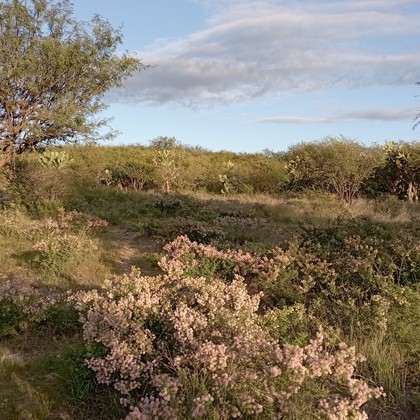
Dry grassland, semi-desert and desert scrub with mesquite, yucca, acacia and cacti, where there is enough open ground between the tussocks to walk; also field edges and the surroundings of ranches, from about 500 to 2000 m. In dry summers it stays near livestock watering points. It eats seeds, green plant matter and insects. It disappears where overgrazing destroys the grass cover.
Where the bird is most at home, classified by the vegetation units of Mexico and Central America.



Range and movements
In the guide area in north-eastern Sonora and across the plateaus of Chihuahua, Coahuila, Durango, Nuevo León and Tamaulipas, south through Zacatecas and San Luis Potosí to Aguascalientes and, more sparsely, to northern Jalisco, Guanajuato, Querétaro and Hidalgo. Outside the guide area in the south-western United States, from Arizona and southern Colorado to western Texas and Oklahoma.
- Resident
- dark = core range, pale = thinly spread
How and when to look
In the desert grassland around Janos in Chihuahua and on the plains around Saltillo and Cuatro Ciénegas in Coahuila, early in the morning along dirt roads. A covey often runs ahead of a car along the road.
Conservation status
Not threatened. Common in the Chihuahuan Desert. It has declined at the edges of its range through the conversion of grassland to fields and through overgrazing; numbers fluctuate strongly with rainfall.
Scientific name
Callipepla squamata | (Vigors, 1830)
Vigors described the species in 1830 as Ortyx squamatus; because it was later moved to another genus, the author and year stand in brackets. The genus Callipepla was introduced in 1832 by Wagler. Callipepla is Greek, from kallipeplos 'beautifully robed', from kallos 'beauty' and peplos 'robe'. squamata is Latin for 'scaly', from squama 'scale', after the scaly pattern on breast and neck. The specimen the first description was based on came from Mexico.