All species › Gamebirds › New World quail › California Quail
Position in the tree Birds Aves › Birds with a flexible palate Neognathae › Fowl Galloanserae
California Quail | Callipepla californica
Californische kuifkwartel | Colín de California
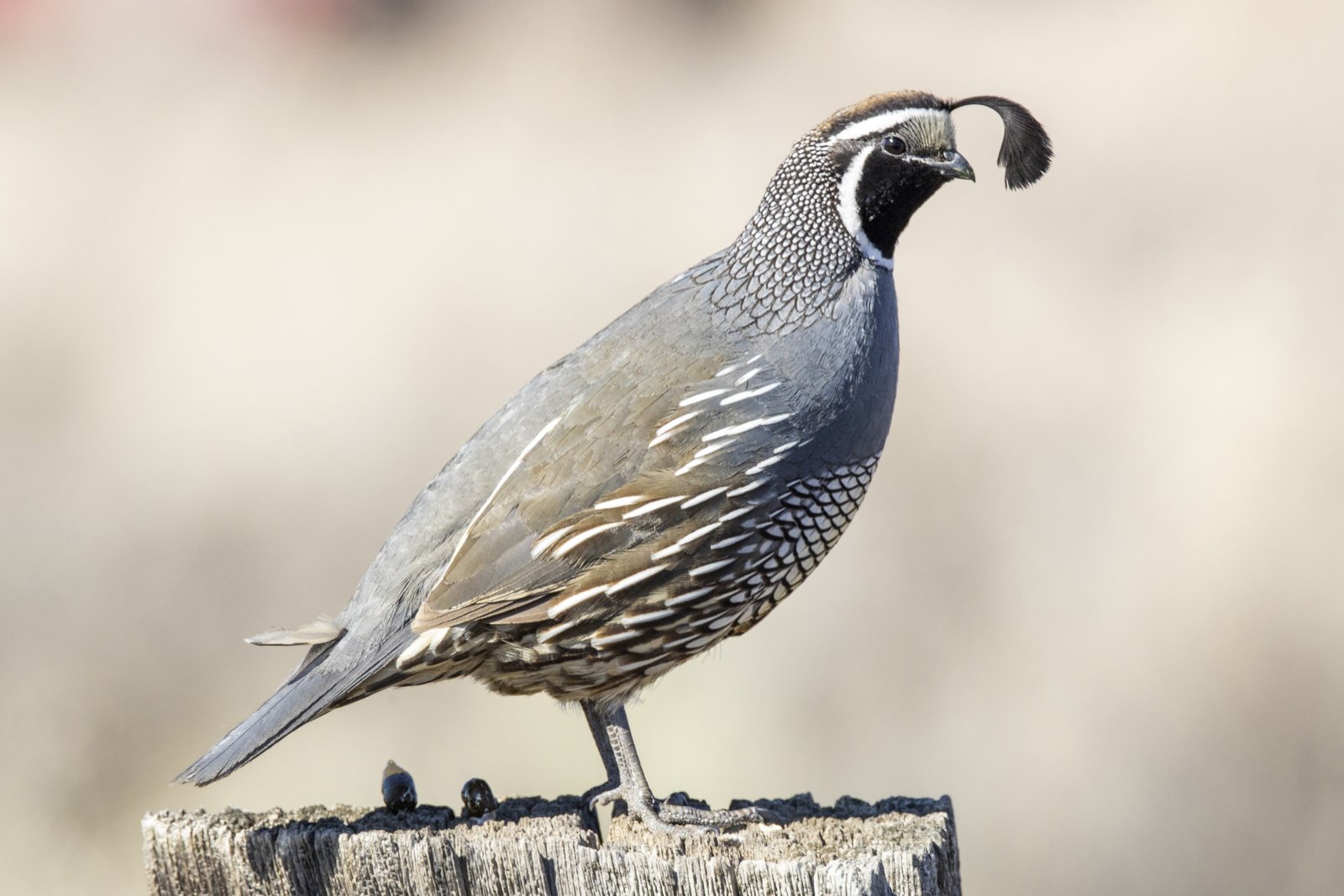
California Quail is a compact, grey-brown quail with a forward-curving black plume and a scaled belly. In the guide area it lives only on the Baja California peninsula, from the US border to the Cape. Coveys forage through scrub, dry stream valleys and the edges of fields and villages.
Voice
The assembly call is a loud, rhythmic chi-CA-go, with the stress on the second syllable, often given from a low bush or post. Covey members keep in contact with soft pip calls; when threatened, a hoarse, rising alarm. In the breeding season the male also gives a single kaaw.
Recording: Cristian Pinto Fernandez — CC BY-NC-SA 4.0 · converted to mono · xeno-canto
Identification
24–27 cm; round, with a short tail and a teardrop-shaped black plume. The male has a blue-grey breast, olive-brown upperparts, a brown crown, a black face and throat outlined in white, and a belly scaled in buff and black with a chestnut patch in the centre. The flanks are brown with white streaks. The female is plainer grey-brown, with a shorter plume, no black-and-white head pattern and a fainter scaled belly. Birds in the south of the peninsula are smaller and darker than those in the north.
Confusion species
Gambel's Quail Callipepla gambelii meets its range in north-eastern Baja California; the male has a chestnut crown and a plain cream belly with a black patch, without scaling. Mountain Quail Oreortyx pictus in the mountains of the northern peninsula is larger, with a long, straight plume and a chestnut throat.
Habitat
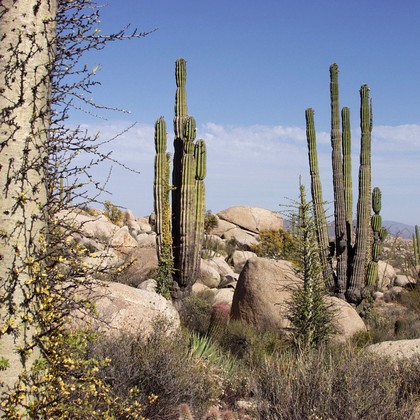
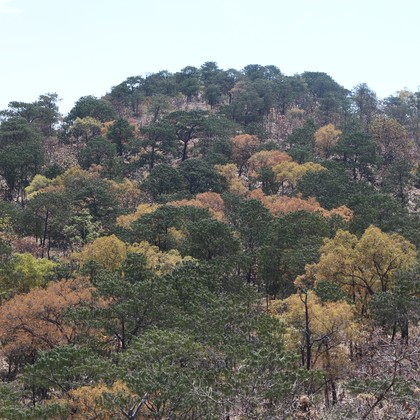
Desert scrub and cactus growth, chaparral, stream valleys with riparian growth, oak woodland and open conifer forest in the mountains, and fields, orchards and farmyards on their edge, from sea level to about 2500 m. More than other crested quails it is a bird of the transition between dense cover and open ground. It eats seeds, leaves, shoots and insects.
Where the bird is most at home, classified by the vegetation units of Mexico and Central America.



Range and movements
In the guide area over almost the whole Baja California peninsula, in Baja California and Baja California Sur, including the Sierra de San Pedro Mártir and the Sierra de la Laguna. Outside the guide area native to the western United States, from Oregon to California and western Nevada; introduced to Washington, Idaho, British Columbia, Hawaii, Chile and New Zealand, among other places.
- Resident
- dark = core range, pale = thinly spread
How and when to look
Along dirt roads and stream valleys in the mountains above Ensenada, in the Sierra de San Pedro Mártir and in the Sierra de la Laguna near La Paz, early in the morning. Coveys regularly come to water at ranches.
Conservation status
Not threatened. Common on the Baja California peninsula.
Scientific name
Callipepla californica | (Shaw, 1798)
Shaw described the species in 1798 as Tetrao californicus; because it was later moved to another genus, the author and year stand in brackets. The genus Callipepla was introduced in 1832 by Wagler. Callipepla is Greek, from kallipeplos 'beautifully robed', from kallos 'beauty' and peplos 'robe'. californica means 'of California', where the species was described from. The specimen the first description was based on came from Monterey, California.